
What’s your salmon story?
Everyone seems to have one. It might be about the day you struggled a massive chinook to the bank of the Ninilchik River, or the day you learned how to flip for reds in the Kenai. Whatever the story is, it’s not hard for someone in the Kenai area to string together a fish-related tale since the area embodies a rich, salmon-centric culture.
Your salmon story may be about the first salmon you ever caught, but there’s no doubt it’s not the first salmon story. Stories of the anadromous fish have been pervasively swimming throughout history, with tales of tails being retold throughout the generations.
Take, for example, the story of Loki the salmon from “The Prose Edda,” a 13th-century book written by Icelandic historian Snorri Sturluson and the main source for most modern retellings of Norse mythology. According to the tale, the trickster-god Loki was the mastermind behind a scheme that killed Baldur, the god of light and radiance, peace and forgiveness. With those credentials, Baldur was known to be the most beloved of all the gods, and the other gods sought vengeance for their slain brother. Always one step ahead, Loki fled and transformed himself into a salmon.
In his new, scalier form, the tricky god hid in the water at the base of Franang’s Falls, a magical waterfall in Midgard, the name given to earth in Norse mythology. To pass the time, Loki would transform back into his human form and play with lengths of linen twine until he found that he’d created a net so fine that no fish would be able to slip through. As he was admiring his creation, he heard the voices of the gods making their way toward him. He cast the net aside and transformed back into a salmon before diving into the falls.
When the gods arrived, they found the net and, knowing Loki was a master of transformation, figured he would be hiding in the nearby falls. Thor, the god of thunder — and, more recently, a member of Marvel’s Avengers — took one side of the net and gave the other to the rest of the group. The tried repeatedly to catch Loki in the net, but came up empty until they perfected the net by placing stones at the bottom to ensure no fish swam under the net.
According to the myth, Loki saw that he was trapped but tried to escape one last time by springing high into the air, like the sockeye jumping all along the Russian River each summer. Thor reached out and grabbed Loki the salmon and squeezed tight to hold onto the slippery creature. He captured Loki, but Thor’s powerful grip tapered the salmon at its tail, changing the look of the creature forever.
It was Loki’s failed escape that gave us the fishing net, which has ruined the escape of generations of salmon since Loki’s days in Franang’s Falls.
But why did Loki choose to transform into a salmon?
“Traditional Norse cultures fall into what I call salmon cultures,” said Alan Boraas, a professor of anthropology at Kenai Peninsula College. “Yes, there is the whole interesting polytheistic level to (the myth), but at the base level, the reason those were healthy cultures was because of the salmon.”
For years, agricultural farming made its way across the the Middle East and Europe, moving north but, according to Boraas, it stopped right at Denmark.
“It stops there for 1,000 years because salmon are so nutritous,” Boraas said. “They are easier to catch … would you rather be home on your field or out catching salmon? Every Alaskan knows the answer to that.”
In Southcentral Alaska, the Dena’ina built their own culture around salmon, and although Dena’ina storytellers didn’t weave tales of the tricky Raven weaving nets, they do have their own salmon mythology found in Athabascan legend of the girl and the salmon.
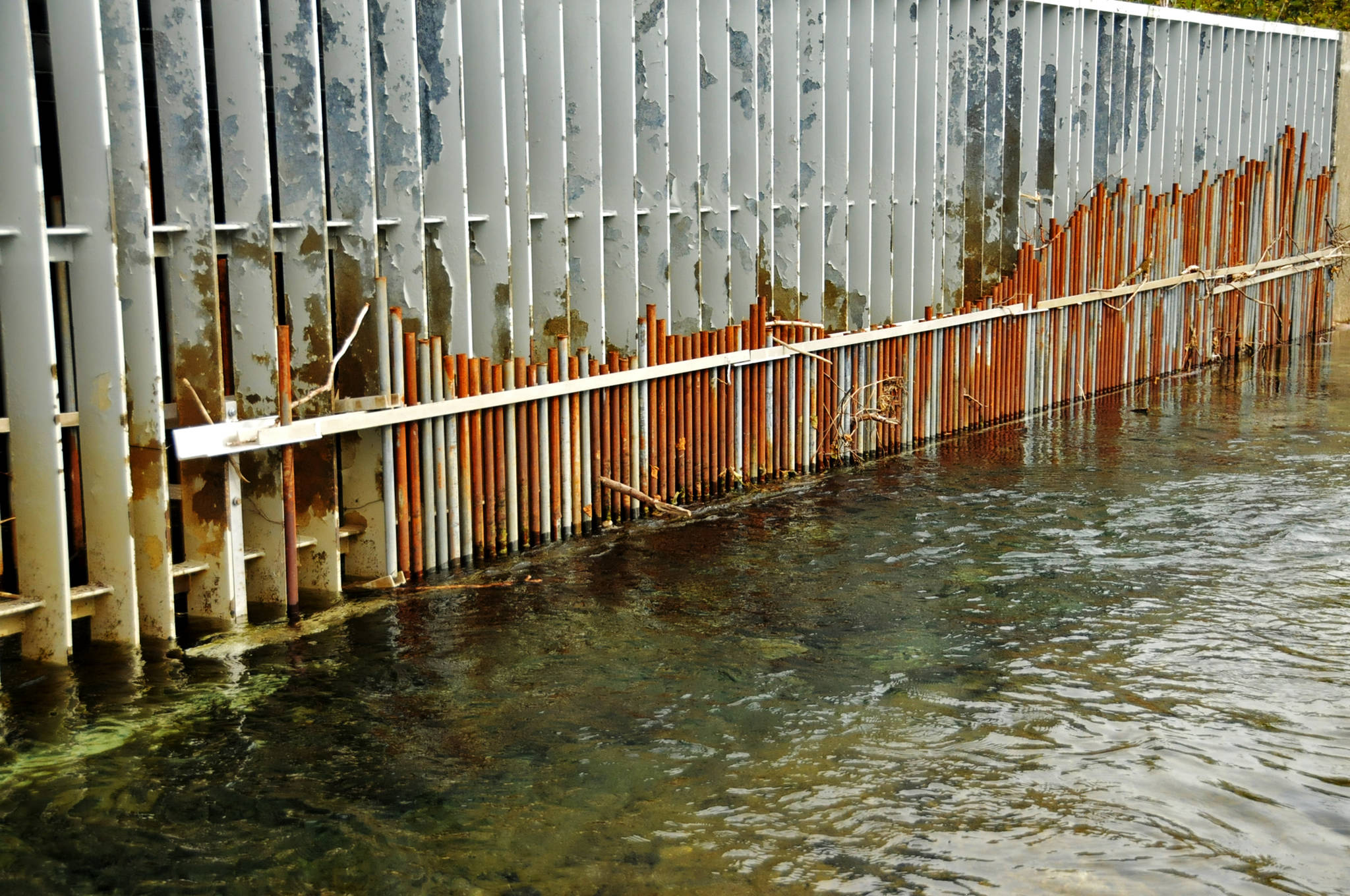
“Even though the tale never states it explicitly, it would track back to when the Dena’ina first developed underground cold storage pits and fish weirs to catch salmon,” Boraas said.
The Dena’ina developed a form of fish weir, a type of fence that would block salmon and soon they found that they were overproducing salmon, Boraas said. So, they developed underground storage pits by sewing together birch bark with spruce roots. The fish was dried on racks and placed in the pit, between layers of grass. The seams of the bark were smeared with fish eggs to waterproof them, and it would be insulated with moss.
“Once this method appears, they are all over the landscapes,” Boraas said. “The three components of life become the house, the storage pit and the fish weir.”
In the tale, a young girl is told to stay away from the fish weir.
“But, being a strong-willed young woman, she goes near it and she slips into the water and she swims away with the salmon,” Boraas said. “The people are distraught. They search for her, can’t find her.”
Four years later, back at the fish weir, the young girl’s uncle is pulling out fish and is caught off guard.
“He sees, in the face of one of the smaller salmon, his nephew,” Boraas said. “So that nephew is the product of his niece and salmon, not half-fish, half-man — fish, but human. The message is that the people and the salmon are one thing. They’re not different, they are the same.”
From that understanding and beliefs, traditions and celebrations were created. Whenever the first salmon swims through a weir, a first salmon ceremony celebrates the arrival.
“They give recognition that they are salmon people in the sense that, allegorically, they are literal salmon people,” he said.
The story of the young girl and the salmon isn’t as common today as stories of told by Peter Kalifornsky in “A Dena’ina Legacy,” like the never-ending tricks that Raven is playing or the tired princess that fell asleep waiting for her fiancé warrior to return and became Mount Susitna. Just like the tale of Loki and the salmon, though, it tells how things came to be.
“This is an origin story,” Boraas said. “This is a genesis story — how we came to be and who we are. We’re salmon people. The community and the salmon are one and this story is a way to express it allegorically.”
Reach Kat Sorensen at kat.sorensen@peninsulaclarion.com.
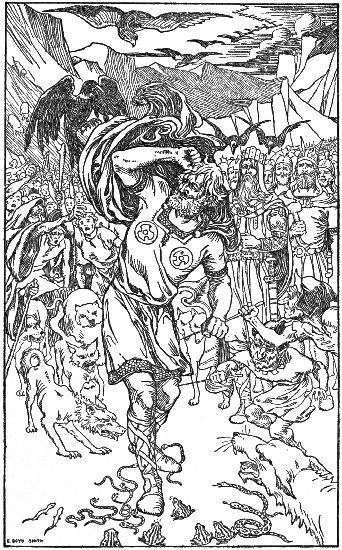
This drawing from ‘In the Days of Giants’ by Abbie Farwell Brown depicts the repercussions of Loki’s is capture as he is led through a long procession. The procession put him face to face with a line of people and animals he had hurt in some way and led him into a cavern deep beneath the earth where he was punished in ways too violent for any Marvel movie. According to some retellings of the myth, as he struggles against the iron chains, the whole ground trembles causing an earthquake. (Photo courtesy of Project Gutenberg)
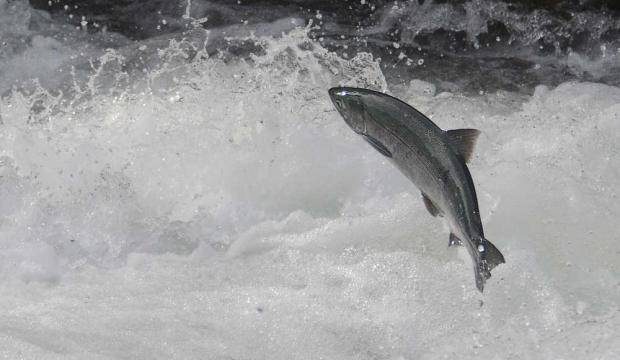
A red salmon makes its way up the Russian River Falls in June 2013 near Cooper Landing. (Clarion File Photo)
