
The Bookworm Sez: ‘Grass Roots’ lays out history of marijuana

The Bookworm Sez: ‘Grass Roots’ lays out history of marijuana

Is the grass greener on the other side of the fence?

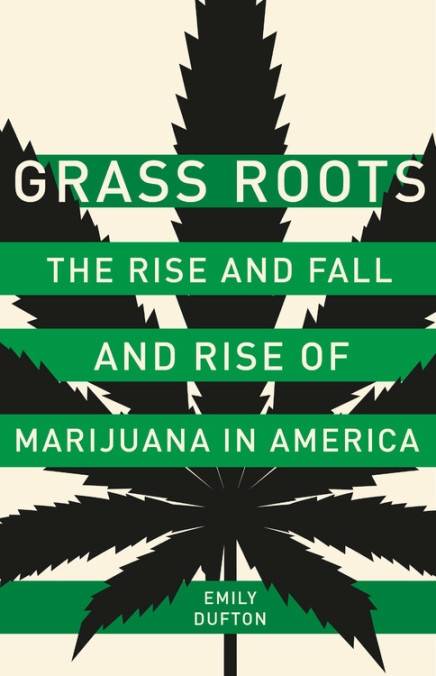
It doesn’t seem to be. Your side looks just fine, healthy, and filled with weed. There’ll be no poison on that, though; weed is exactly what you want there and in the new book “Grass Roots” by Emily Dufton (c.2017, Basic Books, $28, 312 pages), you see how, historically, that’s been a good thing and it’s been bad.

Had you lived in Jamestown 400 years ago, you would’ve been under an interesting edict: all colonists were required by law to cultivate hemp plants. Hemp, a super-strong natural fiber, was important for the making of cloth and rope and, by the late 1800s, its by-product, cannabis, was used as medicine.

Just a few decades later, however, Prohibition was on its way in and marijuana was on its way out. The 1937 Marijuana Tax Act made possession and transfer of cannabis illegal and that was the final word.

For awhile.

On August 16, 1964, Lowell Eggemeier stepped into San Francisco ’s Hall of Justice “and politely asked to be arrested for smoking pot,” which was a felony then. He got what he wanted: to “launch a revolution.” By 1968, “pot had become fiercely political” from coast to coast; by 1970, its usage had swept into suburbia.

Still, despite that weed was widespread, it had its detractors: Richard Nixon “despised” marijuana and did everything he could to link it to society’s ills. Even so, as he “helped pass one of the most sweeping drug laws in American history,” many questioned whether those laws were fair, especially considering the number of arrests for possession of pot. Meanwhile, in Oregon, a member of the House and a pig farmer helped decriminalize weed in 1973, becoming the first state to do so; no other state was willing to follow suit, until Richard Nixon resigned and the decriminalization movement began anew.

By 1978, it was reported that children had “easy access to head shops,” and parents went on the offensive. Nancy Reagan just said “no,” and everyone worried that joints led to crack cocaine. Antidrug sentiment was everywhere, until we came full-circle: in the 1980s, AIDS brought back the idea of marijuana as medicine …

“Grass Roots” proves that marijuana has had its highs through the years — and its lows. But learning about it could have been so much more fun.

True, there’s a lot of historical information inside this book, so it can absolutely be said that author Emily Dufton offers what her subtitle promises. There are dates and stats and Presidents and activists here, plenty of laws and names, but all that info is pretty dry in its delivery. It’s not bad — it’s just not very lively. It should also be mentioned that it’s mostly about smoke-able marijuana, not hemp-as-crop.

And yet — anyone wanting to know about where weed’s been and where it’s going would be happy with this book. It’s comprehensive and fact-filled, which makes it a treasure-trove for the right reader. And if that’s you, then “Grass Roots” is a great place to spend your green.

The Bookworom is Terri Schlichenmeyer. Email her at bookwormsez@yahoo.com.

More in Life

Historic Elwell Lodge Guest Cabin is seen at its new spot near the Kenai National Wildlife Refuge’s Visitor Center. (USWS)
Around the peninsula

Local events and happenings coming soon.

Nián gāo is a traditional Lunar New Year treat enjoyed in China for over two thousand years. Photo by Tressa Dale/Peninsula Clarion
A Lunar New Year’s treat

This sweet, steamed rice cake is chewy, gooey and full of positivity.

This excerpt from a U.S. Geological Survey map shows the approximate location of Snug Harbor on lower Kenai Lake. It was in this area that William Weaver nearly drowned in 1910.
Ben Swesey: More to the story — Part 2

AUTHOR’S NOTE: Michigan’s hard-luck Swesey clan sprang into existence because of the… Continue reading

File
Minister’s Message: Rhythms and routines

Your habits are already forming you.

This dish is creamy, rich and comforting, and gets dinner time done fast. Photo by Tressa Dale/Peninsula Clarion
Full of mother’s love

This one-pot dish is creamy, rich and comforting, and can be ready in 30 minutes.

This screenshot from David Paulides’s “Missing 411” YouTube podcast shows the host beginning his talk about the disappearance of Ben Swesey and William Weaver.
Ben Swesey: More to the story — Part 1

More than a hundred years after Ben Swesey and Bill Weaver steered… Continue reading

Photo by Clark Fair
This 2025 image of the former grounds of the agricultural experiment station in Kenai contains no buildings left over from the Kenai Station days. The oldest building now, completed in the late 1930s, is the tallest structure in this photograph.
The experiment: Kenai becomes an agricultural test site — Part 8

Over the past 50 years or more, the City of Kenai has… Continue reading

File
Minister’s Message: So your life story can be better

Last month the Christmas story was displayed in nativity scenes, read about… Continue reading

These gyros make a super delicious and satisfying tofu dish. Photo by Tressa Dale/Peninsula Clarion
A new addition to the menu

Tofu gyros with homemade lentil wraps are so surprisingly satisfying and add extra fiber and protein to a meal.

Death notice: Marvin “Ted” Dale Smith

Marvin “Ted” Dale Smith passed on Dec. 27, 2025 in his home.… Continue reading

Photo courtesy of the 
Arness Family Collection
L. Keith McCullagh, pictured here aboard a ship in about 1915, was a U.S. Forest Service ranger charged with establishing a ranger station in Kenai, a task that led him to the agricultural experiment station there and into conflict with “Frenchy” Vian and his friends.
The experiment: Kenai becomes an agricultural test site — Part 7

AUTHOR’S NOTE: After the agricultural experiment station in Kenai closed May 1,… Continue reading

These treats are full of fiber and protein and contain less sugar than a Nutri-grain bar, so you can feel good about spoiling yourself a little. Photo by Tressa Dale/Peninsula Clarion
A treat for a new start

These cosmic brownies are a healthier, homemade version of the usual cafeteria currency.