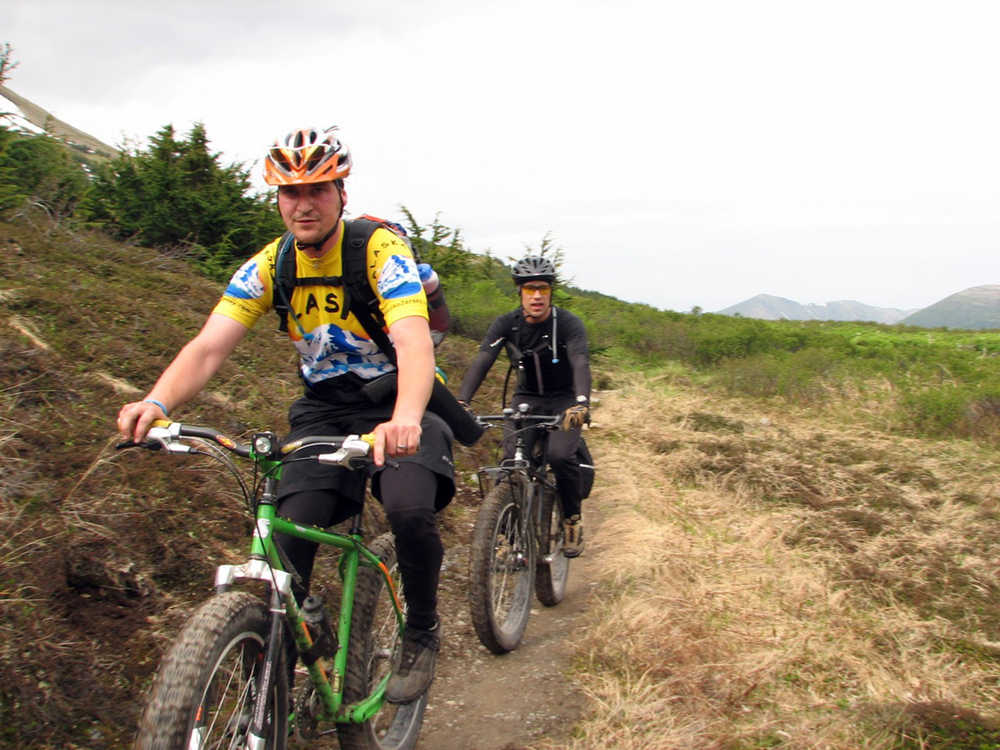
This 2006 photo provided by ArcticCycles.com shows Arctic Cycles guiding a fat-tire biking trip in the summer in south central, A.K. Fat bikes are the ultimate year-round adventure bikes. (AP Photo/ArcticCycles.com, Erica Koitzsch)

This 2006 photo provided by ArcticCycles.com shows Arctic Cycles guiding a fat-tire biking trip in the summer in south central, A.K. Fat bikes are the ultimate year-round adventure bikes. (AP Photo/ArcticCycles.com, Erica Koitzsch)

Stability, extra grip make fat-tire biking a hit

There’s a new trend in mountain biking: Fat is in.

Not the riders. The tires.

Big, puffy tires that look like something NASA developed in case someone ever wanted to ride on the moon.

Yes, they look a little strange, but these fat-tire bikes have a smooth ride, even over the toughest terrain, and are an awful lot of fun to ride.

“You look at them and go, they’re kind of goofy, but once you ride one, it’s kind of hard to go back to a traditional mountain bike because of the additional stability and grip that you get,” said Greg Smith, an enthusiast who started the website Fat-Bike.com.

Fat-tire bikes have been around for decades; photos from a 1982 Iditasport race in Alaska show a bike with two wheels welded together for an easier ride over the snow.

The bikes started to become popular in the early 2000s in places where riders wanted to combat the snow, like Alaska and the Midwest, particularly Wisconsin, Michigan and Minnesota. Riders also took up fat-tire riding in sandy areas of New Mexico, Texas and Colorado.

The trend has spread across the country, spurred by major manufacturers jumping into fat-bikes around 2010.

Now the puffy-tired rides are the fastest-growing segment of the bicycle industry and can be found from the deserts of Arizona to the beaches of Florida.

“It’s the ultimate adventure bike,” said Billy Koitzsch of Arctic Cycles in Anchorage, Alaska. “It’s just a lot of a fun being able to go over more obstacles. Your height and width profile are going to be able to get you over rocks with more ease.”

Stability is the key component.

Regular mountain bikes have tires 2 1-2 inches or less in diameter, which works well on trails or dirt paths. But those tires also tend to slide out from under riders on corners when there’s anything loose on the trail like gravel or sand. They also get bogged down when the terrain gets softer, as with snow or heavy sand.

Fat-bike tires are 4 to 5 inches in diameter, looking like someone put dirt-bike tires on a mountain bike. The wider base puts more rubber on the ground, providing extra stability and traction. Fat-bike riders also use lower pressures in the tires, which adds balance and grip.

“It’s like a mountain bike on steroids,” said Smith, who lives in Milwaukee. “You can’t just put these tires on a traditional mountain bike because there isn’t enough clearance, but the basic mechanics are the same, just enlarged to take that bigger tire.”

In the early days, fat-tire bikes were homemade contraptions by riding enthusiasts who sewed tires together and welded or pinned regular rims into one bigger one. They also took welding torches to frames and forks, creating extra space to accommodate the puffy treads.

The fat-bike industry took a big leap forward in 2005, when Surly introduced the purple Puglsey, which had 65-millimeter rims and the 3.7-inch Endomorph tire.

By 2010, nearly every major bike manufacturer had a fat bike on the market. Now, there are three-wheeled varieties, smaller versions for kids — the aptly-named Fatboy — and even fat-tire unicycles.

Riding groups have taken up the fat-bike craze, often riding in large groups along beaches or across the snow, and there are fat-bike races, including 1,000-mile Iditasport races across the snowy tundra of Alaska.

“It brings people back to cycling: ‘Oh, I used to do that, that was fun,’” said Koitzsch, who has been offering guided fat-bike rides since 1996.

ONLINE:

Home

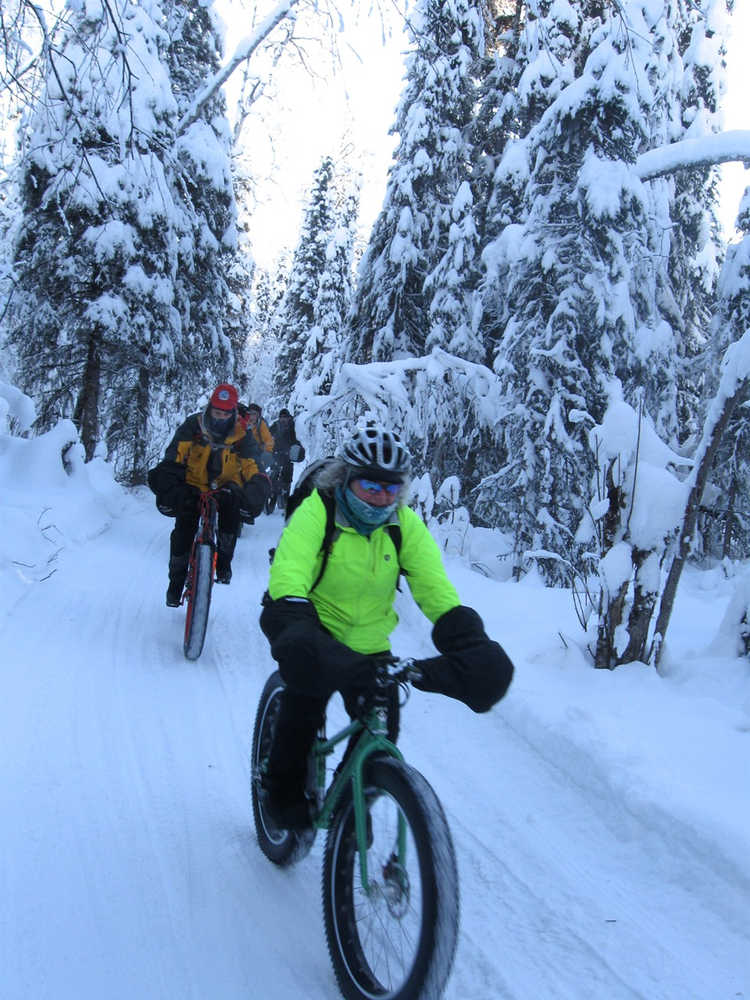
This 2011 photo provided by ArcticCycles.com shows Billy Koitzsch of Arctic Cycles guiding a group in fat-tire biking on snow in Willow, A.K. There's a new trend in mountain biking: big, puffy tires that look like something NASA developed in case someone ever wanted to ride on the moon.  (AP Photo/ArcticCycles.com, Erica Koitzsch)

This 2011 photo provided by ArcticCycles.com shows Billy Koitzsch of Arctic Cycles guiding a group in fat-tire biking on snow in Willow, A.K. There’s a new trend in mountain biking: big, puffy tires that look like something NASA developed in case someone ever wanted to ride on the moon. (AP Photo/ArcticCycles.com, Erica Koitzsch)

More in Life

File
Minister’s Message: Love born to endure

I spend time with people in the final chapters of their lives.… Continue reading

In his 1903 report to the U.S. Department of Agriculture, Prof. Charles Christian Georgeson included this photograph of efforts to break recently cleared ground at Kenai’s agricultural experiment station. The man behind the bull was either station superintendent Hans P. Nielsen or his assistant Pontus H. Ross.
The experiment: Kenai becomes an agricultural test site — Part 4

AUTHOR’S NOTE: A presidential executive order in January 1899 had set aside… Continue reading

This recipe makes a boatload of soft and delicious cookies, perfect for sharing at Christmastime. Photo by Tressa Dale/Peninsula Clarion
Christmas cookies for a shared tradition

These cookies are so soft and delicious, it’s no wonder they’re part of a family Christmas tradition.

Daniel Craig (right), returning as Benoit Blanc, and Josh O'Connor are seen in this still from "Wake Up Dead Man: A Knives Out Mystery," released on Netflix on Dec. 12, 2025. (Promotional photo courtesy Netflix)
On the Screen: ‘Knives Out 3’ truly a film for our times

I often feel the need to watch a film twice. The first… Continue reading

Orange zest and extract bring this literary-inspired treat to life. Photo by Tressa Dale/Peninsula Clarion
Whimsy and magic

This literary-inspired treat is perfect for Christmastime festivities.

File
Minister’s Message: Traditions should be things that support us

Regardless of how you find yourself this season, know that you’re not alone.

Photo from the Alaska State Library historical collection
In Kenai, circa 1903, this trio was photographed on a well-used trail. Pictured are George S. Mearns, future Kenai postmaster; Kate R. Gompertz, Kenai resident; Hans P. Nielsen, superintendent of Kenai’s agricultural experiment station.
The experiment: Kenai becomes an agricultural test site — Part 3

AUTHOR’S NOTE: Presidential Executive Order #148, in January 1899, had set aside… Continue reading

Snow-covered trees and peaks are pictured from a frozen pond near the Herbert Glacier trail in Juneau<ins>, Alaska,</ins> on Thursday, Dec. 11<ins>, 2025</ins>. (Chloe Anderson/Peninsula Clarion)
Out of the Office: Breaking the winter cycle

There’s a learning curve to every new season and every new sport.

File
Minister’s Message: Good grief

Grief doesn’t take a holiday, but it can offer you something the holidays can’t.

This 1903 photograph of mostly Kenai residents shows (back, far left) Hans Peter Nielsen, first superintendent of Kenai’s agricultural experiment station. Nielsen began work at the station in 1899 and resigned at the end of the 1903 season. (Photo from the Alaska State Library historical collection)
The experiment: Kenai becomes an agricultural test site — Part 2

AUTHOR’S NOTE: Presidential Executive Order #148, in January 1899, had set aside… Continue reading

Served together on a bed of greens, these pickled eggs and beets make a light but cheerful lunch. Photo by Tressa Dale/Peninsula Clarion
A wealth of eggs for good health

Pickled along with roasted beets and dill, these eggs have a cheerful hue and bright aroma.

File
Minister’s Message: Lifelong learning is a worthwhile goal

Lifelong learning. That’s a worthwhile goal. Schools have been in session for… Continue reading