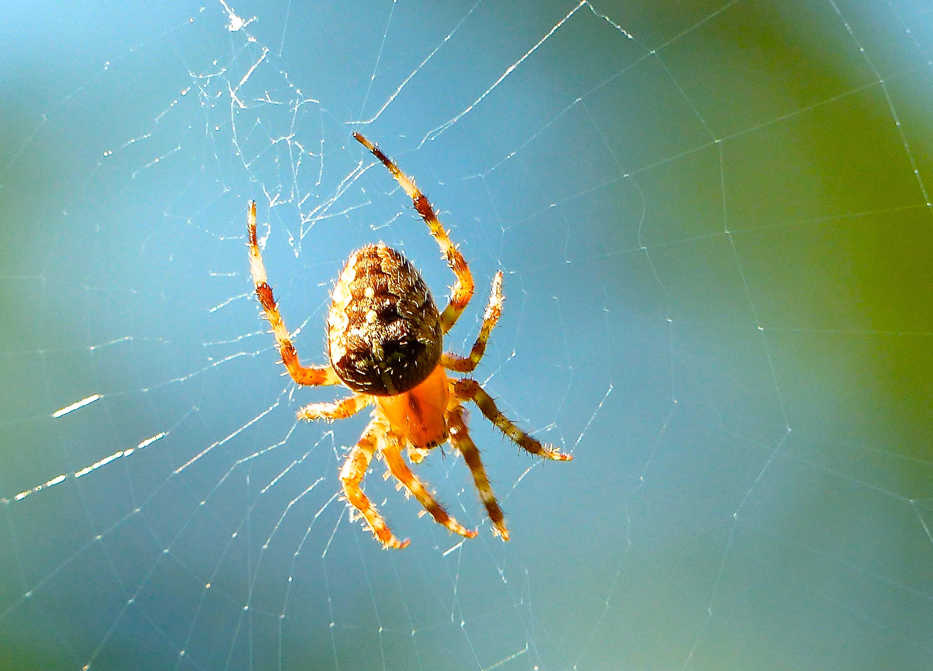
This spider photographed on Sept. 11, 2015, while spinning a web in a Langley, Wash., yard, is one of the gardeners best tools for biological pest control. Spiders also are also one of the few pest predators that don't eat plants. (Dean Fosdick via AP)

This spider photographed on Sept. 11, 2015, while spinning a web in a Langley, Wash., yard, is one of the gardeners best tools for biological pest control. Spiders also are also one of the few pest predators that don't eat plants. (Dean Fosdick via AP)

Spiders are among most effective predators of plant pests

Although many people have a built-in aversion to them, spiders rank as one of the gardener’s best tools for biological pest control.

They also are one of the few pest predators that don’t eat plants.

“Spiders eat the (equivalent insect) weight of all the humans on earth annually,” said Linda Rayor, an assistant professor of entomology at Cornell University. “A significant percentage of those insects are herbivores or granivores (seed eaters) or other insects that adversely affect humans. Spiders perform a vital function.”

There are more than 45,500 known spider species around the world, divided into 110 spider families, Rayor said.

“Few of those have a venom that affects us,” she said. “The yellow sac spider, the black widow and the recluse. That’s about it. And none are aggressive.”

Spiders, including black widows, respond to movements in their webs, and that leads to people getting bitten, Rayor said.

“Black widows are super common in the desert around the U.S. but you’ll also find them in many cities because they have water,” she said. “Houses and edges of houses are perfect for black widows. They can build underneath and protect their webs.”

Spiders use venom to kill or paralyze their prey. They actively hunt or spin webs to trap insects, invertebrates, and even small vertebrates like lizards and frogs. What also makes them garden-friendly is that that they don’t eat plants, Rayor said.

“They’ll eat a little pollen, maybe, but that’s about it,” she said. “They’re totally beneficial to have in the garden.”

On the unfavorable side, spiders are generalists in what they hunt and cannibalistic. They feed on other spiders and many beneficial insects, including honeybees and butterflies.

Spiders also are not a good choice for taking out specific plant pests in fields or gardens if there’s a particular outbreak you’re trying to eradicate, Rayor said. “But for reducing all prey abundance in certain areas, they’re great.”

Rather than try to eliminate spiders in or near homes, the knowledgeable, organic-leaning gardener prefers to recruit them.

You can increase spider numbers in the garden by:

— Adding more trees, shrubs and perennials to provide anchor points for web-building spiders to spin their webs, said Gail Langellotto, an entomologist with Oregon State University’s Extension Service.

— Allowing areas to go untilled, or leaving plant stalks standing for overwintering habitat. Many adult spiders emerge in early spring, before most other bio-control resources are available.

— Mulching with grass or wood chips to provide cover and humidity.

— Growing flowers that attract insect prey.

“Even if you want to bring spider numbers down around your property, consider that they’re difficult to eradicate with pesticides,” Langellotto said.

“The amount and concentration needed is often higher than what’s necessary to kill insects, (and that) poses a greater risk to humans,” she said. “Heavy doses also will kill a lot of other beneficial insects.”

Online:

For more about inviting spiders to the garden, see this Cornell University fact sheet: www.colostate.edu/Dept/CoopExt/4dmg/Pests/spiders.htm

More in Life

Historic Elwell Lodge Guest Cabin is seen at its new spot near the Kenai National Wildlife Refuge’s Visitor Center. (USWS)
Around the peninsula

Local events and happenings coming soon.

Nián gāo is a traditional Lunar New Year treat enjoyed in China for over two thousand years. Photo by Tressa Dale/Peninsula Clarion
A Lunar New Year’s treat

This sweet, steamed rice cake is chewy, gooey and full of positivity.

This excerpt from a U.S. Geological Survey map shows the approximate location of Snug Harbor on lower Kenai Lake. It was in this area that William Weaver nearly drowned in 1910.
Ben Swesey: More to the story — Part 2

AUTHOR’S NOTE: Michigan’s hard-luck Swesey clan sprang into existence because of the… Continue reading

File
Minister’s Message: Rhythms and routines

Your habits are already forming you.

This dish is creamy, rich and comforting, and gets dinner time done fast. Photo by Tressa Dale/Peninsula Clarion
Full of mother’s love

This one-pot dish is creamy, rich and comforting, and can be ready in 30 minutes.

This screenshot from David Paulides’s “Missing 411” YouTube podcast shows the host beginning his talk about the disappearance of Ben Swesey and William Weaver.
Ben Swesey: More to the story — Part 1

More than a hundred years after Ben Swesey and Bill Weaver steered… Continue reading

Photo by Clark Fair
This 2025 image of the former grounds of the agricultural experiment station in Kenai contains no buildings left over from the Kenai Station days. The oldest building now, completed in the late 1930s, is the tallest structure in this photograph.
The experiment: Kenai becomes an agricultural test site — Part 8

Over the past 50 years or more, the City of Kenai has… Continue reading

File
Minister’s Message: So your life story can be better

Last month the Christmas story was displayed in nativity scenes, read about… Continue reading

These gyros make a super delicious and satisfying tofu dish. Photo by Tressa Dale/Peninsula Clarion
A new addition to the menu

Tofu gyros with homemade lentil wraps are so surprisingly satisfying and add extra fiber and protein to a meal.

Death notice: Marvin “Ted” Dale Smith

Marvin “Ted” Dale Smith passed on Dec. 27, 2025 in his home.… Continue reading

Photo courtesy of the 
Arness Family Collection
L. Keith McCullagh, pictured here aboard a ship in about 1915, was a U.S. Forest Service ranger charged with establishing a ranger station in Kenai, a task that led him to the agricultural experiment station there and into conflict with “Frenchy” Vian and his friends.
The experiment: Kenai becomes an agricultural test site — Part 7

AUTHOR’S NOTE: After the agricultural experiment station in Kenai closed May 1,… Continue reading

These treats are full of fiber and protein and contain less sugar than a Nutri-grain bar, so you can feel good about spoiling yourself a little. Photo by Tressa Dale/Peninsula Clarion
A treat for a new start

These cosmic brownies are a healthier, homemade version of the usual cafeteria currency.