
By Clark Fair
For the Peninsula Clarion
This is the story of one of my favorite family photographs — a photo that my mother has never liked, and a story that she has dreaded having me tell in public for nearly as long as the photo has been in existence.
Before I tell that story, however, I want to briefly discuss an entirely different photograph because I want to illustrate my father’s sense of humor. I was the photographer in this instance, while my dad was the one who captured the image my mother has never liked.
In August 1990, Mom and Dad had been out at the chicken pen. It was time for the harvest — time to put birds in the freezer for winter meals. A blood-stained, short-handled axe lay in the tall grass near a blood-stained, upright spruce log, surrounded by scattered white feathers and chicken heads.
Dad’s job was to wield the instrument of decapitation, while Mom’s was to gather the birds for cleaning. They’d both grown up on farms. They knew what to do.
Fast-forward to October. Mom and Dad were moving in and out of an aluminum woodshed, hauling armloads of firewood into the garage for later incineration in the woodstove. The family cat — a Siamese-tiger-cat mix known variously as “Mama” or “Fatty” or “Mama Cat” — was prowling and purring, vying for attention and weaving between human legs, when Dad was struck with sudden inspiration.
“You got your camera?” he asked me. I did. He snatched the cat and handed her to Mom, instructing her to hold the cat over an upright spruce log as he had done with the chickens two months earlier. Dad then hefted a large orange splitting maul, knelt by the log and posed with the cutting implement hovering above the cat, who lay there helplessly, wide-eyed and imperiled across the top of the log.
I snapped the picture. Mom released the cat. And Dad chuckled as he returned the splitting maul to its corner in the woodshed.
Had the choice been his alone, I think he might have considered the photo for that year’s Christmas card.
And although my mother exclaimed how awful this “photo-op” had been, the finished photograph shows that she was smiling.
Mom and Dad didn’t always find the same things funny, but Mom almost always appreciated Dad’s sense of humor.
Now it’s time to flash back to early spring of 1972.
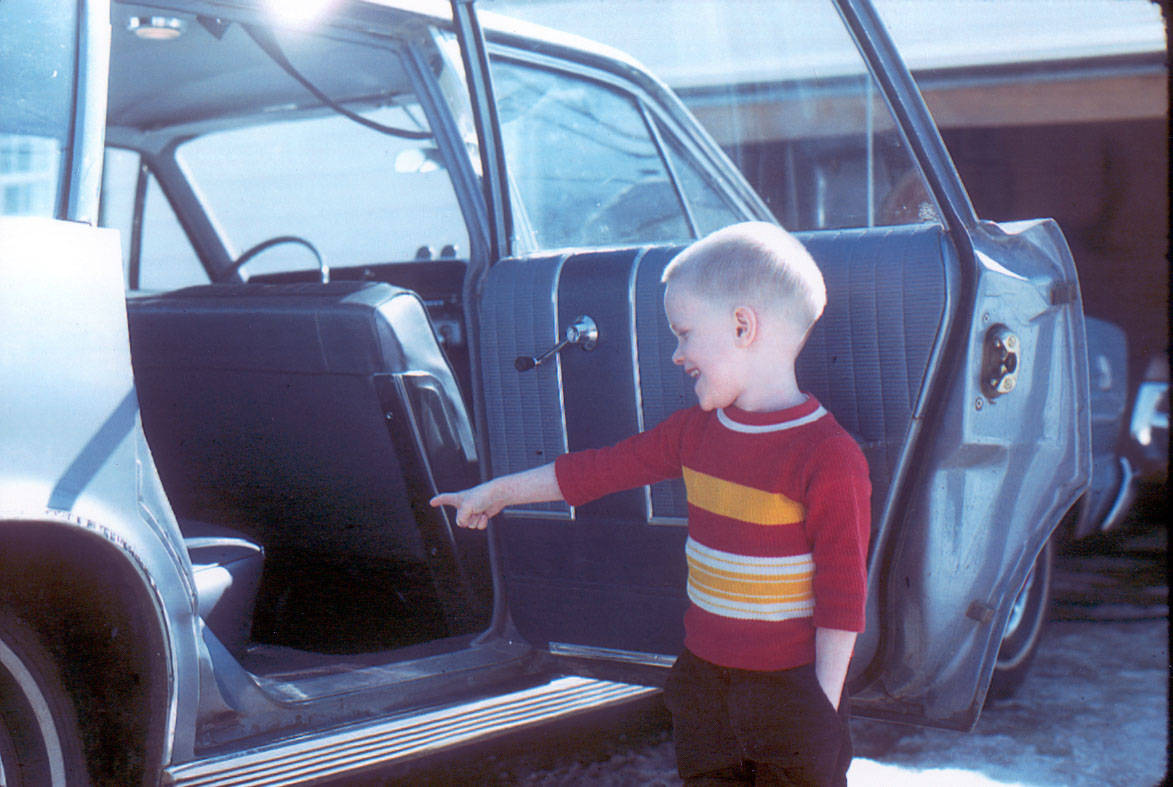
In the photograph in question, a tow-headed boy of perhaps four is standing next to the open back door of a blue Ford stationwagon of late 1960s vintage. The boy, with his crew cut, his maroon-gold-and-white cotton short-sleeved shirt, and his brown corduroys, is smiling and pointing at the backseat.
Although the photo itself does not make this clear, the boy is pointing at the behest of his father, for whom this simple gesture is at once humorous and deeply meaningful.
The boy is my younger brother Lowell, and our father was Dr. Calvin Munson Fair.
The stationwagon is parked on the somewhat snowy garage apron in front of our homestead house, which at that time was just five years old. On the far-right edge of the photo appears the back bumper of our other family car, a brown four-door Dodge Dart Swinger.
The photo is indicative of our family progress: To begin with, Lowell was the third of three Fair children, born 10 years after me and six and a half years after my sister. Next, the appearance of two cars is important because for a several years we had only a single vehicle, which meant that my mother was often left on the homestead without transportation (other than our 1948 Ford tractor) when Dad traveled to Soldotna to work at his dental practice.
The big white colonial-style house replaced the single-wide, turquoise-and-white trailer that we had lived in since October 1960. Inside the house was the family’s first telephone (rotary-dial) and first color television. Roaming just out of frame was the first family dog (an independent-minded German short-haired pointer named Queen).
But this photograph was much more about looking backward than looking forward.
Dad had captured the image as a permanent reminder of this story:
On Jan. 25, 1968 — a cold and stormy day — Dr. Paul Isaak was preparing his single-engine Cessna 180 to carry two passengers on another flight to the Seward hospital.
Isaak had made hundreds of such flights — in fact, in 1983 he calculated that he’d made at least 2,000 of them — through Resurrection Pass between his medical practice in Soldotna and the hospital in Seward, where he often performed surgeries, delivered babies, and responded to emergencies.
Here’s how Isaak (in the book “Once Upon the Kenai”) described the Jan. 25 flight: “I was going to take one of my obstetric patients and her husband to the hospital in Seward for delivery. This man was a prominent citizen in the community, and it turned out that when we got about five miles out of Seward, the weather deteriorated rather rapidly and I was unable to continue, so we turned around and came back.”
That’s the way it was sometimes back then. Plan A fails. Move on to Plan B.
“And so [the husband] drove [us] to Seward,” Isaak continued, “and about seven or eight miles out of Seward [his wife] decided that she was going to have that baby, and indeed did have it in the back seat of the car.
“Fortunately, I had some of the bare necessities with me to manage the delivery … even though it wasn’t the most ideal situation. Everything turned out fine for mother and baby, and they spent several days in the hospital after that experience.”
Of course, the “prominent citizen in the community” was my father, and the “obstetric patient” was my mother.
Although Mom is 85 now and suffering from dementia, she is still embarrassed by this story, despite the fact that more than a half-century has passed since it occurred.
For years, I threatened to write this story in the form of a newspaper article, but Mom dampened my enthusiasm by forbidding me to mention her name or to use the photograph of Lowell. As a grown man who owned his own copy of the photo, I didn’t technically need her permission, but I would have liked her blessing.
Still, I have never been her most obedient child.
And by now there has been something that might be termed precedent.
In October 2012, my brother told the story in Anchorage as part of a presentation for his Toastmasters group. A year or so later, I told it, too, in the Redoubt Reporter, but I left out all the names.
Today, I have chosen to break my silence. I’d like to think that somewhere Dad is smiling.
The photograph I described earlier had been carefully orchestrated by Dad. He had parked the stationwagon out in good light, had opened the back door, had posed my brother in front of that door, and then had prompted his gesture with, “Lowell, point to where you were born.”
I can imagine him laughing almost too hard to depress shutter button.
I can also imagine that when his yellow box of slides came back from the Kodak Company, he laughed again.
And even though Mom truly did appreciate Dad’s sense of humor, he may not have shared the photo with her right away.
