
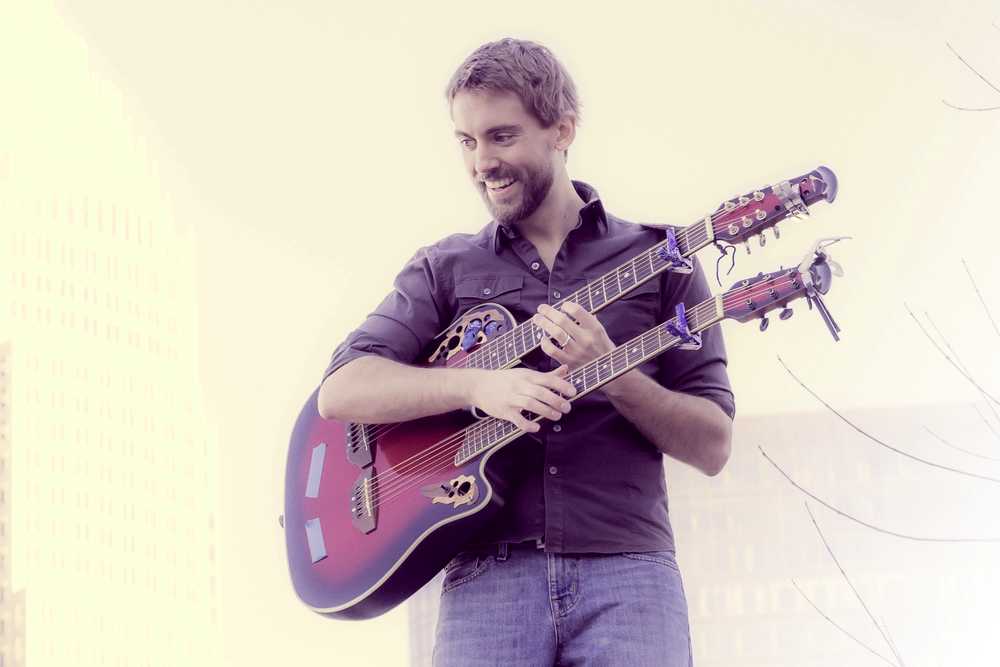
This summer Triumvirate Theatre president Joe Rizzo was trying to teach himself to play “Dueling Banjos.” When he searched YouTube for instructional videos, he found one surprising rendition: guitarist Mark Kroos playing both dueling parts of the popular duet by himself on a double neck guitar.
“It was so astounding, I thought ‘We’ve got to get this guy up here,’” Rizzo said.
Using a grant from the Alaska Council on the Arts, Rizzo booked Kroos to play a show this Saturday at the Triumvirate Theatre. Kroos will also play Friday at the Ninilchik Fairground in a fundraiser concert for Ninilchik Emergency Services.
The “Dueling Banjos” video — the most popular on Kroos’ YouTube channel, with over a million views since it was uploaded in February 2013 — shows off the essential techniques of his unorthodox playing. Kroos produces sound from his guitar — a modified Ovation acoustic double neck — by tapping, rather than plucking, picking, or strumming, the strings. He uses one hand to tap out clean, folkish melody lines on the frets of one neck while tapping rhythms and harmony on the other. Instead of having the usual 12-string upper neck and six-string lower neck, Kroos made both necks of his guitar six-stringed. He said that inventing his style wasn’t easy.
“It isn’t necessarily something I’m super gifted at, but I’m pretty good at banging my head against the wall,” Kroos said. “I’m pretty good at practicing if I have an idea of what I want to do, if I have a composition in mind.”
He arrived at the style after living an odd musical life in a mix of genres. A native of Lansing, Michigan, he went to Bowling Green University in Ohio to study jazz guitar performance.
“I didn’t do so hot in the school of music,” Kroos said. “I was a really awful jazz guitar player. …I thought I could get good at it — I do like jazz, I like listening to it, but I don’t really have much of a natural knack for it. When I left the school of music, I figured I wouldn’t really have a career in music after that — I thought it would just end up being my hobby.”
After leaving Bowling Green and jazz, Kroos stopped playing guitar for about two years — until he began giving guitar lessons and found that “teaching rekindled (his) love for the instrument.” Inspired by the two-handed tapping of acoustic guitarists like Michael Hedges and Andy McKee, Kroos started writing new music, including “Indigo Child,” a song with parallel guitar parts he tried to play with right-handed fretting.
“I had this section where my hands kept getting in the way of each other,” Kroos said. “I wanted to play parts using the same string with two different hands. So I thought, ‘Maybe I can set up one guitar lying flat on a keyboard stand and use my right hand to play that guitar and my left to play another guitar. I tried that and it was clumsy as all get-out, but I found it was possible. …I worked on that for a while, and then I thought ‘why not get a double neck guitar?’”
In March 2009 he bought his double neck Ovation on eBay for $500 and began the heavy practicing that led to his current playing. He was also gathering other musical experiences in this time. Kroos played bass and sang in a ska-punk band, and later moved to Williamsburg, Virginia — where he still lives — to be the guitarist in a country band at the Busch Gardens theme park.
The music that eventually resulted from his melange of experiences is smooth-sounding, resonant, and full of harmonies. Some listeners have told Kroos it’s reminiscent of Celtic or Appalachian music. He agrees, saying there’s something of the Chieftains and Nickle Creek in it, but names a less obvious influence as well.
“Everything I listened to growing up was a lot of punk rock bands,” Kroos said. “People say punk rock music, rock music in general, is just like four chords. Well, I use those same four chords in a lot of compositions. A lot of my influences have been punk rock bands, and it comes into this, this — I think it’s pretty — acoustic guitar music. It doesn’t sound like punk rock at all — it’s pleasing, it’s diatonic, it fits within the key, and it’s generally relaxing. But a lot of the chord structures that you hear in those (punk) songs are similar to what you’d hear in my songs. It’s just not fast or loud or raw-sounding. It’s instrumental guitar music. It’s interesting how when you make some slight changes to a genre, it sounds completely different.”
Kroos began attracting wider attention with his YouTube videos and was invited to compete in Guitar Player magazine’s 2011 Guitar Superstar competition. Of the five finalists, he won with his acoustic double neck.
Since then, he’s recorded two instrumental albums (and is working on a third) and built his musical career with long tours of shows in churches, coffeehouses, schools, and community centers. He estimates he’s played in most of the continental United States, though this weekend will be his first visit to Alaska.
Between his shows on the Kenai Peninsula, Kroos said he also plans to do some assemblies at local schools. After the Triumvirate performance, he’ll be playing at the Sea Otter Community Center in Seldovia on September 18, then heading north to play at a church in Fairbanks. Then back to the Lower 48 to continue touring in Ohio and Pennsylvania.
“It’s my full-time gig and it’s how we pay rent, but it’s also kind of an addiction,” Kroos said of touring. “It’s my favorite thing to do — going out and playing shows.”
Reach Ben Boettger at ben.boettger@peninsulaclarion.com.
