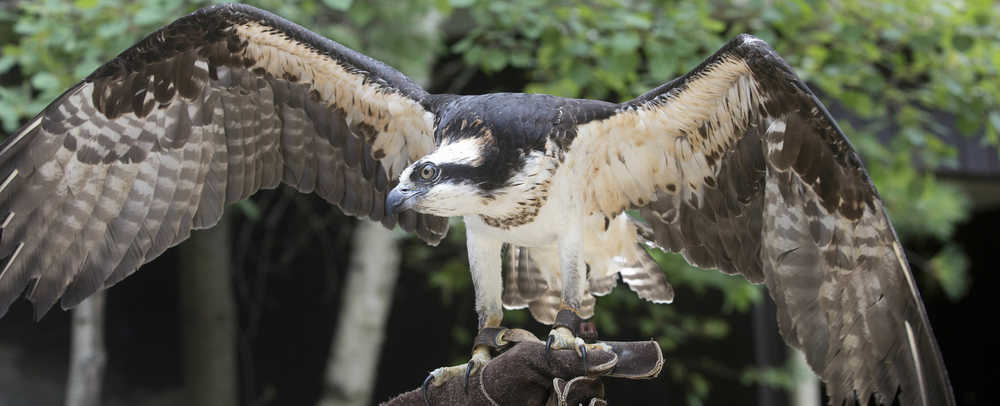
In this photo taken Monday Aug. 15, 2016, a captive Osprey is seen at the Squam Lakes Natural Science Center in Holderness, N.H. Iain MacLeod, a researcher at the center, is using solar-powered satellite transmitters attached to the backs of juvenile and adult Ospreys to track the international migrations of birds nesting in the Northeast. (AP Photo/Jim Cole)

In this photo taken Monday Aug. 15, 2016, a captive Osprey is seen at the Squam Lakes Natural Science Center in Holderness, N.H. Iain MacLeod, a researcher at the center, is using solar-powered satellite transmitters attached to the backs of juvenile and adult Ospreys to track the international migrations of birds nesting in the Northeast. (AP Photo/Jim Cole)

Scientists unravel mystery of osprey migration

TILTON, N.H. — Scientists have long known ospreys make an epic journey each summer from New England to South America. But the details of their dangerous trip remained a mystery — until now.

Thanks to trackers on the backs of these fish-eating raptors, scientists are filling in the picture. And what they are learning is troubling.

The brown-and-white birds get hit by cars and ships, shot by angry chicken farmers and blown off course during hurricane season. One even ended up on a ship that took it to Portugal.

By some accounts, up to 80 percent of the young birds making the trip don’t return to New England — compared to 15 percent of adults.

“Some of them make it to South America. A lot of them don’t,” said Iain MacLeod , executive director of the Squam Lakes Natural Science Center in Holderness, New Hampshire, who studies ospreys that spend their spring and summers in the state raising their young.

Despite migration troubles, ospreys are experiencing a resurgence similar to bald eagles: from a low of a few hundred osprey pairs in the 1970s in New England to as many as 2,000 pairs currently, including 1,000 in Maine.

Some of the recovery results from a ban on pesticides like DDT as well as measures such as guards on nests to keep out raccoons and other predators that eat their eggs. Adult osprey can live up to two decades.

Starting in August, the birds travel as much as 5,000 miles down the Atlantic Coast and across the Caribbean before they end up in the northern part of South America and the Amazon basin, where they spend the winter.

Scores of male birds have been equipped with trackers, nearly 500 so far in the United States and Europe. The matchbox-size devices use miniature GPS-enabled transmitters to show the birds’ precise location, altitude, speed and time it takes for them to complete the trip.

First used in 1995, the devices provide a detailed map of the route taken by the birds, including pit stops in Rhode Island and Florida. Juvenile ospreys on Martha’s Vineyard, too, were tracked crossing nearly a thousand miles of ocean on their way to Bermuda.

The trackers show most birds go through a narrow route across the island of Hispaniola that includes the Dominican Republic and Haiti and then onwards over Cuba.

“All of the birds are funneling through a very narrow area,” said Rob Bierregaard , an ornithologist at Drexel University in Philadelphia who has tagged ospreys with MacLeod.

“If something bad happens there, they could be vulnerable,” he said. “You got your eggs all in one basket if you will … If something bad happened in Cuba, virtually all the East Coast and a lot of Midwest ospreys would be exposed to that.”

Should they make it across the Caribbean, the birds, especially juveniles on their first trip, face challenges finding a wintering spot. While the experienced birds typically return to the same safe location every year, the young birds spend several months “house hunting” over a range from Venezuela to Brazil, where they can find plenty of fish. That can often get them killed.

“When they hit South America, they are kind of clueless,” MacLeod said, adding that search can often lead to conflicts with other predators or humans especially fish farm workers. “We can literally see them go to a fish farm and you go, ‘Oh, no, don’t stay there!’”

What the trackers can’t tell scientists is how the young birds manage to find their way to the wintering ground and how they know when to stop. Since they are flying blindly and doing it alone with no help from their parents, scientists suspect they may be using the Earth’s magnetic field to guide them and an internal clock that tells them they have arrived.

“The young birds flying over the Atlantic from Martha’s Vineyard on their first trip fly this amazing straight line for 24 to 36 hours with no land marks and they are correcting for wind drift,” Bierregaard said. “They have some magnetic sense where they are based on magnetic fields. We don’t understand how they do that … It’s fascinating.”
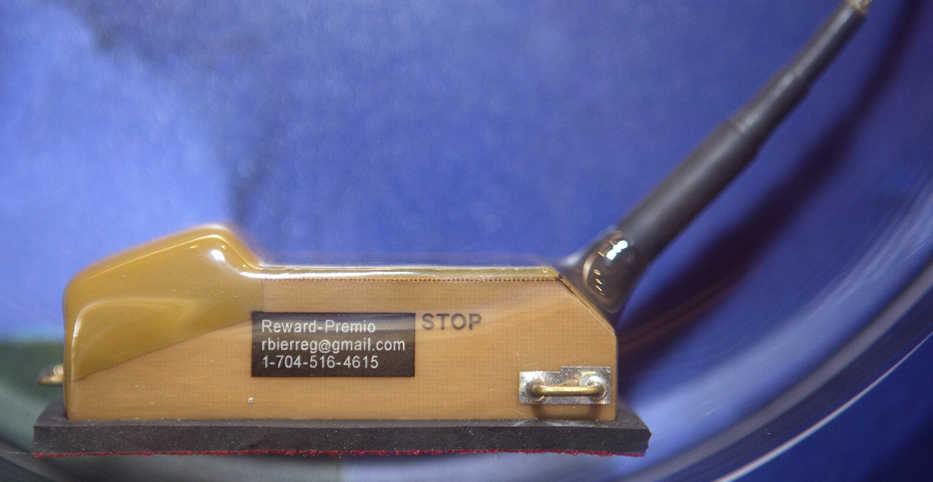
In this photo taken Monday Aug. 15, 2016 a solar-powered satellite transmitters is on display at the Squam Lakes Natural Science Center in Holderness, N.H. Researchers are using the transmitters track the international migrations of Ospreys nesting in New Hampshire and other parts of the Northeast. (AP Photo/Jim Cole)

In this photo taken Monday Aug. 15, 2016 a solar-powered satellite transmitters is on display at the Squam Lakes Natural Science Center in Holderness, N.H. Researchers are using the transmitters track the international migrations of Ospreys nesting in New Hampshire and other parts of the Northeast. (AP Photo/Jim Cole)

More in Life

File
Minister’s Message: Love born to endure

I spend time with people in the final chapters of their lives.… Continue reading

In his 1903 report to the U.S. Department of Agriculture, Prof. Charles Christian Georgeson included this photograph of efforts to break recently cleared ground at Kenai’s agricultural experiment station. The man behind the bull was either station superintendent Hans P. Nielsen or his assistant Pontus H. Ross.
The experiment: Kenai becomes an agricultural test site — Part 4

AUTHOR’S NOTE: A presidential executive order in January 1899 had set aside… Continue reading

This recipe makes a boatload of soft and delicious cookies, perfect for sharing at Christmastime. Photo by Tressa Dale/Peninsula Clarion
Christmas cookies for a shared tradition

These cookies are so soft and delicious, it’s no wonder they’re part of a family Christmas tradition.

Daniel Craig (right), returning as Benoit Blanc, and Josh O'Connor are seen in this still from "Wake Up Dead Man: A Knives Out Mystery," released on Netflix on Dec. 12, 2025. (Promotional photo courtesy Netflix)
On the Screen: ‘Knives Out 3’ truly a film for our times

I often feel the need to watch a film twice. The first… Continue reading

Orange zest and extract bring this literary-inspired treat to life. Photo by Tressa Dale/Peninsula Clarion
Whimsy and magic

This literary-inspired treat is perfect for Christmastime festivities.

File
Minister’s Message: Traditions should be things that support us

Regardless of how you find yourself this season, know that you’re not alone.

Photo from the Alaska State Library historical collection
In Kenai, circa 1903, this trio was photographed on a well-used trail. Pictured are George S. Mearns, future Kenai postmaster; Kate R. Gompertz, Kenai resident; Hans P. Nielsen, superintendent of Kenai’s agricultural experiment station.
The experiment: Kenai becomes an agricultural test site — Part 3

AUTHOR’S NOTE: Presidential Executive Order #148, in January 1899, had set aside… Continue reading

Snow-covered trees and peaks are pictured from a frozen pond near the Herbert Glacier trail in Juneau<ins>, Alaska,</ins> on Thursday, Dec. 11<ins>, 2025</ins>. (Chloe Anderson/Peninsula Clarion)
Out of the Office: Breaking the winter cycle

There’s a learning curve to every new season and every new sport.

File
Minister’s Message: Good grief

Grief doesn’t take a holiday, but it can offer you something the holidays can’t.

This 1903 photograph of mostly Kenai residents shows (back, far left) Hans Peter Nielsen, first superintendent of Kenai’s agricultural experiment station. Nielsen began work at the station in 1899 and resigned at the end of the 1903 season. (Photo from the Alaska State Library historical collection)
The experiment: Kenai becomes an agricultural test site — Part 2

AUTHOR’S NOTE: Presidential Executive Order #148, in January 1899, had set aside… Continue reading

Served together on a bed of greens, these pickled eggs and beets make a light but cheerful lunch. Photo by Tressa Dale/Peninsula Clarion
A wealth of eggs for good health

Pickled along with roasted beets and dill, these eggs have a cheerful hue and bright aroma.

File
Minister’s Message: Lifelong learning is a worthwhile goal

Lifelong learning. That’s a worthwhile goal. Schools have been in session for… Continue reading