
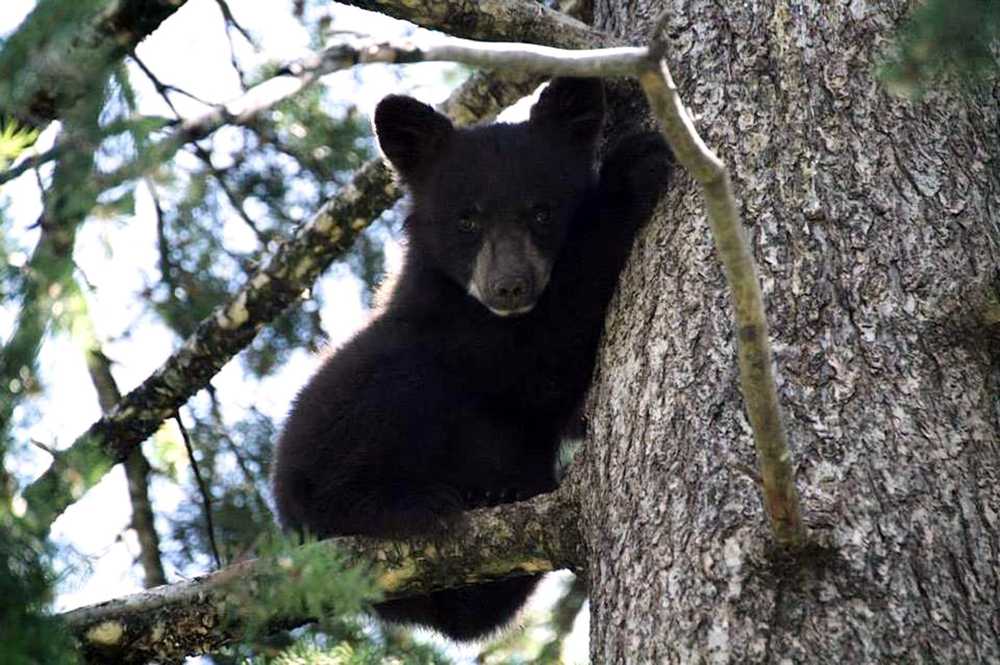
MCCALL, Idaho — Janell Carr first met Mr. Cinnamon when the black bear cub was eating out of her bird feeder in Cascade. She and her husband eventually startled the bear, who climbed 80 feet up a tree in their yard and took a nap.
Later that weekend, neighbors found Mr. Cinnamon in their kitchen sink. They left an upstairs window open — and the cub climbed the deck to get there.
Carr saw the bear again, walking through her yard while she was sitting on the deck.
“I didn’t know if I should feed him or pet him or be afraid,” she said. “He was a little guy. Everybody had seen and heard of him.”
So the neighbors called Idaho Fish and Game, which trapped the bear and sent him to rehab — at the Snowdon Wildlife Sanctuary outside McCall. Snowdon rehabs all kinds of animals and releases them back into the wild but has become known for its bear cubs.
The orphaned cubs — almost always less than a year old — are kept in a naturally forested, two-acre enclosure. They’re fed dog food and produce, inspected to make sure they’re healthy, given preventative medicines and released into the wild following the fall or spring hunting season, depending on when they arrive and how big they are.
The enclosure, which has huckleberry bushes, allows them to practice the climbing and foraging skills they need in the wild.
“It’s really neat to see them come in as these tiny, little, cute fluffball things and then by the time we catch them again in the spring they look like wild, adult bears,” said Maeghan Elliott, Snowdon’s executive director. “It’s really neat to be a part of that transformation and be able to help them and know that if they didn’t have us, they might not be able to be back in the wild.”
Snowdon rehabbed a facility-record 15 bears last winter, including Mr. Cinnamon, who turned out to be more than a year old but underweight when he was rolling through that Cascade neighborhood. The facility doesn’t have any bears so far this winter.
Snowdon takes bears from all over the state and releases them in spots isolated from towns and campgrounds. It also has a one-acre enclosure that can be used to house out-of-state bears.
The bears are caught by Idaho Fish and Game — often after calls from concerned citizens, or hunters who inadvertently shot a mother — and delivered to Snowdon. Hunters aren’t allowed to shoot a female bear “accompanied by young.” Fish and Game usually won’t pick up a cub based on an initial report; it asks people to monitor the bear for a couple days to make sure it’s orphaned.
“Typically we see more cubs when we have a lot of fires in the area,” said Regan Berkley, a regional wildlife manager for Idaho Fish and Game who is based in McCall. “Mom and her cubs can get separated a little more easily.”
Snowdon was founded by Linda DeEulis in the early 1980s. She was approached by Fish and Game about the possibility of keeping some young cougars in her yard, before she started the sanctuary, and declined. When she learned the cougars were euthanized, DeEulis decided to start a rehab facility.
She bought 35 acres off a dirt road and next to the Lake Fork River — an area blanketed with snow in the winter and where sounds from the human population are rare. Snowdon was incorporated as a non-profit organization in 1989.
DeEulis died in 2012. Since then, the facility has been run by a volunteer board of directors. Elliott, a former college intern from Boise, was hired two years ago and is the only paid employee.
The board and Elliott have tried to maintain DeEulis’ vision, including the difficult task of staying open to a wide range of species.
“It is a sanctuary, but it’s a short-term sanctuary,” said Carolyn Walpole, the Snowdon board president. “Our main mission is to get those animals back into the wild as soon as they’re fit … and show people that wildlife should be respected.”
Snowdon operates off donations and grants and uses its three resident birds — raptors that were unreleasable — for educational programs throughout the region. Businesses and residents in the McCall area often donate unused produce, Elliott said, which helps feed the bears.
Snowdon’s population varies throughout the year but has included bears, foxes, raccoons, squirrels, deer, bobcats, badgers, owls, eagles, hawks, falcons, many other birds — even a cougar and some wolf pups. The facility doesn’t handle adult deer, adult predators or grizzly bears.
Raptors and bear cubs are the primary rehab animals statewide.
“Deer and elk do not rehab well,” Berkley said. “Cougars do not rehab well. When you get those types of animals, you have to size up the situation on a case-by-case basis. … Once wild animals are adults, they do not rehab well at all.”
Snowdon’s goal is to release all of the animals it takes. The bear cubs are tagged and subject to a one-strike rule in the wild, Elliott said. If they became problem bears, they will be removed.
Only two Snowdon bears have resurfaced, Elliott and Walpole said. Both were shot by hunters, who reported finding the tags.
Elliott, who lives on-site, and other Snowdon crew members limit noise when they have bear cubs. The cubs are kept in a “catch cage” for a couple days when they arrive to monitor their health. Once they’re placed in the bear enclosure, they’re left alone except for twice-a-day feedings. The crew also checks trail cameras a few times a week to make sure all the bears are accounted for and seem healthy.
Perhaps Snowdon’s best-known visitor was Boo Boo, a black bear cub burned in a fire near Salmon in summer 2012 and released into the wild in May 2013.
“They basically grow up being a wild bear,” Elliott said. “… Every once in a while a cub will get curious (about the people). You can pick up a stick (a foot long) and they’ll run. They’re so terrified of us. Rarely do we have any cubs who are too interested in what we’re doing.”
Cubs usually hibernate through their first winter with their mothers, which is why the orphans need a rehab facility. They likely would die on their own, Berkley said.
“There’s a biological trigger that will make them hibernate,” Elliott said. “If they aren’t heavy enough, that won’t happen. They’ll continue trying to find food in the winter and they’ll freeze or starve to death.”
At Snowdon, with food readily available, the cubs often nap for two or three days and then awake to eat, Elliott said. They sleep in trees, under rocks, buried in the snow or in two man-made shelters on the property.
Elliott is “super, super hands-off” with the bears — which can be difficult for someone who enjoys animals.
“They are so cute,” she said. “But I always keep in mind, if I do that, we can’t release them. So that makes it worth it for me.”
One of Walpole’s favorite Snowdon success stories occurred earlier this year. A young bobcat showed up at Elliott’s door on the Snowdon property in January.
The next day, the bobcat was curled up in the roof of one of the bird cages. Elliott and a caretaker lured the malnourished kitten into one of Snowdon’s cages, where it was fed for a couple of months and released.
“It was almost like it knew where to go (for help),” Walpole said. “It really was amazing to all of us.”
