
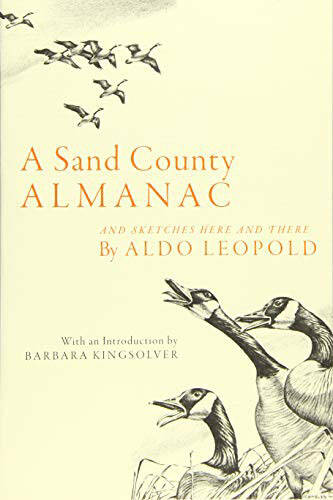
With Earth Day set for Friday, and the Kenai National Wildlife Refuge celebrating its 80th anniversary, all trails lead to a review of “A Sand County Almanac: Sketches Here and There” by Aldo Leopold.
Earth Day, first held in 1970, is an annual event to demonstrate support for environmental protection. Recognized as the founder of the science of wildlife conservation and management, Leopold is relevant here.
He also is tied up in the history of the refuge. According to a Feb. 3 Refuge Notebook in the Clarion by Dom Watts, David Spencer studied under Leopold at the University of Wisconsin. In 1948, Spencer was hired as the first manager of the nearly 2 million acres of the Kenai National Moose Range, which became the refuge in 1980.
Leopold references are peppered throughout Refuge Notebooks, including a look back at “A Sand Country Alamanac” by Ted Bailey in November 2016 for the 75th anniversary of the refuge.
When it comes to interest in and knowledge of nature, I am a far cry from Bailey, who died last year and was the supervisory wildlife biologist at the refuge until 2001, or Leopold, who lived from 1887 to 1948. “A Sand County Almanac” was published shortly after his death.
I love hiking and skiing in the refuge, but have never been able to take much of an interest in plants or animals. A friend of mine says I’m walking in a museum with all the paintings turned toward the wall.
I’ve edited the Refuge Notebook, a weekly column written by refuge staff for the Clarion, for years, but I’ve always had a murky understanding of what exactly the refuge is.
The refuge’s website tells you wildlife conservation is at the heart of everything the refuge does. I get that. But whenever I would attempt to contact somebody at the refuge for the story, I’d see 29 refuge staff on the website as contacts and wonder why wildlife conservation took the dedication of so many highly trained professionals.
I had to be missing something and read “A Sand County Almanac” to see exactly what that something was.
Written in three parts, the first two parts of “A Sand Country Almanac” establish that Leopold not only had all the paintings facing the right way in his natural museum, but that he meticulously examined each of them.
The first part is an essay for each month from the Leopold sand farm in Wisconsin. By the end of 12 months, Leopold has put on display a vast store of knowledge on plants, animals and natural history, and an affinity for patient perception and meticulousness.
In February, the Leopold family saws through a fallen oak, using tree rings to estimate that the oak dates to the 1860s. With every few pulls of the saw, Leopold marks the year and gives a history of events happening nationally, in Wisconsin and on that farm to which the old oak bore witness.
In April, he wakes at 3:30 a.m. and sits with a coffee pot and notebook, noting the time at which various species of birds start their songs.
In the second part of the book, Leopold continues with sketches from around Wisconsin, plus other states and some areas in Mexico.
In a sketch from Wisconsin, Leopold follows the passage of a few atoms through nature, with that journey including rocks, flowers, trees and humans. Such creativity and nose for minute detail.
I was past overwhelmed. Sometimes writing opens a door, making you think, “I could be like this guy.” Other times you look in through the window, thinking, “This guy is something else. I could never be like him.”
I was definitely looking through the window on this one. I was also starting to understand the immense value of people like Leopold.
He writes: “A conservationist is one who is humbly aware that with each stroke he is writing his signature on the face of the land.” Leopold gives as an example his decision whether to cut down a white pine or red birch on his property.
This completely changed my perception of conservation. To me, “conservation” and “refuge” are passive words. Just let nature be nature. Have some staff on the refuge study that nature.
Leopold shows that conservation is active and an awesome responsibility. Suddenly a flood of Refuge Notebook columns flooded back to me.
The project to try and eradicate elodea, the invasive plant, in order to protect salmon. The intense effort to try and make wildfire healthy for the refuge, yet to keep Kenai Peninsula residents and structures safe at the same time. The tree crushing done by massive machines in the 1970s to try and convert spruce stands to hardwood stands.
In all these instances, the refuge is putting a massive signature on the face of the land. I suddenly realized that having signatories who have studied plants and animals for years, like Leopold or many on the refuge staff, is invaluable.
Not that Leopold gives them a pass. After all, they are human. In a sketch on Escudilla Mountain in Arizona, Leopold was part of a group of forest officers that decided to extinguish a bear.
“It did not occur to us that we, too, were the captains of an invasion too sure of its own righteousness,” he writes.
Leopold also writes of the limitations of science, writing “the biotic mechanism is so complex that its workings may never be fully understood.”
I immediately thought of a Refuge Notebook from 2020 in which Matt Bowser, an entomologist at the refuge, estimates there may be around 1,300 species of insects in a 3.5 square mile area of the refuge.
Ultimately, even the staff at the refuge are not enough, as Leopold makes clear in the third part of the book. Here, he devotes essays to the conservation esthetic, wildlife in American culture, wilderness and the land ethic.
“There is a clear tendancy in American conservation to relegate to government all necessary jobs that private landowners fail to perform,” Leopold writes.
The knowledge on display for the first two parts of the book was impressive, but the probing and challenging essays of the third part of the book are stunning due to their timelessness.
They ask questions as relevant today as they were 70 years ago.
Have we fully realized recreational development “is a job not of building roads into lovely country, but of building receptivity into the still unlovely human mind”? Have we hurt outdoor recreation with excessive mechanization that “moves the factory to the woods or to the marsh”? Have we developed a land ethic in which humans change from “conqueror of the land-community to plain member and citizen of it”?
These questions are good to reflect upon as Earth Day approaches, and also ample reason to read “A Sand County Almanac.”
“A Sand County Almanac” was originally published in 1949 by Oxford University Press.
Off the Shelf is a bimonthly literature column written by the staff of The Peninsula Clarion that features reviews and recommendations of books and other texts through a contemporary lens.
