
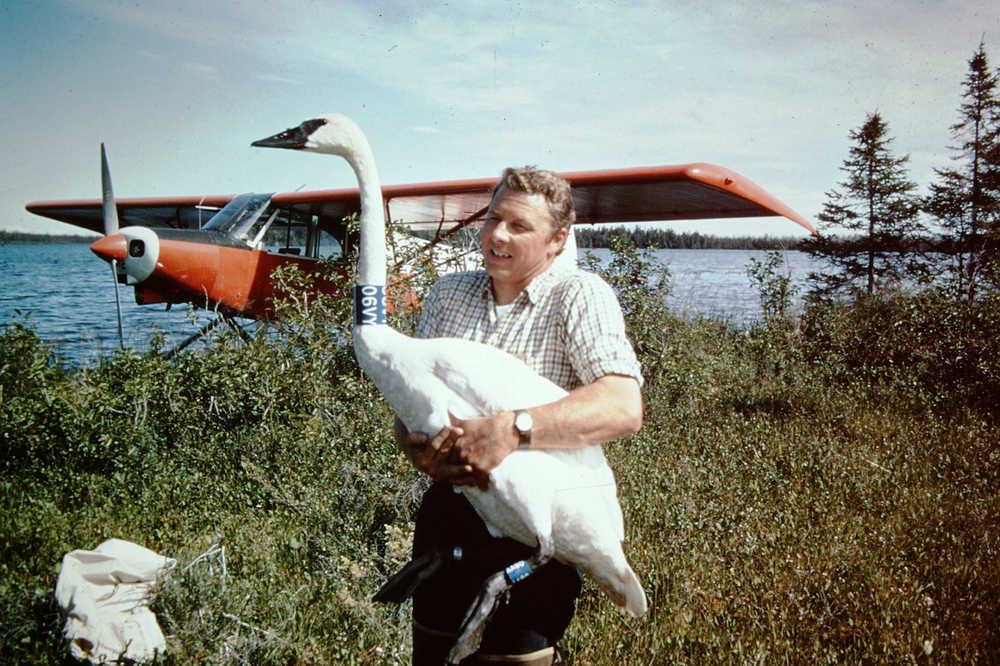
Did you know that Trumpeter swans have been surveyed on the Kenai National Wildlife Refuge since 1957? Six decades ago, when only 20 pairs were known to nest on the Kenai Peninsula, Trumpeter swans were almost extinct in the Lower 48. Since then, swans have increased to about 50 nesting pairs on the Kenai, and breeding populations have been restored to much of their former range in the Western and upper Midwestern states.
As the biggest North American bird species, Trumpeter swans are slow to mature. They need 140-154 ice-free days to successfully complete a breeding cycle: 49 days for nest building, egg laying and incubation, and 90-105 days for cygnets to fledge and become fully flight capable for migration. The earliest known hatch date on the Kenai Peninsula is June 4, with the earliest cygnets fledging in mid-September and some as late as mid-October. As such, it becomes a dire race to fly before ice locks them in.
Now, with winter descending on the Kenai, most Trumpeter swans have flown the coop as lakes freeze up. A few swans may linger in open water on the Kenai River below Skilak Lake, but most are now headed south, scattered along the Inside Passage from the Copper River Delta to the Stikine River near Wrangell. But what’s their ultimate destination?
Dairy farms. Yes, dairy farms that grow orchard grass and ryegrass as cover crops for silage during the winter. Agricultural landscapes like those that surround Duncan on Vancouver Island or the alluvial soils of the Fraser River delta or, in particular, the Skagit Valley in northwestern Washington. Swans, geese and dabbling ducks have learned to forage on these grasses to the dismay of local farmers.
Data from the Bird Banding Laboratory in Laurel, Maryland, show nine records of eight different Trumpeter swans that were originally neck-collared on the Kenai Refuge and were re-sighted on or near Barney Lake in the Skagit Valley during several winters in the 1970s and early 1980s. These birds were among 160 swans, mostly cygnets, which were neck-collared and leg-banded by refuge staff between 1966 and 1984 to understand swan movements and survivorship.
To get a more detailed understanding of brood movements among the many lakes and wetlands in the Kenai Lowlands, retired refuge biologist Ted Bailey and his staff tracked 45 Trumpeters during 1982-85 that were harnessed with VHF radio transmitters. One adult female captured on Kenaitze Lake in the northern lowlands eventually traveled more than 1,400 miles to the Barney Lake area between September 17 and December 2 in 1984.
In researching historical records of trumpeter swan management and research by the Kenai Refuge, I ran into an interesting account in a 1980 report: “Swans banded on the Kenai National Wildlife Refuge continue to be observed at Barney Lake in Washington and on Vancouver Island in Canada. Barney Lake, a prime wintering area for Kenai trumpeters is being subjected to intensive development along its shores and the future of this wintering area is in jeopardy. However, there is a movement to proclaim this area as a swan preserve.”
Last week I met Martha Jordan, now the Executive Director of the Northwest Swan Conservation Association, who was a field biologist actively involved in re-sighting neck-collared swans around Barney Lake during those early years. In a 1980 paper, she wrote that an effort was underway by the Audubon Society, Friends of the Swan, what-was-then the Washington Department of Game, and The Nature Conservancy to protect this wintering area.
After a petition drive, these co-conspirators succeeded in getting the Barney Lake vicinity designated a “steel shot ammunition only” hunting area, 12 years before the steel shot prohibition for waterfowl hunting became a nationwide mandate. By 1995, the Skagit Land Trust began conserving lands around Barney Lake for wintering waterfowl including Trumpeter swans.
Consider that in 1957, as aerial surveys for swans were being inaugurated on the Kenai Refuge, only six Trumpeters were recorded at Barney Lake. By 1980, 355 swans wintered there. There are now 7,000 Trumpeters and 2,000 Tundra swans wintering in Skagit County, and perhaps 15,000 swans in the greater Skagit-Whatcom area.
The Kenai Refuge has done its small part in helping Trumpeter swans recover by providing good breeding and staging habitats with minimal aircraft disturbance of nests and broods during the summer and fall, and prohibited motorboat activity below Skilak Lake during the spring.
Our small population of nesting swans on the Kenai Peninsula has cumulatively contributed more than 3,500 cygnets over the past six decades to the Pacific Coast meta-population that now numbers almost 6,000 pairs in Alaska.
What a great conservation success story!
Dr. John Morton is the supervisory biologist at Kenai National Wildlife Refuge. Find more information about Trumpeter swans through the Trumpeter Swan Society (http://www.swansociety.org/). Find more information about the refuge at http://www.fws.gov/refuge/kenai/ or http://www.facebook.com/kenainationalwildliferefuge.
