
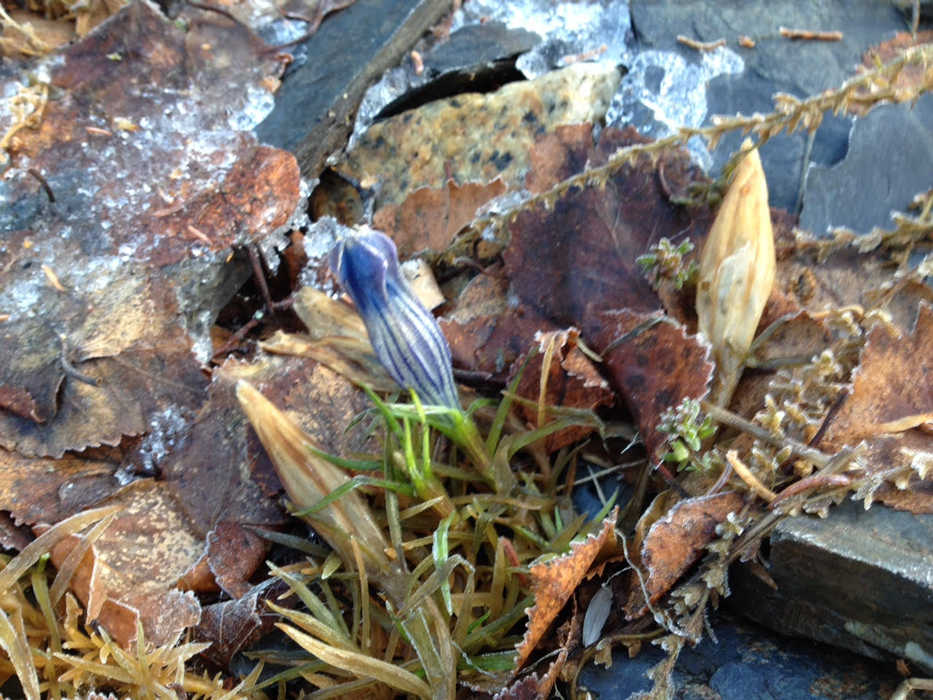
Most Alaskans would likely agree that this has been a winter of very strange weather with very strange outcomes. Winter 2015 was the warmest the U.S. has experienced since records began in 1895 — Alaska was almost 11 degrees warmer than normal! The first wildfire of 2016 near Delta was strange on two counts: it started in tundra and it started in late February. During the first week of our rainy January, a local resident sent me a photo of a gentian blooming in her rock garden above the Kenai River! And now Margie Mullen, one of our original and still very spry homesteaders, says this is the first winter since 1947 that the Kenai River near Soldotna Creek hasn’t frozen over.
These are startling statistics and observations about a winter gone awry. Most think these are signs of a warming climate, but many still think it’s just unusual weather. A survey of 750 Alaskans in January 2016 by Ivan Moore Research showed that 54 percent of Alaskans believe climate change is happening while 21 percent believe it will happen in the future. That still leaves 1 in 5 Alaskans believing that climate change will have negligible impacts. And while slightly more than half of Alaskans believe climate change is caused mostly by humans, 38 percent also believe it’s due to natural variation and 7 percent believe it simply doesn’t exist.
I can accept there are varying levels of understanding among Alaska’s diverse public, but here’s what’s really weird to me. According to the Yale Program on Climate Change Communication, only 37 percent of Alaskans (in 2014) think that most scientists think that climate change is happening.
And that couldn’t be farther from the truth. The most recent update by the Intergovernmental Panel on Climate Change, comprised of more than 830 international scientists, concluded that warming of the atmosphere and ocean system is unequivocal, and there is a clear human influence on the climate. More than 97 percent of actively-publishing climate scientists agree that climate warming trends over the past century are extremely likely due to human activities.
So why do so many reasonable people doubt science? An article published in National Geographic this month asks that question. The author, Joel Achenbach, raises a lot of interesting points, but two caught my attention. Most of us walk around (frequently unwittingly) with “naïve beliefs” about the way the world works that were likely shaped by our upbringings and the cartoons we watched as kids (my words). Even as we educate ourselves, these beliefs haunt us, waiting for an anecdotal observation or spurious event to confirm these beliefs to ourselves despite overwhelming science and data to the contrary, a behavioral phenomenon called “confirmation bias.” So, if you are one of those who believe that humans couldn’t possibly have changed global climate (it’s global for goodness sake!), you just need to read about the less than 3 percent of climate scientists for whom climate warming is a hoax to feel vindicated.
I see three great uncertainties in discussions about contemporary climate change, only two of which are regularly discussed in public forums and which were introduced again in this article: Is climate change real? And is it caused by humans? The third one that gets routinely overlooked not just among the public, but among agency and academic professionals who are engaged in developing adaptation approaches to climate change, is how bad is it really going to be? There’s bad and then there’s really, really bad. After all, a snowless winter in 2015 isn’t the end of the world nor do ducks returning early this spring to Kenai Flats constitute an imminent threat. But salmon spawning in non-glacial waters that reach lethal temperatures in July is another thing.
And on the far end of the badness scale is the Anthropocene, a term made infamous by Dr. Paul Crutzen, who won a Nobel Prize in Chemistry. The Anthropocene was suggested as a term to describe the geologic time we are in now and probably have been in since at least the beginning of the industrial age (mid 1800s), a period coinciding with contemporary climate change. Sometime this year, the International Commission on Stratigraphy is expected to decide whether the Anthropocene is a true geologic epoch, a decision that leaves no doubt about what causes contemporary climate change.
What makes the Anthropocene so “bad” is that it explicitly assumes that mass species extinction is the outcome of contemporary climate change. Starting 450 million years ago, radical disruptions in earth’s climate caused extinctions of 50 percent or more of species at the close of five periods now called Ordovician, Devonian, Permian, Triassic and Cretaceous. The Anthropocene is viewed as the beginning of the world’s sixth extinction, a notion popularized in a 2014 book by Elizabeth Kolbert.
So, be open to the idea that while science doesn’t have it all figured out, climate scientists are genuinely and increasingly concerned about the velocity of climate change. You don’t have to believe that the world is barreling towards mass extinction, but there are no solutions until a problem is recognized as a problem. Think of it this way. If scientists are wrong about climate change, then we’ve wasted some time and money trying to make our world a little more sustainable. But if scientists are right about climate change and the Anthropocene is upon us, we’re at the beginning of a long and rough ride.
Dr. John Morton is the supervisory biologist at Kenai National Wildlife Refuge. Find more information at http://www.fws.gov/refuge/kenai/ or http://www.facebook.com/kenainationalwildliferefuge.
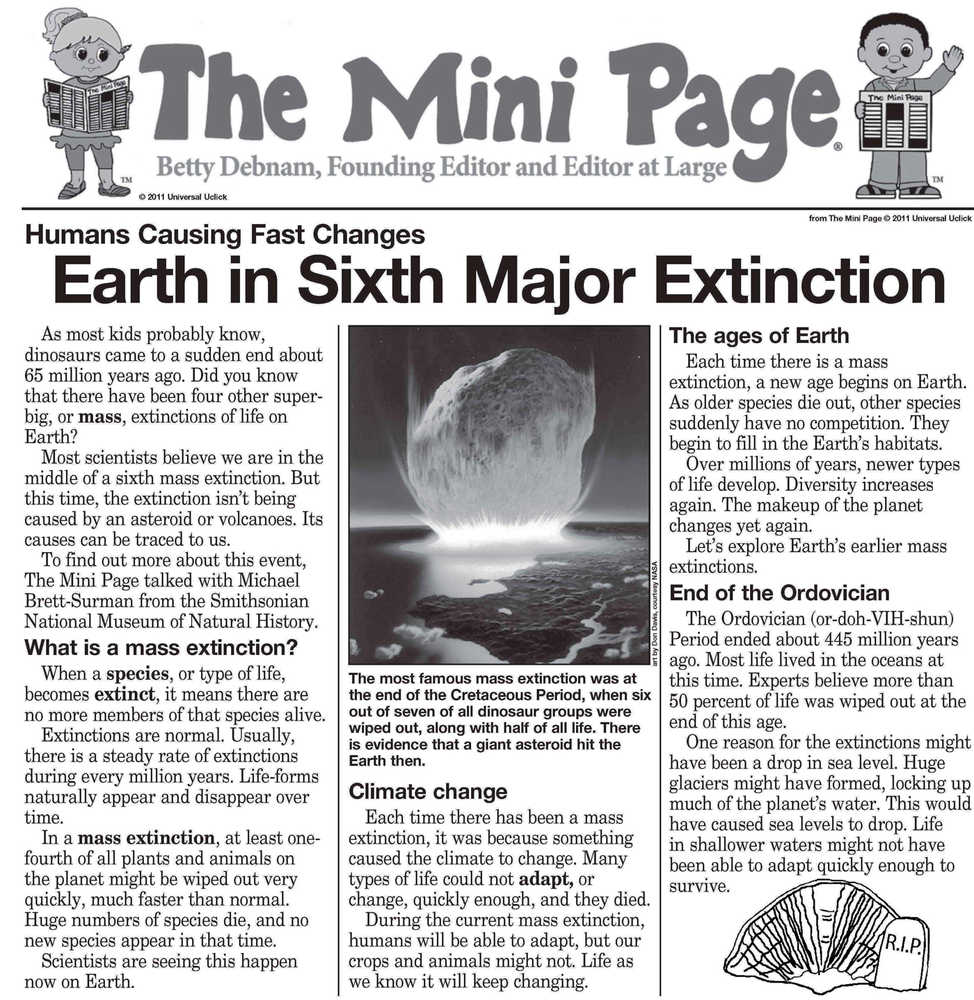
Five years ago when most adult Americans were just starting to have serious conversations about whether or not climate change was real, our kids were learning about the Anthropocene in this Mini Page published in the Peninsula Clarion in June 2011.
