
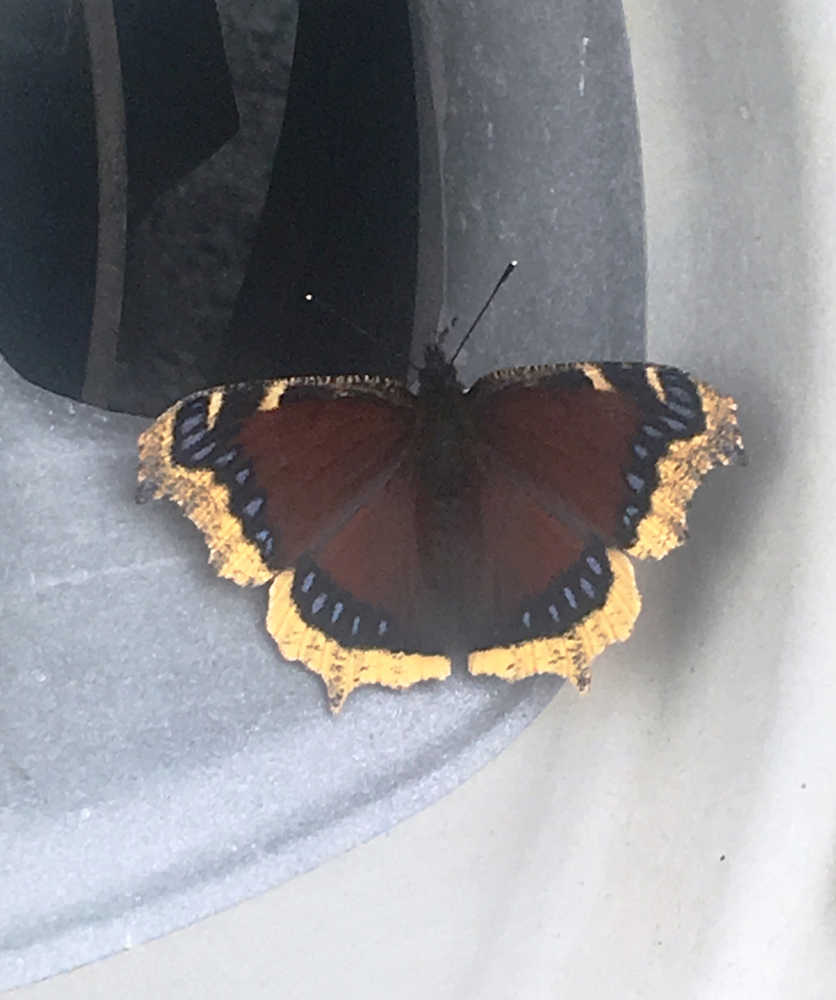
September 19 was one of the first frosty mornings of the fall last year and I had moose calls on the brain. Deep in the woods I was grunting and groaning with the best of them, trying to entice a very large (or very small) moose into my bow’s range. Things were going well except there were zero animals in the area that I was audibly abusing with my poor moose imitation. As the sun rose and my chances of finding anything were dashed by 60 degree weather, I noticed a colorful butterfly flitting around my camo-covered legs.
I recognized the butterfly as a Mourning Cloak and wondered what it was doing out so late in the year. There were no flowers blooming and no apparent food source. Perhaps another victim of climate warming? I guessed it emerged late in the summer and was bound to die soon as temperatures dropped below freezing. For many critters requiring orchestrated timing for their lifecycles, a changing climate can often disrupt the timing of critical events and result in a quick demise. In this case, I hadn’t seen this butterfly during the height of summer so I investigated further.
There is an emerging field of study on how climate change leads to shifting phenology. In some cases, species that are obligates to a migration route or seasonal window may be unable to shift. So they arrive at their destination to find that the critical hatch of insects, a spawning fish, or blooming of a particular plant happened two weeks early and now they are out of luck. For species locked into a particular path, this can lead to complete reproductive failure and, possibly, even extinction. This phenological mismatch is described in an article by Visser and Both in 2005 (http://www.ncbi.nlm.nih.gov/pmc/articles/PMC1559974/).
It turns out what I was seeing was completely normal. Mourning Cloaks are one of the longest lived butterflies in their adult stage. They often survive as adults for up to 10 months, which is an eternity for butterflies. They overwinter as adults in any little nook or cranny to protect them from harsh winter temperatures and moisture. Hidden away, they enter a period of frozen stasis called cryopreservation.
As soon as temperatures rise in the spring they come out of stasis, typically May but as early as the March thaws we’ve had in recent years. The males sun themselves on the ground or on a twig trying to attract females. A brief aerial courtship ensues and mating occurs. After mating, the eggs are laid on deciduous twigs like willow, aspen, cottonwood or birch. Adult Mourning Cloaks die shortly after breeding and laying eggs.
An interesting article by Mikaela Huntzinger in 2003 in Biological Conservation describes the positive effects that shaded fuel breaks and other fire management practices have on butterflies. Presumably, opening the canopy allows more sun and the proliferation of hardwoods following canopy thinning provides egg laying substrate. The forest clearing by fire managers along Funny River Road and more recently in Sterling may have collateral benefits for some butterflies.
The caterpillars hatch and as a group consume greenery from their host deciduous tree or shrub until they are fully grown. They then disperse from their host tree and pupate in June or July. After a short period, Mourning Cloaks emerge as adults but then aestivate (a kind of hibernation) in mid-summer, protecting them from extreme warm or dry conditions — thus the reason I had not been seeing any during the summer months. When temperatures cool in the fall, the adults seek out food to store for their long winter stasis period.
With nectar in short supply during this period, Mourning Cloaks fuel up on tree sap and decaying berries, storing energy needed to overwinter and for the post-emergence period in early spring when food is scarce. They will often be found when there are still patches of snow on the ground.
So my initial guess that the butterfly I saw flitting around on that late fall day was a goner was completely wrong. The Mourning Cloak may be one of the most versatile and resilient butterflies to climate change that we have. Being able to go into stasis during the cold of winter and heat of summer as an adult allows it the flexibility to respond to wide climate and weather fluctuations. And there is nothing critical about the timing of its emergence. All it needs is to have mild temperatures in the spring and fall. It is not specialized to one habitat, but survives from northern Alaska to Mexico. It requires no specific plant host, just some common deciduous woody plants.
While there are many valid concerns over migratory birds or insects that may be impacted greatly by global warming, the Mourning Cloak appears to be off that list of vulnerable species for now — this butterfly species is among the least of our worries.
Todd Eskelin is a Wildlife Biologist at the Kenai National Wildlife Refuge who specializes in subsistence management and birds. Find more information at http://www.fws.gov/refuge/kenai/ or http://www.facebook.com/kenainationalwildliferefuge.
