
First let’s paint a picture. I am sitting at a concrete table sipping the best cup of coffee I have ever tasted. It was slow dripped through a coffee sock and the beans were grown, hand-picked, dried and roasted in the hills surrounding my current location.
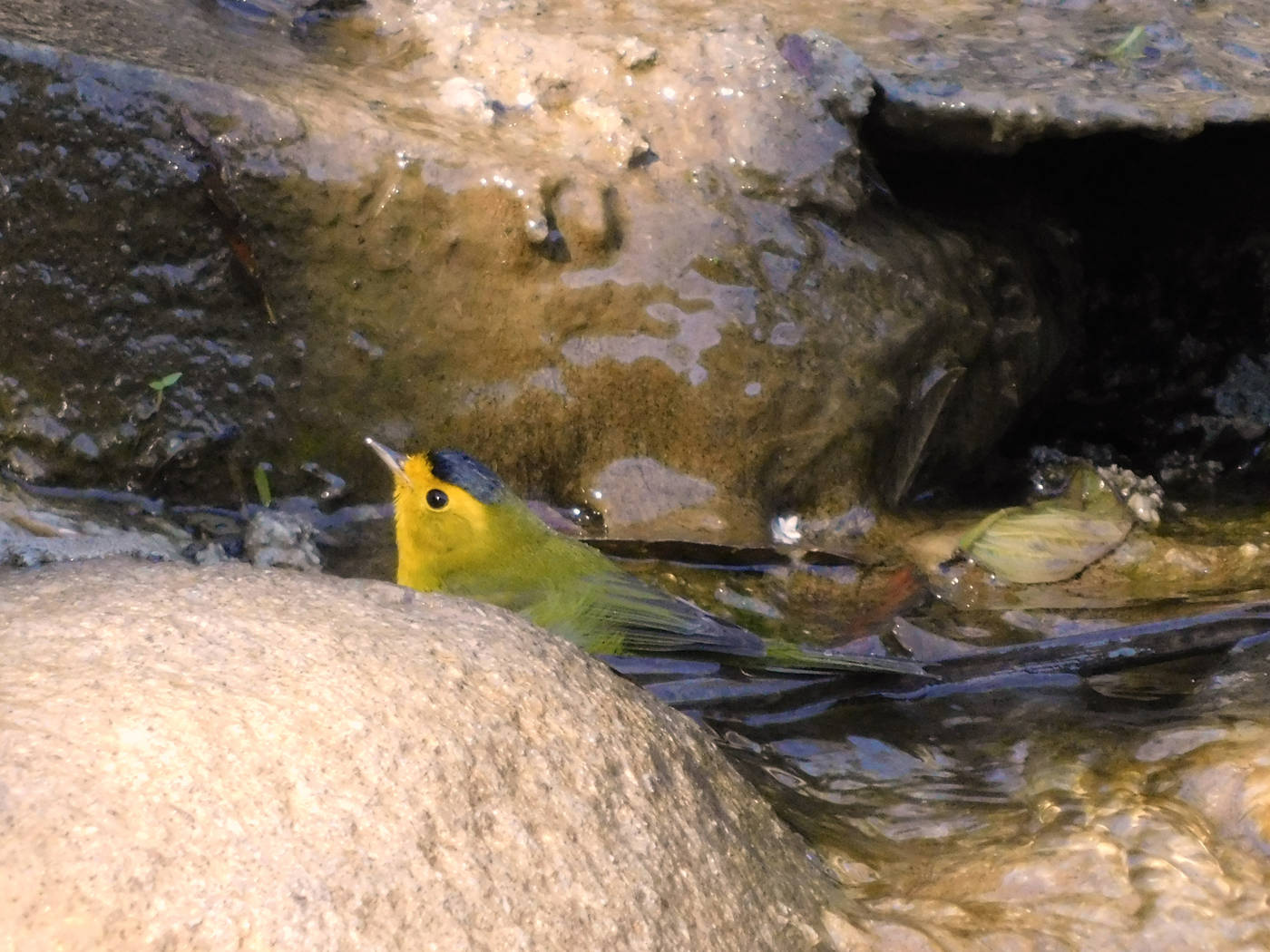
After an incredible morning of toucans, motmots, and trogans, I position myself next to the tilapia pond with a small cascading waterfall. Almost nothing could draw me from the bliss of this cup of coffee. The Costa Rican national bird, Clay-colored Thrush, is foraging in the underbrush near me and I catch a flash of yellow bathing in the pools of the waterfall. This has to be a Euphonia or some other tropical gem that will further bolster my bird list that is growing daily by the dozens.
It is not a Central American endemic, but a bird I have banded in Alaska, a striking male Wilson’s Warbler, or WIWA in the American Ornithological Union banding code list. I would guess it ranks in the top 5 of the 20,000-plus birds I have banded in the state. I am so struck by the connection that I even looked for a band to make sure it was not a bird I had handled before.
As I myself struggle to acclimate to temps in the upper 80s in Santa Elena, I look back at my Alaskan adventures with Wilson’s Warblers. On the Alaska Peninsula I banded a few thousand WIWA’s in a “mosquito rich” swamp with alder and willow shrubs on all the ridges. High temps of 60s and lows in the 40s and 50s throughout the nesting period dominated the landscape. Occasional hurricane force winds and sideways rain were commonplace as these fledglings fattened up for the journey to this tropical paradise.
How strikingly different is Alaska from this species’ wintering grounds? Plasticity is a term often used in discussing biological systems or components of those systems. It is often thought of in terms of a species’ ability to adapt to a changing environment or a change in the timing or phenology of the requirements of a species to successfully breed and replace themselves before expiring. Can a species change its migratory path or timing if the food sources needed along the route are shifted to another place or occur two weeks earlier?
Rarely do we think about plasticity in terms of an individual that makes radical shifts twice a year for its entire life. Mostly, we are talking about a species that changes from generation to generation. In this case the birds are emerging from a nest in a gray, cold, damp, windy environment. Then they successfully navigate over 5,500 miles to a lush, green, tropical climate and repeat in the opposite direction six months later. This is an incredible feat.
I was just happy to make it through customs in Los Angeles and these birds cross up to eight international borders twice a year. Another thing I noted from my view at 31,000 feet while traveling from Liberia, Costa Rica to Los Angeles, California was the frequency of fires. They were all small fires at least from my vantage point and looked as though the fires were likely being used as land clearing techniques. This requires another level of individual flexibility. Not only do you have to make the change between Alaska and Central America twice a year, you may have to adapt from the lush tropical forest that was cleared and replaced with a homogeneous date palm or banana plantation. Option two would be to deviate from your hard wired sense of where you are “supposed” to be migrating and pick a new wintering ground that still provided the habitat you were accustomed to.
Again, this would be a demonstration of extreme individual plasticity as opposed to a new generation randomly locking in on a new spot and then being more successful at passing on their genes at the new site than ones locked in on the site that became a date palm plantation. It is astounding when you begin to stack these hurdles collectively, to imagine a scenario where any of these species are able to return to Alaska year after year and provide splashes of color across our summer landscape.
On my last day at the tilapia pond, I realized I had become very acclimated to the Costa Rican environment, culture, and climate. I found myself wondering if I had enough plasticity to migrate back to the winter environment and work that awaited us in Alaska. How do birds maintain enough plasticity to be resilient and not so much that they just don’t migrate at all?
Todd Eskelin is a Wildlife Biologist at the Kenai National Wildlife Refuge. He specializes in birds and has conducted research on songbirds in many areas of the state. Find more information at http://www.fws.gov/refuge/kenai/ or http://www.facebook.com/kenainationalwildliferefuge.
