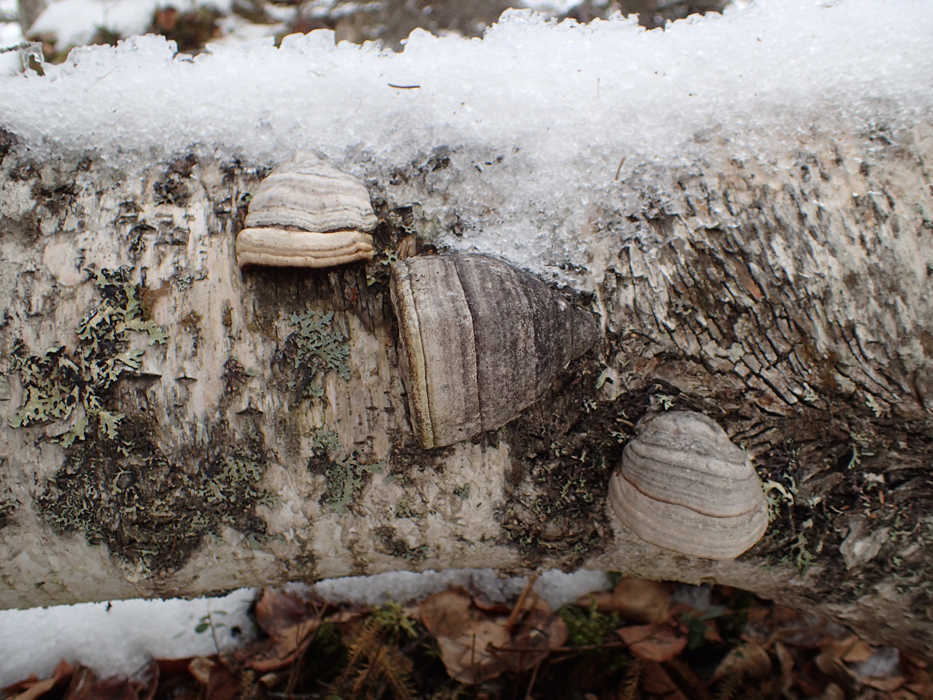
A conch of a fungus (Fomes fomentarius) on a birch log near Nordic Lake, Kenai National Wildlife Refuge, on Feb. 17. (Photo courtesy Matt Bowser, Kenai National Wildlife Refuge)

A conch of a fungus (Fomes fomentarius) on a birch log near Nordic Lake, Kenai National Wildlife Refuge, on Feb. 17. (Photo courtesy Matt Bowser, Kenai National Wildlife Refuge)

Refuge Notebook: Tinder fungus, the Ice Man and amadou

A couple of years ago I was given a remarkable, beautiful hat by my friend Dominique Collet. This cap is made of a soft, brown material with decorative, stamped trim of the same. Light and velvety, it is reminiscent of wool felt but finer and smoother. Dominique had traveled through Eastern Europe specifically to learn how these amadou caps were made from a kind of tree-killing fungus.

Known by several names including hoof fungus, tinder fungus, and the “true” tinder fungus, Fomes fomentarius grows on hardwoods, especially birch, around the world in northern latitudes. It is quite common here on the Kenai and anywhere else in Alaska where birch trees grow.

Ecologically, tinder fungus acts both as a pathogen, causing wood rot and contributing to the demise of living trees, and as a decomposer, continuing to break down dead wood in snags and logs. The fungus enters the tree through damaged bark or broken branches, then ramifies through wood and bark. Woody, durable conchs of the tinder fungus appear on the outside of the tree or log and grow larger each year as new layers are added to the underside of the conchs.

By removing, soaking, and pounding the inner, fibrous tissue of the conchs, a material called amadou can be made. This amadou is soft, extremely absorptive, and highly flammable. The abovementioned hat is one example of clothing made from this material.

Tinder fungus has been used by humans for its namesake purpose for thousands of years. An extraordinarily well-preserved, 5,000-year-old mummy from the Alps known as the Ice Man had on his person in a little pouch a store of carefully prepared tinder fungus as part of an impressive fire starting kit. Remnants of this fungus have been found in excavations of even older human habitations, where they are believed to have served as tinder and as a way to transport embers in hollowed-out, slowly smoldering conchs.

Amadou’s absorptiveness is superlative. Into the 1800s, this material was widely employed by doctors, dentists, and barbers in bandaging, where it earned the name “agaric of the surgeons.” To this day, patches of amadou are carried by fly fishermen to dry wetted flies.

Various cultures have taken tinder fungus medicinally as remedies for rheumatism, hemorrhoids, bladder infections, and pain relief. Derivatives of the fungus were imbibed, smoked, and even placed on the skin and ignited. Though some extracts of tinder fungus do show promise as medicinals, I have found no conclusive studies on its medicinal properties, so it would be wise to hold off on consuming tinder fungus until we know more about it.

Learning about the uses of Fomes fomentarius has changed my perspective on this species, moving it from its place in my mind as just another of many wood-rotting fungi to a useful, available resource. I have yet to try my hand at processing tinder fungus, but I think I will soon. I would like to be able to craft a hat similar to the unique amadou cap that was given to me. I might even wear it around, but, given the material’s properties, I will not be sporting any amadou clothing anywhere near a campfire!


Matt Bowser serves as Entomologist at the Kenai National Wildlife Refuge. You can find more information at http://www.fws.gov/refuge/kenai/ or http://www.facebook.com/kenainationalwildliferefuge.
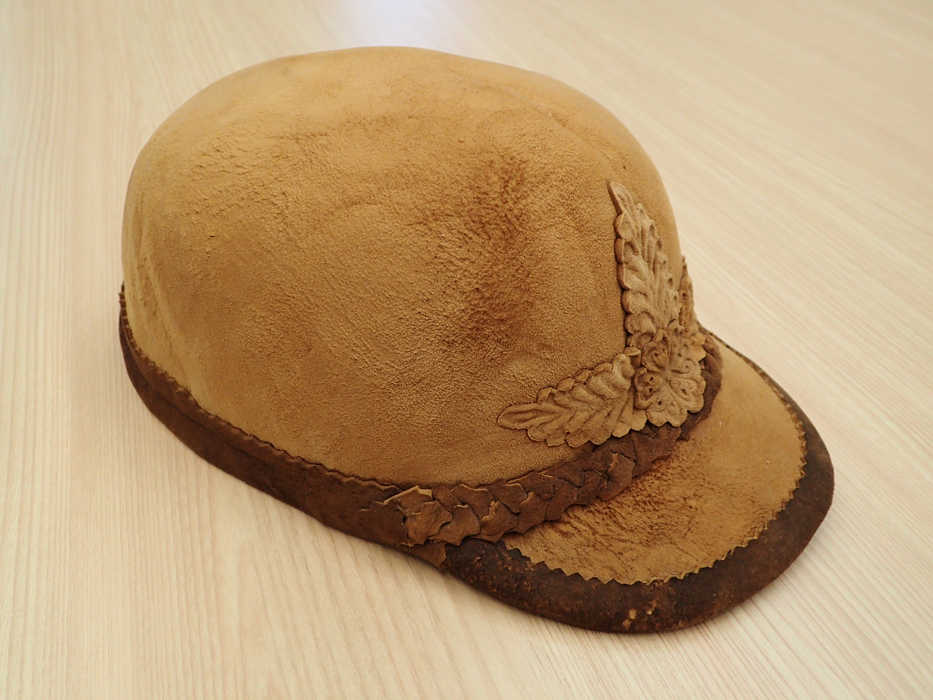
An amadou cap given to the author by Dominique Collet. (Photo courtesy Matt Bowser/Kenai National Wildlife Refuge)

An amadou cap given to the author by Dominique Collet. (Photo courtesy Matt Bowser/Kenai National Wildlife Refuge)

More in Life

Historic Elwell Lodge Guest Cabin is seen at its new spot near the Kenai National Wildlife Refuge’s Visitor Center. (USWS)
Around the peninsula

Local events and happenings coming soon.

Nián gāo is a traditional Lunar New Year treat enjoyed in China for over two thousand years. Photo by Tressa Dale/Peninsula Clarion
A Lunar New Year’s treat

This sweet, steamed rice cake is chewy, gooey and full of positivity.

This excerpt from a U.S. Geological Survey map shows the approximate location of Snug Harbor on lower Kenai Lake. It was in this area that William Weaver nearly drowned in 1910.
Ben Swesey: More to the story — Part 2

AUTHOR’S NOTE: Michigan’s hard-luck Swesey clan sprang into existence because of the… Continue reading

File
Minister’s Message: Rhythms and routines

Your habits are already forming you.

This dish is creamy, rich and comforting, and gets dinner time done fast. Photo by Tressa Dale/Peninsula Clarion
Full of mother’s love

This one-pot dish is creamy, rich and comforting, and can be ready in 30 minutes.

This screenshot from David Paulides’s “Missing 411” YouTube podcast shows the host beginning his talk about the disappearance of Ben Swesey and William Weaver.
Ben Swesey: More to the story — Part 1

More than a hundred years after Ben Swesey and Bill Weaver steered… Continue reading

Photo by Clark Fair
This 2025 image of the former grounds of the agricultural experiment station in Kenai contains no buildings left over from the Kenai Station days. The oldest building now, completed in the late 1930s, is the tallest structure in this photograph.
The experiment: Kenai becomes an agricultural test site — Part 8

Over the past 50 years or more, the City of Kenai has… Continue reading

File
Minister’s Message: So your life story can be better

Last month the Christmas story was displayed in nativity scenes, read about… Continue reading

These gyros make a super delicious and satisfying tofu dish. Photo by Tressa Dale/Peninsula Clarion
A new addition to the menu

Tofu gyros with homemade lentil wraps are so surprisingly satisfying and add extra fiber and protein to a meal.

Death notice: Marvin “Ted” Dale Smith

Marvin “Ted” Dale Smith passed on Dec. 27, 2025 in his home.… Continue reading

Photo courtesy of the 
Arness Family Collection
L. Keith McCullagh, pictured here aboard a ship in about 1915, was a U.S. Forest Service ranger charged with establishing a ranger station in Kenai, a task that led him to the agricultural experiment station there and into conflict with “Frenchy” Vian and his friends.
The experiment: Kenai becomes an agricultural test site — Part 7

AUTHOR’S NOTE: After the agricultural experiment station in Kenai closed May 1,… Continue reading

These treats are full of fiber and protein and contain less sugar than a Nutri-grain bar, so you can feel good about spoiling yourself a little. Photo by Tressa Dale/Peninsula Clarion
A treat for a new start

These cosmic brownies are a healthier, homemade version of the usual cafeteria currency.