
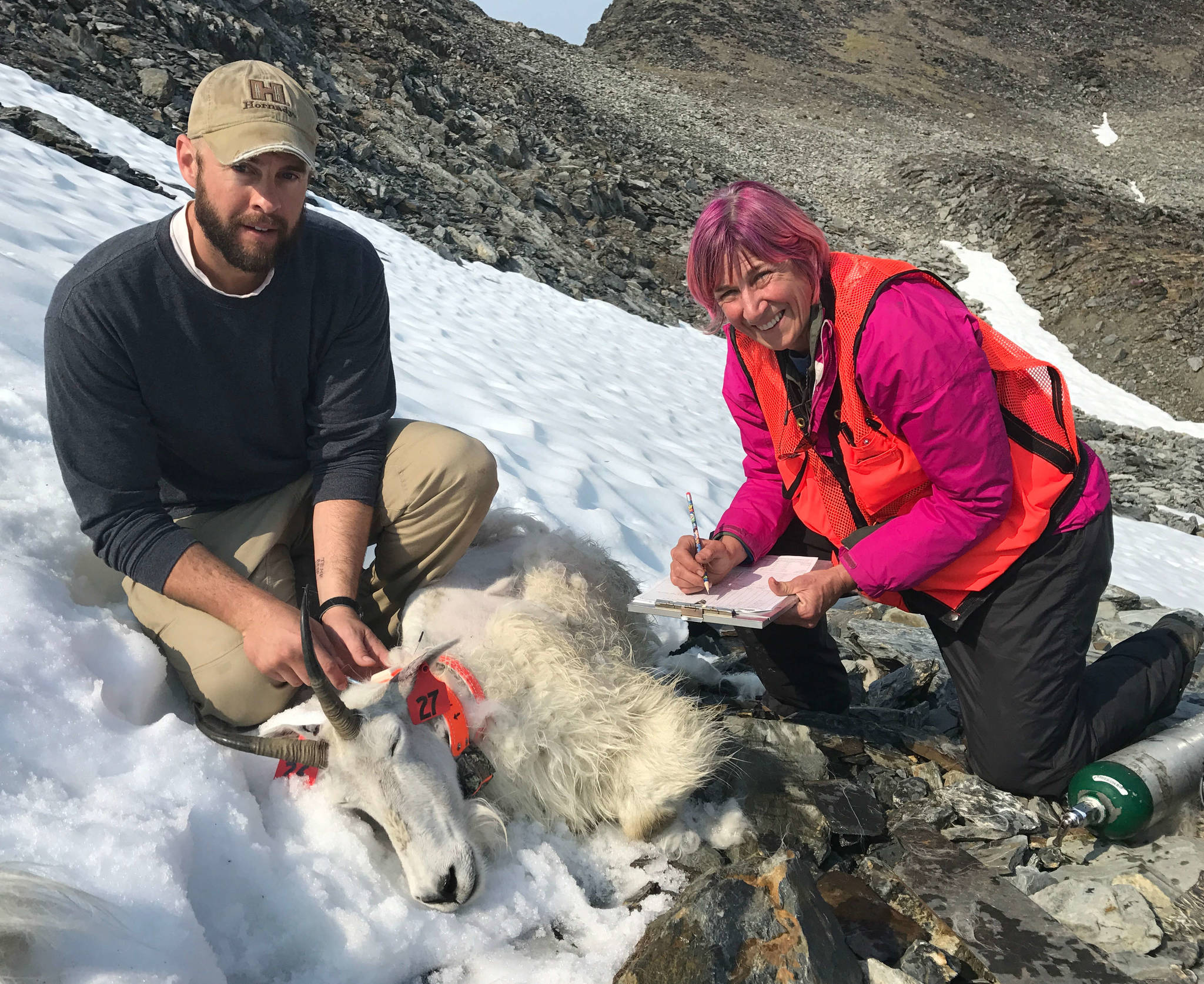
The dart was in and the helicopter veered off to give some time for the capture drugs to take effect. The 6-year-old male mountain goat, hereafter known as goat “071701,” bedded down in a great spot in the alpine tundra just over a minute later. We approached and got to work fitting him with a highly visible orange radio-collar and ear tags, and taking a variety of samples to collect information on diseases, parasites and genetics within the population. This capture marked the beginning of an intensive study of mountain goats throughout the Kenai Mountains.
At first glance, counting mountain goats from an airplane seems pretty straightforward. Just fly around in the mountains, count the obvious white blobs scattered throughout alpine meadows, and then tally them up at the end of the day, right? Well, as Philip Roth wrote in his book American Pastoral, “simple is never that simple.”
Wildlife surveys are deceptively complex and there are many aspects of wildlife surveys that are not apparent. In the case of mountain goat surveys, the biggest factor is simply missing animals for one reason or another, which ultimately boils down to “sightability,” or the probability of detecting or missing an animal during surveys.
With wildlife surveys, you’ll always miss a few and there will always be circumstances that result in missing some individuals on the landscape. Accordingly, surveys will almost never result in a complete census, or exact count, of the population and estimates will always be lower than the actual number of animals in the area. The key to interpreting estimates where some individuals have been missed is not only using a reliable and consistent survey method, but also having some way to account for missed individuals. Because these population estimates are the basis for management and conservation strategies, it is important for surveys to produce reliable information.
For mountain goats, which live in a diverse mixture of rocky slopes, cliffs, alpine meadows, alder thickets and even subalpine forests, the probability of observing an individual may vary with something as simple as what habitat the individual is standing in that day. A goat in an open alpine meadow is more likely to be seen than one bedded in the shade of alders or up in a tight rocky canyon with camouflaging snowfields. Larger groups are also more likely to be detected than smaller groups or individuals.
Temperature and light intensity can also influence sightability. On sunny days, goats are often more difficult to detect because they may be bedded in the shade of boulders or in dense brush and because the reflection of bright light on rocks can reduce their detectability. The list goes on — but the end result is that the seemingly simple task of counting goats is fraught with obstacles when trying to derive accurate estimates of population size.
In an effort to develop improved survey methods that take into account variation in sightability and missed individuals during surveys, the Kenai National Wildlife Refuge, Alaska Department of Fish and Game, National Park Service, Chugach National Forest, and Rocky Mountain Goat Alliance are working together to develop new methods for estimating mountain goat abundance.
The primary objective of our study is to develop a sightability-model using collared goats that provide a “marked” or known segment of the population and the numbers of marked individuals either observed or missed during surveys. We also collect additional information from these marked individuals during surveys such as habitat type, group size, climatic conditions, and other factors that can influence the probability of detecting or missing these individuals. These data are then used develop a sightability model that, ultimately, will provide more accurate estimates of mountain goat abundance and trends in the Kenai Mountains.
During July 2017, researchers from the Kenai Refuge and Fish and Game captured and fitted 16 mountain goats with radio-collars. Capture efforts went well, especially given the relatively low goat densities that occur in the interior mountains of the peninsula where initial efforts were concentrated. Collared goats were distributed throughout several key areas to ensure representation of different habitats throughout the Kenai Mountains. Future captures during 2018–2019 will increase the number of collared individuals to more than 30 and expand the project into new habitats.
We fitted these initial 16 goats with GPS collars that not only identify individuals during surveys, but also collect several locations per day and relay this information via satellites to provide real-time information on goat movements, survival, and habitat use. These collars are also equipped with a mechanism that remotely releases the collar as battery power wanes after several years of collecting intensive location data. Goats were also fitted with micro-VHF radio-collars that will allow us to continue monitoring their survival and reproduction, and continue collecting sightability data, long after the GPS collars have released. These and other data collected during this study will help to enable science-based management of goat populations on the Kenai Peninsula.
Dominique Watts is a wildlife biologist at Kenai National Wildlife Refuge. Find more information about the refuge at http://kenai.fws.gov or http://www.facebook.com/kenainationalwildliferefuge.
