
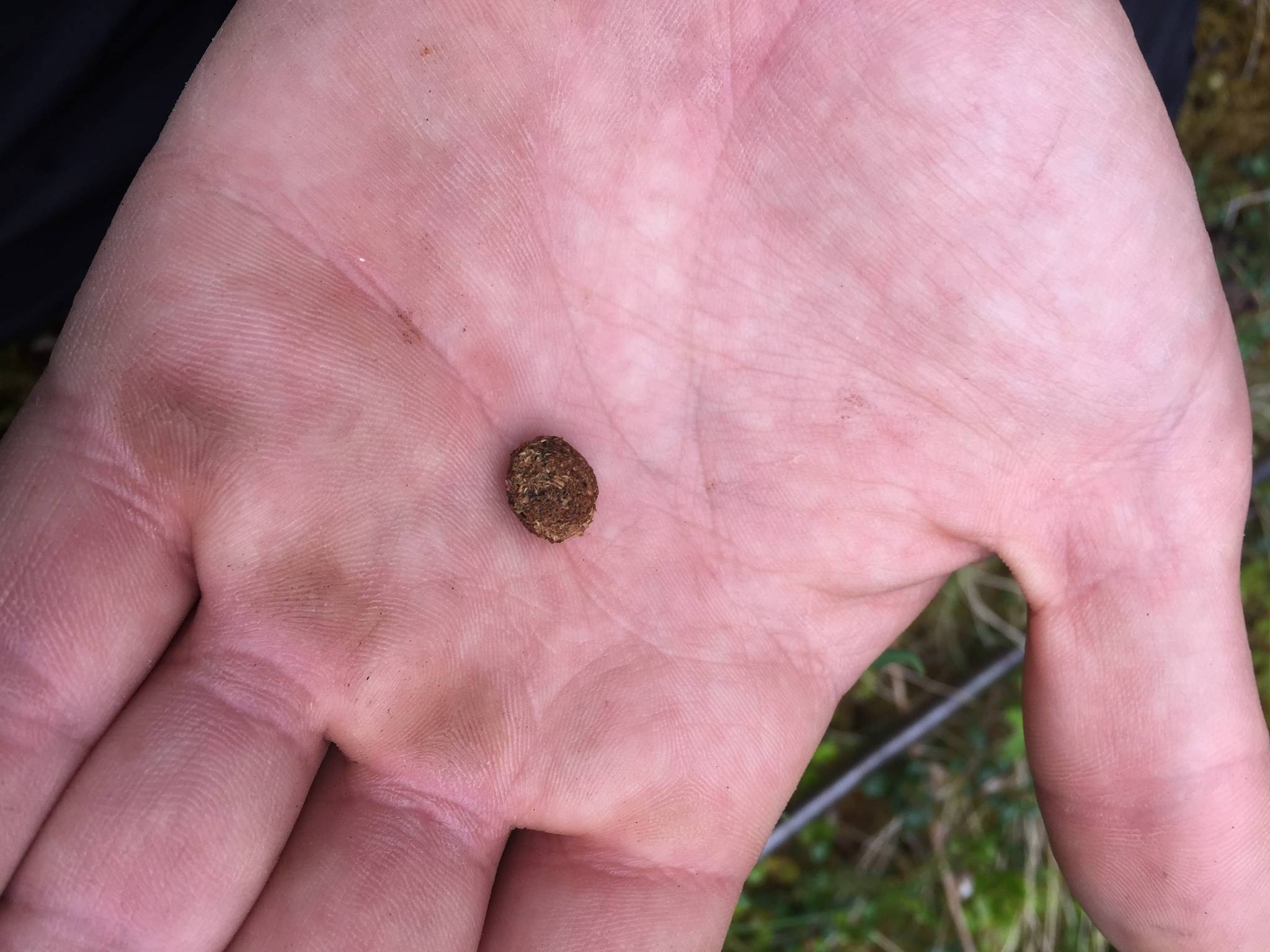
Few people are aware of a unique tradition that happens annually here at the Kenai National Wildlife Refuge. For the past thirty years only the luckiest of individuals have had the honor to take part in this important event and, this year, I was one of them. What is this tradition, you may ask? It is the annual counting of snowshoe hare pellets. That’s right, ever since 1983 the Refuge has been counting bunny poop!
In 1983, five grids were established on the Refuge to systematically count the pellets dropped by snowshoe hares. Each grid has 49 points that are spaced 200 feet apart. At each point, all pellets are counted within a square-meter metal frame that is placed on the ground. The pellets are thrown out of the sample frame as they’re counted so, when we return next year, only the pellets accumulated during the year will be tallied.
The locations of these five grids were originally chosen to be in optimal snowshoe hare habitat. Much like moose, hares prefer early successional forests that regenerate in the first couple of years after a disturbance. Large wildfires in 1947 and 1969 provided Refuge biologists with several prime locations to survey for hares in 1983. After a half century, however, forests in some of these grids have matured past ideal hare habitat. So, in 2015, we added two more grids in areas that recently burned.
Now to most people this may sound like grunt work interns are made to do, but the data we gather is actually really important. The pellet counts give us a clear image of snowshoe hare population abundance, which helps provide the demographic context for numerous other wildlife populations in our boreal ecosystem.
Snowshoe hare populations go through a predictable boom and bust cycle. Depending on where the populations are in that cycle clues biologists into many other things such as predator populations. Hares on the Kenai Refuge are prey for a large assortment of predators, most notably lynx, great-horned owl, and northern goshawk. Throughout Alaska and northern Canada coyote, golden eagle, red-tailed hawk, northern hawk owl, northern harrier, wolf, wolverine, red fox, pine marten, weasel, mink, and even squirrels, prey on snowshoe hares. The smaller predators can only prey on leverets, or young hares.
Most mammalian predators, like the lynx, follow the same boom and bust cycle as the hares but lag behind by a year or two. When the hare population begins to climb, more prey is available for the lynx. A year or two later the lynx population explodes in response to the abundant food supply. After hare populations crash and lynx no longer have enough food to support their population, they crash as well. The hares then have time to rebuild their populations and the cycle repeats itself.
This predator-prey relationship is certainly a major factor in the snowshoe hare population cycle, but it is not the only driving force. As populations increase there are more social stresses on the hares due to crowding and competition. Stress lowers snowshoe hare reproductive and survival rates. In the years of a population increase when predator pressures are still low, the average litter sizes decrease from 17 to 15 the first year and from 15 to 8 the second year.
Survival rates for both male and female hares also decrease during these first years of a boom. After the first two years of an ascending cycle, predator populations begin to increase and the combination of stress and predation and food depletion likely causes the hare population to crash. Studies have found that stressed females who survive till after the crash continue to have small litter sizes which may be one reason it takes five to six years for hares to re-establish themselves.
Based on the data we have collected since 1983, the hare population cycle on the Kenai Peninsula is 12 to 14 years. Most of the populations in northern Canada cycle in 10 years. The Refuge hare populations crashed in 2014, but recent sightings of hares dashing across roads suggest that hare populations are once again on the rise. When pellet counts are completed for this year we expect to see this hypothesis confirmed.
Next time you’re out hiking on the Kenai Refuge, take a minute to squat by a tree and look for a round little turd, a sign that snowshoe hares were there before you.
Kyra Clark is a seasonal biological technician at Kenai National Wildlife Refuge. Find more information about the Refuge athttp://www.fws.gov/refuge/kenai/ or http://www.facebook.com/kenainationalwildliferefuge.
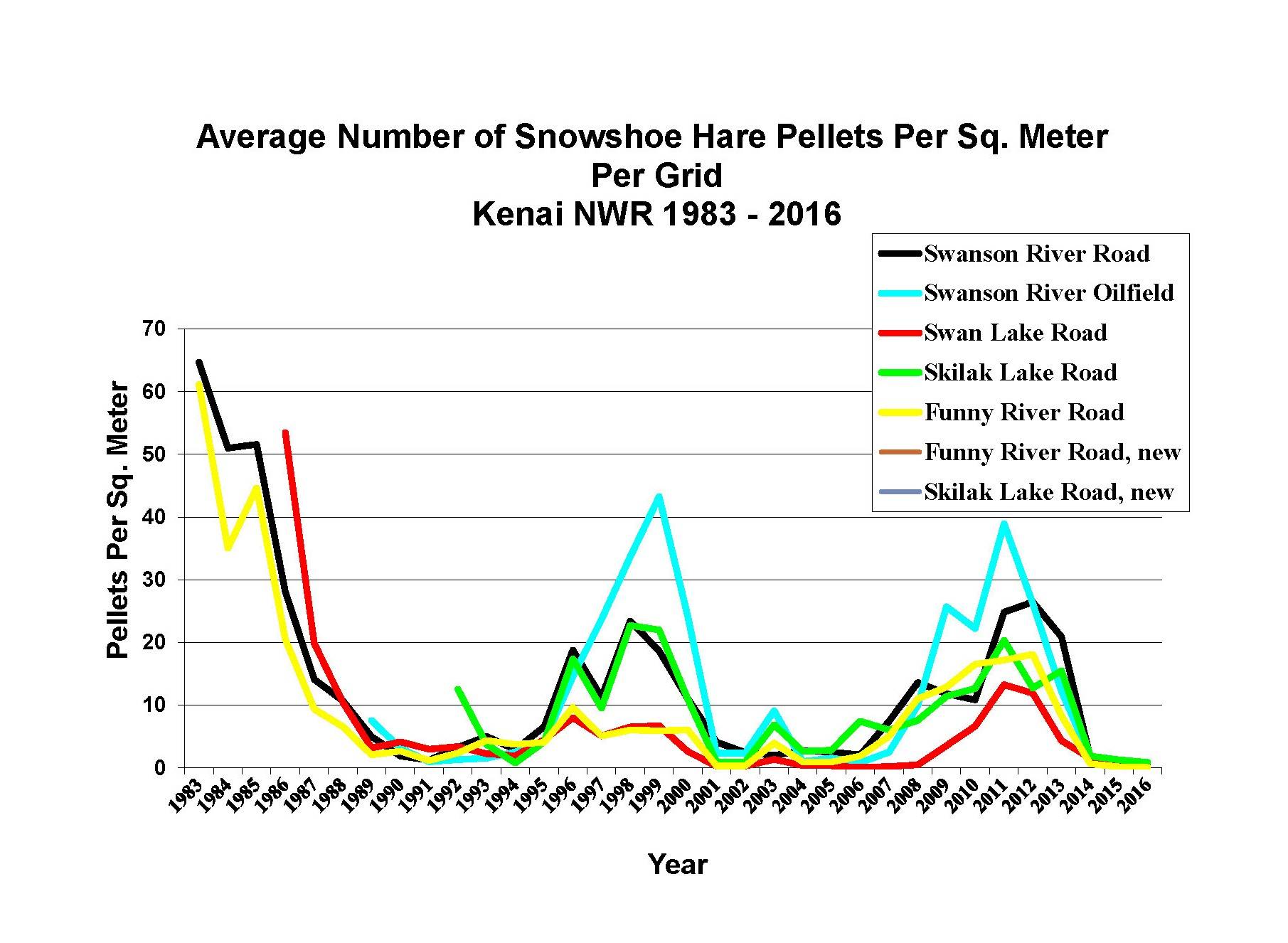
Standardized pellet counts indicate where local snowshoe hare populations are in their 12—14 year cycle. (Kenai National Wildlife Refuge graphic)
