
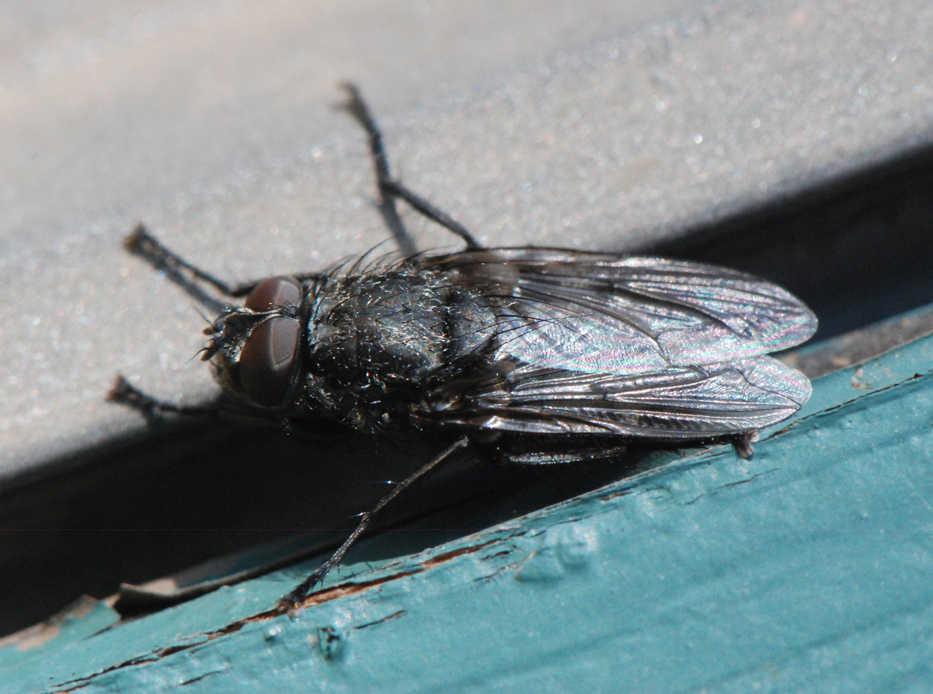
Last February through March as our snow melted away, some of early spring’s most precocious invertebrates pranced in the sunshine, warming themselves on south-facing wood siding of the Kenai National Wildlife Refuge’s headquarters building. Intermingling among the usual metallic green and blue flesh flies that typically awake in the early spring were many large, dark flies having a golden wooliness. These were cluster flies (genus Pollenia), a kind of fly that had not previously been found in Alaska (article: http://bit.ly/1Q1iPyA).
Worldwide, there are 196 species of cluster flies according to the Catalogue of Life, all of them native to the Old World. Six of these have now become established in North America. Our cluster flies turned out to be Pollenia vagabunda, which means the wandering or vagabond Pollenia, so perhaps the “vagabond cluster fly” would be a good common name for it. Since the first North American record of this species on the East Coast in 1958, it has spread west to British Columbia and now Southcentral Alaska.
Cluster flies get their name from their habit of gathering in dense aggregations in and on man-made structures from late fall to early spring, where they can be a serious nuisance simply because there are so many of them. Pest control techs can do a brisk business in response to sometimes remarkable numbers of flies reminiscent of the Biblical plagues. Now you can even buy Cluster Buster™ traps specifically designed to trap and kill these flies.
Thankfully, cluster flies really are no more than a nuisance to humans. They apparently end up in and on buildings only when seeking a cozy spot to spend the winter or when gathering at a sunny perch to warm up and meet potential mates on a nice spring day. The rest of the life of a cluster fly is more interesting and mysterious, blurring the line between parasite and predator.
We only know the life of one cluster fly well. Females of Pollenia rudis, after mating in the spring, lay their eggs on the soil surface. Soon the eggs hatch and the tiny maggots dive down into the soil. Weak burrowers, they must exploit pre-existing passages in the soil as they hunt down their quarry: a particular kind of earthworm. A successful larva will burrow into the unfortunate worm’s side, then slowly eat the living host from the inside out. If its host worm dies before it is done eating, the now larger maggot behaves more like a predator than a parasite, resuming its search for a new worm to consume. Once sated, the cluster fly larva pupates in the soil, later emerging as a new adult fly.
Other species of cluster flies attack earthworms and snails, and there is evidence that some cluster flies may go after certain insect larvae in the soil. For most cluster flies, including the vagabond cluster fly that now lives with us here, we do not know who they are hunting.
It could be that our cluster flies eat earthworms. If this is true, then we would now have an exotic fly feeding on exotic worms, a completely imported parasite-host or predator-prey system! Worms infected by cluster fly larvae are quite conspicuous, so I checked worm specimens in the Refuge’s collection and freshly-caught earthworms from around the headquarters building. I found no cluster fly larvae.
Perhaps I did not check enough worms or maybe our cluster flies eat snails, slugs, insects, or something else. As a new and at least locally abundant member of our fauna on the Kenai, cluster flies certainly affect something out there, but figuring this out could be a real challenge. Have you ever tried to follow a fly to learn its secret life?
There is a new, high-tech method designed specifically to solve this genre of mysteries. Termed MAPL (molecular analysis of parasitoid linkages), the technique relies on small amounts of host DNA from food eaten as a larva lingering in the digestive tract of the adult insect. By selectively targeting and sequencing DNA from the host, researchers have been able to find previously unknown host-parasite and predator-prey relationships.
However it is done, I would very much like to learn the enigmatic details of the life of the vagabond cluster fly. This would be relevant not just here on the Kenai, but also in much of Canada, the northern tier of the Lower 48, and northern Europe, where Pollenia vagabunda is an abundant and seasonally annoying nuisance.
Matt Bowser serves as Entomologist at the Kenai National Wildlife Refuge. You can find more information at http://www.fws.gov/refuge/kenai/ or http://www.facebook.com/kenainationalwildliferefuge.
