
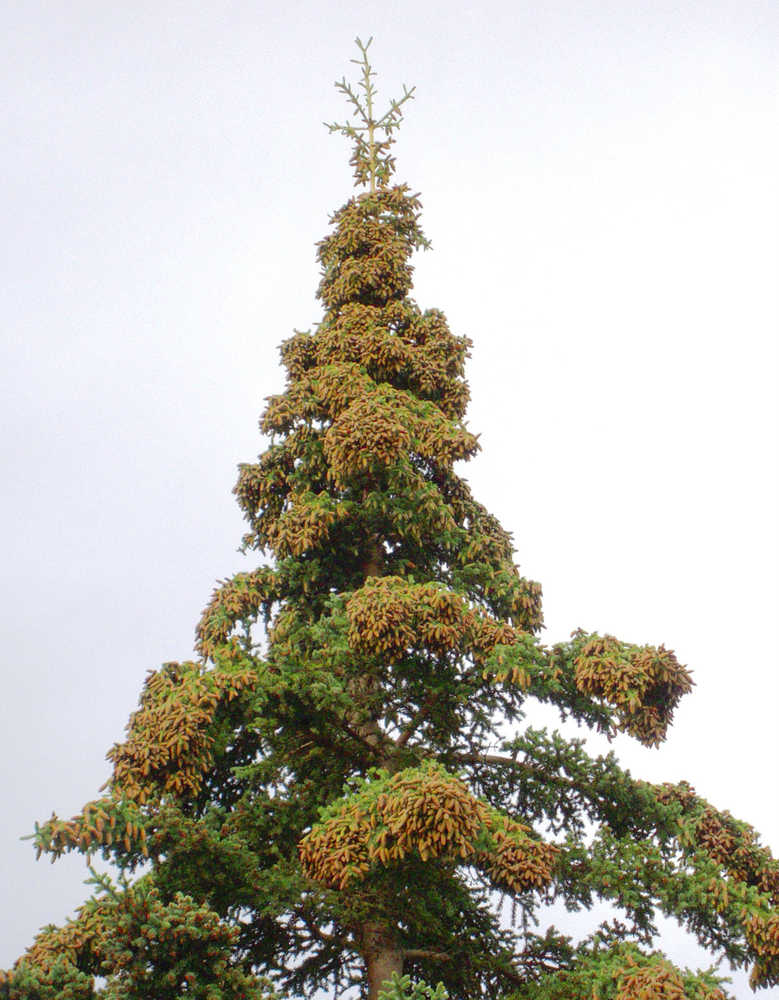
Peer out the window or take a walk around the neighborhood asking yourself if the spruce trees bear an unusually large load of cones this summer. I do not know of anyone who keeps track of spruce cone crops locally, but this appears to be a mast year.
When a population of trees produces a larger than average seed crop, this is termed a mast year or masting event. Many tree species — including our white, black, and Sitka spruces — yield variable crops of seeds from year to year. This variability in seed production has very real consequences for seed-eating animals, a population effect that can cascade through the food chain and affect their predators.
What I find most striking is how coordinated the present masting event is across the Kenai Peninsula and perhaps further on to the mainland. Spruce trees across the Kenai National Wildlife Refuge from Kasilof to the Kenai Mountains bear especially heavy loads of cones right now. I also obtained reports of heavy cone loads in Interior Alaska and the Yukon this summer. In fact, masting events can extend over the spatial scale of subcontinents, with seed production in phase across 1,500 miles! Multiple tree species can be in synch including paper birch and other conifers like mountain hemlock.
It turns out that year-to-year climate variation synchronizes cone production cycles in white spruce, at least in part. We see the largest cone crops following optimal conditions: a cool growing season two years before a cone crop, allowing trees to grow and build reserves; a hot spring in the year preceding a cone crop, stimulating trees to initiate cone development; and cool growing conditions the year of a cone crop, enabling maximum development of the cones. The trees’ reserves are exhausted during a masting event, resulting in very few cones the following year. The cycle repeats every two to six years.
Our trees are responding to temperatures over the last several summers: cool growing seasons from 2010 to 2012, then a warm summer in 2013, leading to a mast crop this year (see graph). We should see meager cone production next year.
Similar to predator satiation strategies of pink salmon and periodical cicadas, spruce tree’s synchrony of masting is advantageous to the trees by overwhelming seed predators. During a boom year, so many seeds are produced that seed predators can only eat a small portion of seeds, increasing the chances of survival for each seed. Population sizes of seed predators are then limited by the intervening years of low seed production.
Red squirrels, our most important seed predators of spruce, depend on spruce seeds for roughly half of their diet. They mitigate the trees’ predator satiation strategy by doing what squirrels are famous for: hoarding. The tiny squirrels can only eat so much before the seeds are dropped and have little capacity for fat reserves, but each squirrel can store away about 9,000 cones in a good year.
Even so, the trees’ cone production in mast years (500-1,000 cones per tree) vastly outstrips the squirrels’ abilities to hoard them, so most seeds escape the squirrels. During years of low cone production, red squirrels switch to hoarding more mushrooms.
White-winged crossbills, specialists on conifer seeds, consume up to 3,000 seeds per bird per day. They deal with cyclical cone production by wandering great distances in search of good cone crops. I have heard that this is a good year for seeing white-winged crossbills on the Kenai. Expect many fewer next year, when cone production should be quite low.
Spruce cone maggots can be major pests of spruce cones, causing up to 100 percent loss of spruce seed crops. Adult flies emerge in the spring. Females lay eggs on scales near the bases of young cones. The larvae bore into the cone, mining out a spiral around the cone axis, destroying scales and seeds. Mature maggots emerge, drop to the soil, and pupate there.
These flies employ a different strategy to deal with the ups and downs of spruce cone production. Some of the pupae emerge their first spring, while others wait in the soil for an additional year, spreading out their risk of emerging during a crop failure.
Populations of red squirrels, crossbills, and cone maggots do respond to the spruce mast cycle, increasing with mast years and declining between masting events. Their predators (lynx, coyotes, marten, and sharp-shinned hawks, for example) are affected by this cycling of their prey, but none rely solely on red squirrels or crossbills for food, dampening the effects of the spruce mast cycle as they ripple up the food chain.
While landscape change agents including introductions of exotic species, urbanization, and climate change are expected to alter where white spruce and other tree species occur on the Kenai Peninsula, the cycle of mast seeding should persist. Local year-to-year temperatures vary together over the scale of the Peninsula, providing synchronizing cues to the trees. This means that squirrels and other seed eaters will be dealing with alternating and synchronized feasts and famines of the spruce mast cycle for the foreseeable future.
Matt Bowser serves as Entomologist at the Kenai National Wildlife Refuge. You can find more information at http://kenai.fws.gov or http://www.facebook.com/kenainationalwildliferefuge.
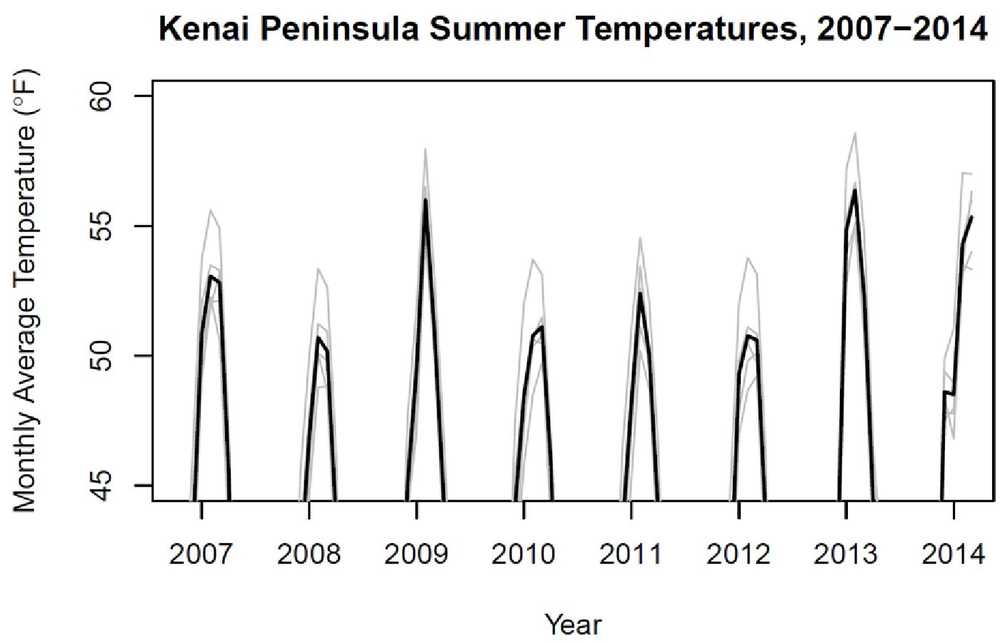
Western Kenai Peninsula monthly average summer temperatures from the following USDA NRCS SNOTEL sites: Summit Creek, Cooper Lake, Swanson River Road, McNeil Canyon, and Anchor River Divide. Grey lines represent individual stations and the bold black line represents monthly averages over all sites.
