
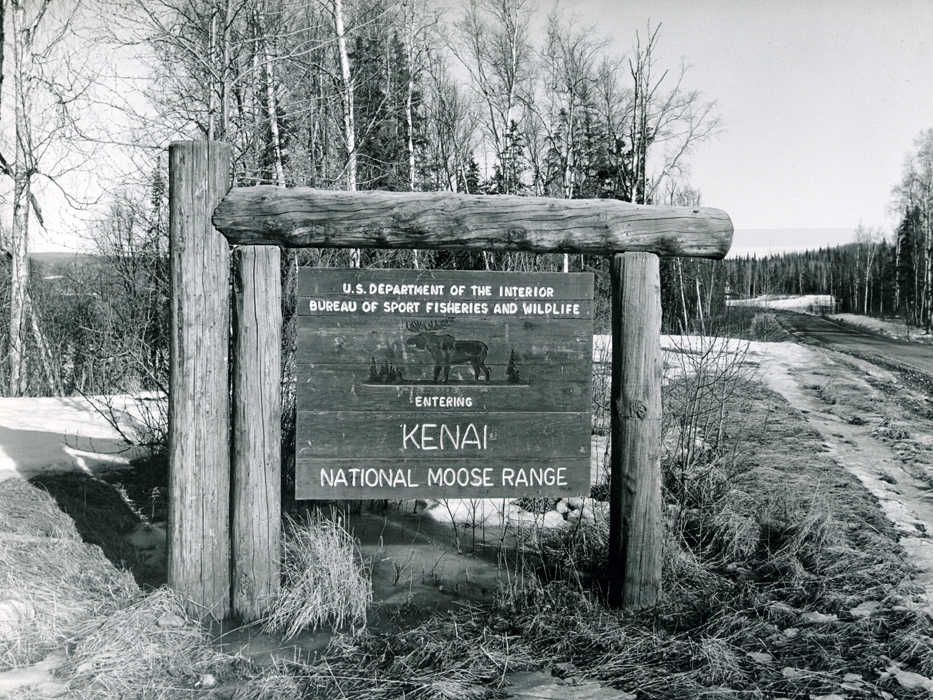
On December 16, 1941, President Franklin D. Roosevelt issued Executive Order 8979 establishing the Kenai National Moose Range. The eve of its 75th anniversary presents an ideal moment to reflect on the history of the Moose Range, later to become the Kenai National Wildlife Refuge.
At the time of Russian settlement in late 1700s, the Kenai Peninsula’s rich fish and wildlife resources had long been known and revered by its first inhabitants. For millennia, Dena’ina people had made the Kenai Peninsula their home, as did Alutiiqs in the south and Chugaches in the east. The Dena’ina knew the Kenai as Yaghanen — the “good land” — and their lives were intimately intertwined with the seasonal abundance of salmon, wildlife and berries.
One hundred years later, word had spread beyond Alaska about the natural wonders of the Kenai. Dall DeWeese visited from Colorado in 1897 to hunt big game, acquiring the guiding services of Andrew Berg, the Kenai Peninsula’s first big game guide. As is the case in many wildlife conservation stories over the last century, hunters played a pivotal role here. DeWeese wrote several articles and sent letters to government officials about what he found, creating an interest in Alaskan big game. It wasn’t long before the Kenai became famous for its large moose and abundance of “white sheep,” nor was it long before DeWeese and others began to warn of depletion of game populations due to overharvest.
Gifford Pinchot, who would later become the first chief of the U.S. Forest Service, commissioned William Langille in 1903 to investigate forest resources in Southcentral Alaska. Langille explored the Kenai in 1904 and followed up his expedition with a report entitled “The Proposed Forest Reserve on the Kenai Peninsula.” He acknowledged the need for wildlife and habitat protection in the area, noting: “The forest cover in its primal state is also very essential to the prolonged existence of the living game, which represents the best types of its kind and if cared for, will be a source of revenue to the inhabitants and pleasure to the world for many years to come … and in consideration of this and the other circumstances mentioned I have the honor to recommend the creation of the Kenai Forest Reserve.” Langille’s expedition helped set the stage for establishment of the Chugach National Forest by President Teddy Roosevelt in 1907 and its expansion in 1909 to include most of the current Refuge.
In the ensuing years, interest in settling the Kenai Peninsula and increasing demand for its spectacular wildlife resources created conservation concerns. The last caribou on the Kenai was killed circa 1915, and wolves were extirpated through an extensive poisoning and shooting campaign around the same time. Moose populations were declining. In 1931, the Alaska Game Commission recommended establishing a moose sanctuary, by executive proclamation, on the Kenai. Many in the community helped sound the alarm — among those was big game guide Andy Simons who advocated for more protection to conserve game populations.
Ten years later, bolstered by strong advocacy from the U.S. Fish and Wildlife Service’s first Director Ira Gabrielson, F.D.R. established the Kenai National Moose Range “… for the purpose of protecting the natural breeding and feeding range of the giant Kenai moose on the Kenai Peninsula, Alaska.” It is a wonder that President Roosevelt had the vision and sense of purpose to establish a conservation area in distant Alaska at a time when his attention must have been so focused on the attack on Pearl Harbor only nine days earlier and on events in Europe.
In 1948, World War II veteran and pilot Dave Spencer arrived on the Kenai to assume his duties as the Moose Range’s first Refuge Manager. Within two years, he developed an extensive research program that set a very high bar, and that in many aspects continues even today. His aviation legacy was the first in a long line of Refuge pilots that have contributed significantly to wildlife and resource protection and scientific discovery over the ensuing seven decades. Early work included studying vegetation and wildlife response to a large wildfire, started by a road construction crew the year before Mr. Spencer’s arrival. The 1947 burn consumed over 300,000 acres of spruce forest mostly north of Skilak Lake and the Kenai River, creating favorable habitat to which the moose population responded dramatically.
While modern wildlife management and scientific research were being introduced to the Moose Range, demand for oil exploration and development, and pressure to remove areas of the Range to allow for settlement, would result in large-scale changes. Oil discovery in the Swanson River area in 1957 created an economic boon but also brought industrial development and new roads to the relatively pristine Moose Range. Mr. Spencer and his successors, John Hakala and Will Troyer, worked to protect remaining areas, seeking innovative ways to conserve the Moose Range’s wildlife and wildlands. One approach was the designation of an 806,000-acre Research Natural Area in its eastern portion, to be managed so as to allow natural ecological processes to function and to protect wildlife that depended on large and undisturbed tracts of land.
Industrial development within the Moose Range also had the indirect effect of helping to usher in an era of increased outdoor recreational access and activities. The establishment of a dedicated canoe route took advantage of this new access and helped generate great interest in new outdoor recreational opportunities on the Kenai. The now nationally-designated Swanson River and Swan Lake Canoe Trail System became a cornerstone of wilderness-type recreation in Southcentral Alaska.
Twenty years after its establishment in 1941, agency management activities, the reappearance of a large predator, and another major wildfire would greatly influence wildlife populations on the Kenai National Moose Range. In the 1960s, the Alaska Department of Fish & Game and the Refuge cooperatively translocated caribou from the Nelchina herd, beginning the reintroduction of a species absent from the Kenai since the early 1900s. Coincidentally, wolves re-established themselves on the Kenai by the mid-1970s, after a nearly 50-year absence. In 1969, the Swanson River wildfire burned 86,000 acres, to which the moose population again responded, reaching some of its highest densities in the ensuing 25 years. This period also marked the initiation of active habitat management on the Moose Range with the use of giant LeTourneau tree crushers and, later, prescribed fire.
In 1979, the Refuge headquarters moved from Kenai, where the original Quonset building which served as the Moose Range’s first office in 1948 still stood, to its current location south of Soldotna. The new facilities included a Visitor Center to serve residents and tourists.
Andy Loranger is Refuge Manager of the Kenai National Wildlife Refuge. Part II of this article will appear next week and will explore the Refuge’s more recent history. The public is cordially invited to help celebrate the Refuge’s 75th anniversary on Dec. 16 from 5-7 p.m. at the new Refuge Visitor Center on Ski Hill Road in Soldotna. For more information, please call 907-262-7021.
