
Remember Beer Nuts? Those sweet and salty peanuts with a crunchy outer shell used to be a staple of football parties and baseball games. Plus, who can forget that great name? Just having a bag of Beer Nuts on a road trip or at the office could bring you instant friends.
I first discovered them on a summer vacation at my cousin’s cabin, as us younger kids dared each other to try those small, flavorful morsels. Beer Nuts may be the perfect snack food: tasty, crunchy, and full of protein. The only problem is that they are getting harder to find. They are no longer within easy reach at the local gas station counter or grocery store. Very few stores carry them and last time I tried to buy some, I had to walk really far, searching the aisles for that trademark red and white label of happiness. That’s when I realized my favorite high-protein snack was disappearing.
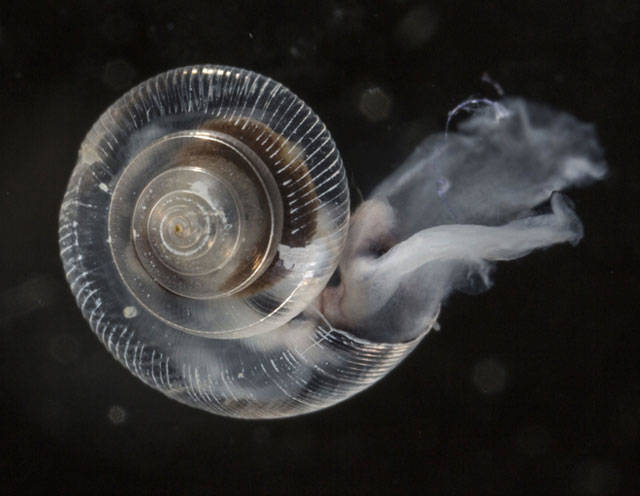
The same thing is happening to our wild Alaska salmon out in the ocean. One of their favorite foods, the pteropod, is disappearing. They used to be an abundant food source, a tiny little snail eaten as a tasty treat. Pteropods are small, salty, and full of protein with a crunchy outer shell … sound familiar? Salmon eat a lot of them, making up about 60 percent of a pink salmon’s diet in the ocean.
Like Beer Nuts, pteropods are getting scarcer. As they disappear, our salmon have to search harder for other foods, some of which have less protein so our salmon have trouble reaching their full growth potential. Taking pteropods away from our salmon is like replacing my Beer Nuts with fat-free unsalted pretzels. It’s just not the same.
Studies show that pteropods are having trouble forming their shells due to changes in our atmosphere. Since the industrial revolution, humans have extracted carbon from deep in the earth in the form of coal and fossil fuels. As these fuels are burned for energy to power our cars, factories, airplanes, and power plants, they release carbon dioxide into the air. About 30 percent of that carbon returns to our oceans where carbon dioxide dissolves in the sea water, releasing hydrogen ions which then form carbonic acid.
Today our oceans are 30 percent more acidic than they were a hundred years ago. This is called ocean acidification — the sister companion of climate change. Although some people don’t accept that the climate is changing, ocean acidification is a very real and dangerous problem. There are many ways acidification affects us, especially Alaskans, even if you do not live near the ocean. The increasing acidification makes it difficult for some shellfish and corals to complete their shells. Some species may continue to slowly form their shell, but will ultimately not survive to become adults because they’ve used up all their energy.
Why should you care? Pteropods are the bottom link in the ocean’s food chain that includes our salmon. Less food for salmon means less salmon for us. Loss of pteropods affects salmon runs, commercial fisheries, the Alaska seafood industry, sport fishing, tourism and restaurants.
For many Alaskans, the loss of salmon is also the loss of our salmon culture. Salmon is part of our economy and our family life. The quest for salmon brings us together on beaches, in boats, at fish camps, while tending smoke houses, and at the dinner table. Wild Alaskan salmon are part of our local identity. It’s not just about us either — across the globe, one in seven persons gets most of their protein from fish and seafood. The ocean food chain affects all of us from our own food abundance to our local jobs and our state’s economy.
There is good news, however. We can take steps to reduce our carbon emissions by reducing energy and using less fossil fuel. The amount of carbon dioxide produced by each person is called our “carbon footprint.” There are websites with carbon footprint calculators that show the difference made by each person as we choose to walk or ride a bike or drive our truck or carpool with friends to save energy (and pteropods!). Making choices to reduce the energy we use, reusing items instead of purchasing new ones to cut down on packaging and consumer waste, and recycling when possible are all ways to minimize our carbon footprint.
Remember, the pteropods are the Beer Nuts of the ocean – they are a crunchy protein food source that is disappearing and difficult to replace. Choices we make every day can slow the process of ocean acidification so the pteropods can feed our salmon and our salmon can grow healthy and return to Alaska’s rivers and people.
Brenda Trefon is the Environmental Program Coordinator for the Kenaitze Indian Tribe. Find more information about the Kenai National Wildlife Refuge at http://www.fws.gov/refuge/kenai/ or http://www.facebook.com/kenainationalwildliferefuge.
