
As much as we hate to admit it, winter is approaching. For some of us winter means snow dances, aurora photos, and ski waxing clinics. For others it is the season when it’s safe to break out the bird feeders and stare out the window in hopes that some energetic songbird will find our black oiled sunflower seeds palatable.
For years I have enjoyed watching the normal array of chickadees, nuthatches and redpolls grace the bushes surrounding my little “store bought” feeder packed to the gills with seeds. I was always jealous of other folks who showed me wonderful pictures of the Pine Grosbeaks that lit up their yard in the winter with their brilliant red and green hues. I always assumed it was because I didn’t have enough hardwoods or I wasn’t close enough to the river. Turns out it was my feeder, and not the food or location, that these large finches were not impressed with.
Years ago I started banding Pine Grosbeaks at a house on Funny River Road. There were reports of 8 or 10 grosbeaks frequenting a feeder. So I set up a mist net and started banding. In two weeks, I had banded 119 at that location and I became the No. 2 bander of Pine Grosbeaks in North America that year. I was only a handful of birds behind the top dog from Alberta, Canada. Who knew that little house with the hanging platform feeder could attract that many grosbeaks?
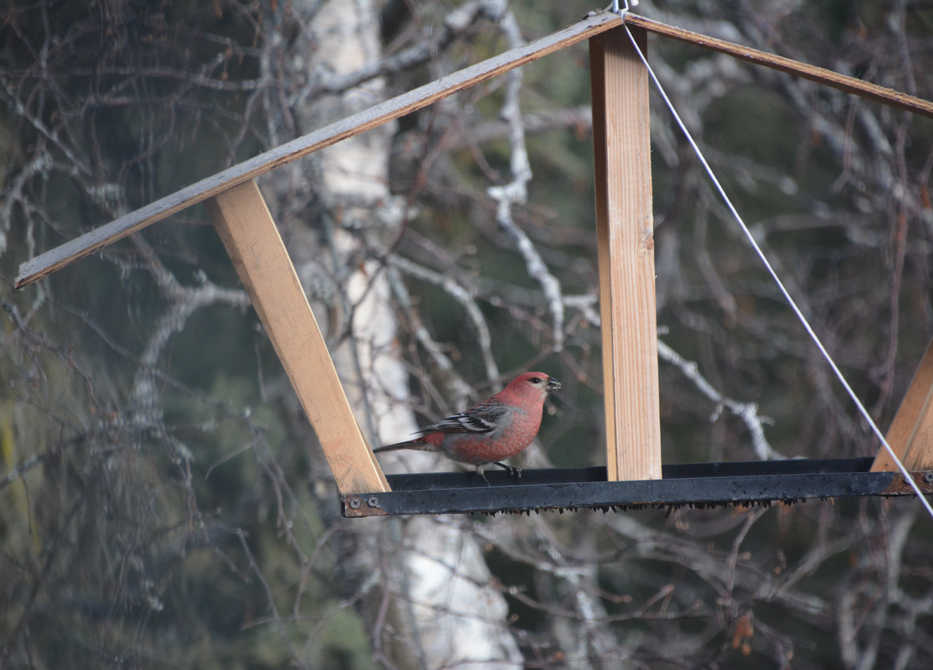
Fast forward 20 years when I decided to match the setup I had seen at the Funny River house. It only took me about an hour to build the new feeder and rig up the system so it was viewable from the kitchen window. A growing red squirrel problem was the instigator for my new project, but in the back of my mind I wondered if I might coax some pine grosbeaks to my buffet. Five days after erecting my new feeder I had a pair of Pine Grosbeaks sitting there plain as day. Coincidence? Possibly, but I really do attribute it to a preference for platform style feeders where the threat of squirrels jumping on them is negligible. They also can see other avian predators like Merlins and Sharp-shinned Hawks coming from a distance.
The setup is simple. Make a small wooden frame (12-by-18 inches) and staple a fine mesh across to dump the seeds onto. The mesh helps keep the seeds dry and reduces cleaning requirements. Build an angled roof over it that is substantial enough to allow the feeder to be hung from the peak. Make sure there is a good gap of 10 to 12 inches between the platform and the lowest point of the roof.
I secured a cable between my deck and a tree about 25 feet from the house. I use a pulley system to pull the platform feeder back to the deck to be restocked and then return so it is 10 to 12 feet from the closest branch on the tree. This keeps the squirrels from jumping to it and it is about 10 feet off the ground so moose can’t raid it either during tough winters. Remember to account for any snowfall that may give the moose an ability to reach and then add an extra foot or two in case this turns out to be a year with deep snow (seems unlikely).
Almost from the day I put up the new feeder I have had grosbeaks, several species of woodpeckers, and even some White-winged Crossbills dining. These were species I had seen in the yard for the past 3 years, but they had never even taken a look at the multiple other styles of feeders I had out. To test it even further, I temporarily replaced my new feeder with the old style feeder on the pulley system for a few weeks. It was like a switch had gone off and all my new birds once again decided to ignore the large quantities of the same sunflower seeds right there at their beak tips.
If you are lucky enough to draw in some grosbeaks, spend some time watching them. They have these massive seed crushing beaks which are ideal for cracking open sunflower seeds. The will just stand there at the feeder, pick up a seed, nibble for a few seconds until the empty shells drop away and swallow the contents. You can easily separate the adults as the males are a bright red color and the females have an olive head and rump and the rest of the body is grey. Younger birds are harder to separate, but you will notice some of the birds have a flame orange head and rump which will eventually turn all red by age 2.
No promises that this feeder type will produce grosbeaks for you, but it will certainly improve your chances.
Todd Eskelin is a Wildlife Biologist at the Kenai National Wildlife Refuge. He specializes in birds and has conducted research on songbirds in many areas of the state. Find more information at www.fws.gov/refuge/kenai/ or www.facebook.com/kenainationalwildliferefuge.
