
There is a subtle little path leading into the woods off of a quiet dirt road deep in the Kenai National Wildlife Refuge. It whispers now, as the little plants perk back up, and will soon stop telling the story of a busy week with 50 boot-clad feet travelling back and forth between the gravel and a little forest clearing. It’s not hard to see how game trails are created when looking at this little path, with each traveler following in a neat line. But it wasn’t a train of bears or moose who passed by here. It was a happy group of campers, led by an experienced team of counselors and scientists, who travelled to and from the clearing last week.
The Kenaitze Indian Tribe’s Susten Archaeology Camp has been going strong on the Kenai National Wildlife Refuge for over 20 years, connecting Alaska Native youth to their cultural heritage through studying the landscape, discovering subtle depressions in the ground and excavating these cache pits (called “ełnen t’uh” in Dena’ina) with the oversight of the group’s archaeologist, Debbie Corbett, who retired from the U.S. Fish and Wildlife Service a few years ago. This year’s study site was discovered by last year’s campers, and some of the same kids were back for a second year to dig into what they had found together.
What is there to find in these pits? It’s a glimpse into the past just like all archeological projects, but on a more subtle level. Only rarely are human tools or other man-made materials found in the caches. Often only charcoal, fire-cracked rocks and disruptions in the soil layers are evidence of past generations. Why? It’s really a beautiful reason. The Dena’ina people, who once sat in the same clearing in the woods hundreds of years before we stopped for a visit, believed that every personal item or tool they used collected information about themselves, information that could be used against them by someone up to no good. As a result of this belief, personal things were just not discarded like we are apt to do now. Torn clothes were mended, broken tools were fixed and, when they were well and truly used up, they were burned or destroyed, leaving not a trace.
Even the manner in which fish was stored in the cache pits was designed to be efficient, effective and temporary. Once the pit was dug, layers of grass would be used to separate the frozen fish forming a repeating pattern: fish, grass, fish, grass … it was a natural cold storage method that provided for the tribe all winter long.
It’s a far cry from the annual frozen fish freezer clear-out we witness this time of year as modern Alaskans empty out perfectly fine fillets to make room for new vacuum sealed bags this summer. We could learn a thing or two about respectfully using our resources and not creating waste from the ancient people whose natural “freezers” we dug into last week.
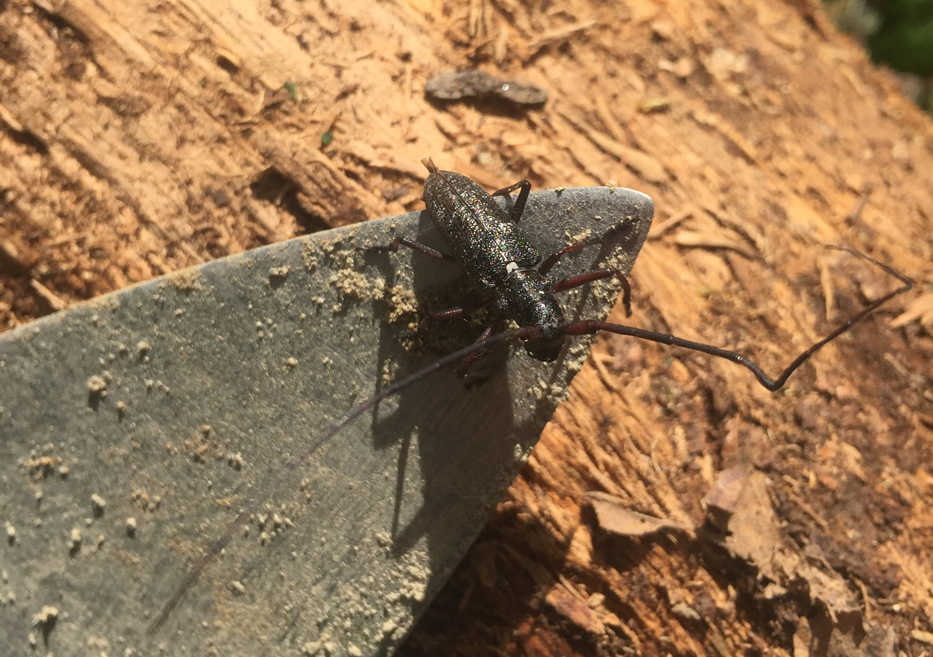
I participated in Susten Camp this year as an interpretive Refuge Ranger, leading vegetation surveys, insect dipnetting and digital photography activities for the group. My goal was to help connect the campers with the natural world around them while they connected to their cultural heritage. We collected photos of the plants and animals (mostly insects if you don’t count our single brown bear sighting and some moose nuggets) found at each dig site and identified the things we knew in the field. The unknown species were documented by photos for future identification by Refuge biologists through our project site on inaturalist.org. Some insects we found during our bug hunts and dipnetting were collected for DNA analysis and cataloguing by the Refuge.
Back at camp, we combined the natural and cultural heritage lessons of the week during a language activity. The campers worked together to translate the English common names of each identified species we documented into the Upper Cook Inlet dialect of their Dena’ina language. Prickly Rose was introduced by its other name, “heshkegh,” which means “big thorn.” Club moss, found in great carpets in the clearing, is “dlin’a kajada,” meaning “mouse’s tail bone.”
I learned about an amazing group of people, ancient and modern, and their techniques of reusing resources and living light on the land last week. Likewise, we all learned how to see the details in the nature world, being observant, patient, and sometimes brave as we photographed insects that were a little scary looking.
This leads me to the really impressive thing I saw last week — teens who were empowered to excavate important archeological finds. What’s more, they completed the task with patience, dedication and care. Do you know one teenager who can spend a full week outside of cell coverage, cooperating with other students, following scientific procedures, and staying cheerful despite biting flies? Can you name two? Three? I am pleased to say that after this past week, I can name 19!
Leah Eskelin is a Visitor Services Park Ranger at the Kenai National Wildlife Refuge who loves bringing fun hands-on nature programs to the public every month. Join the summer fun by checking out the events schedule at kenai.fws.gov or www.facebook.com/kenainationalwildliferefuge.
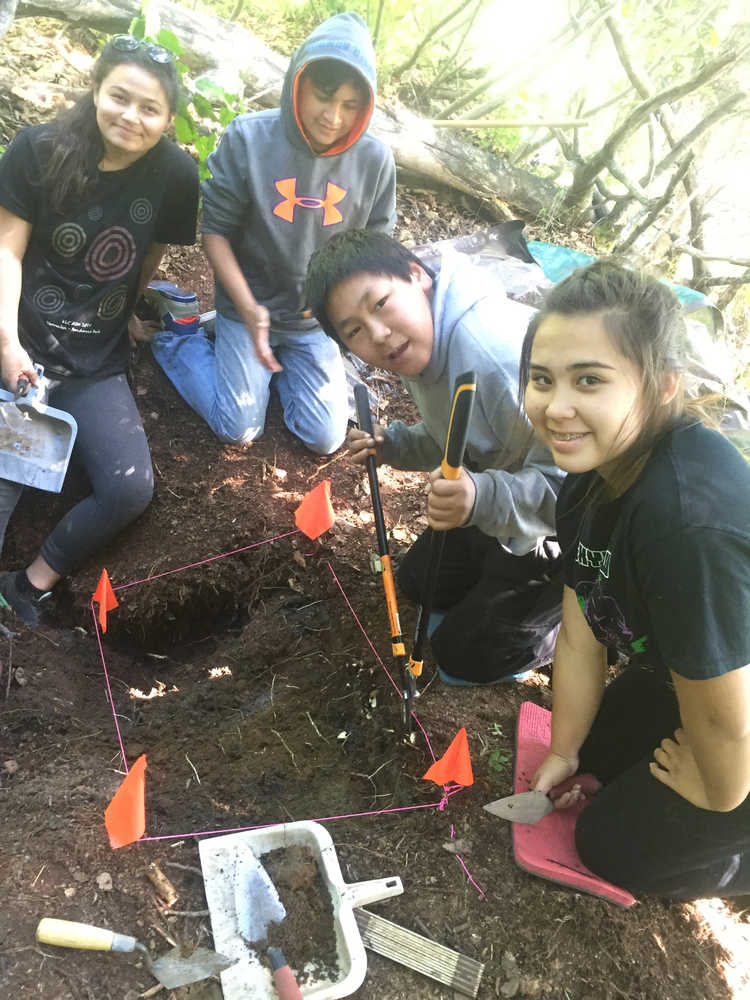
Susten campers carefully excavate a cache pit found on the Kenai National Wildlife Refuge. (Photo courtesy Kenai National Wildlife Refuge)
