
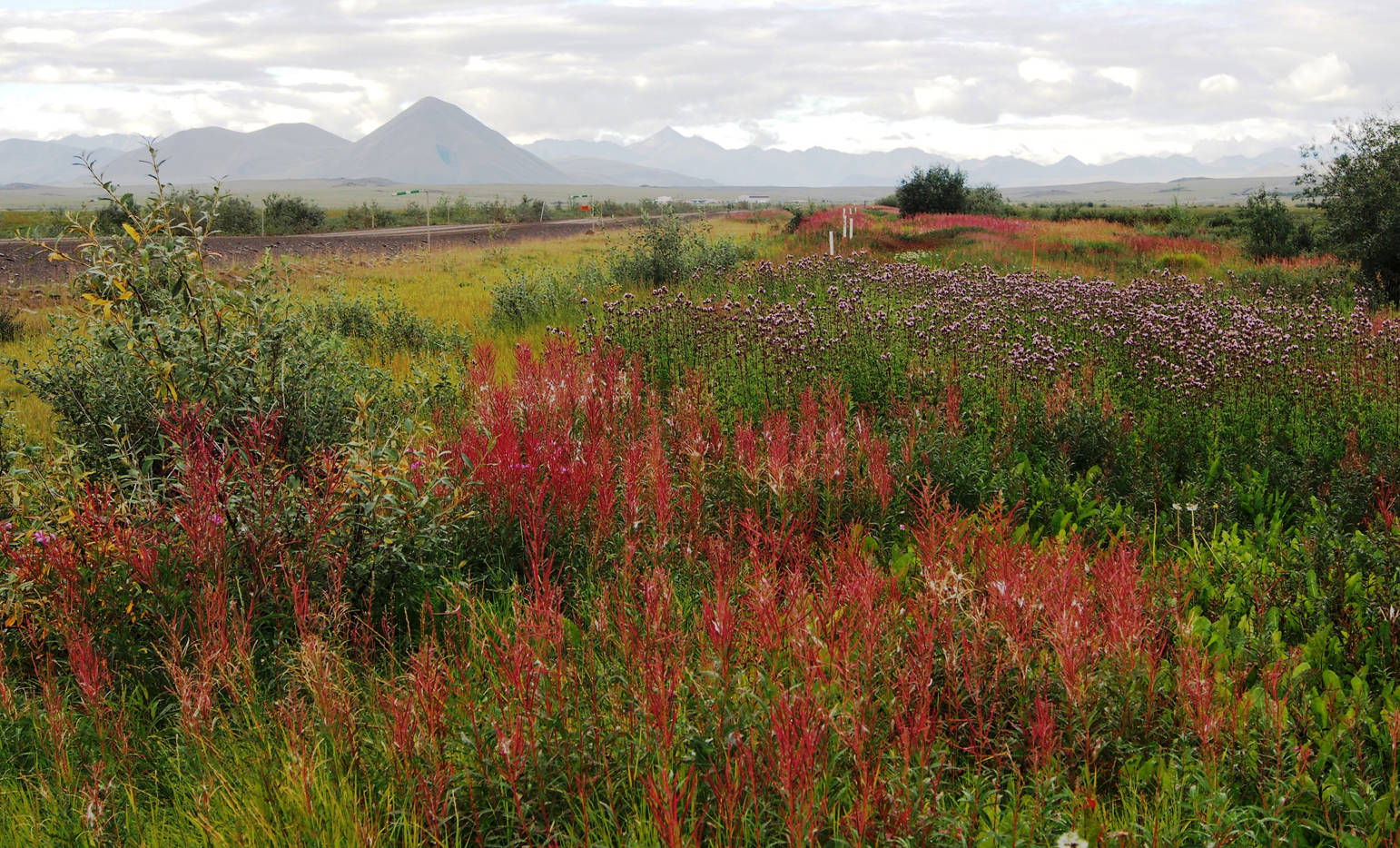
I just returned from the Dalton Highway, a thousand-mile road trip from Soldotna that can take as long as you want. Sometimes I do this trip in a manic, coffee-infused 20-hour drive that’s a little reminiscent of “Fear and Loathing in Las Vegas.” Other times I putz, camping wherever and whenever.
It was different this time. I hit peak flowering for White Sweetclover (Melilotus albus), an invasive legume native to Asia and Europe that was introduced to the American colonies in the 1600s, likely as cattle forage. Now, four centuries later, I couldn’t help but notice its white flowers almost continuously marking the Alaska Highway for 700 miles between Girdwood and Coldfoot. Sweetclover was introduced to Alaska in 1913 as a potential forage crop and was foolishly cultivated to become more cold hardy.
What’s troubling is that en route to the Brooks Range, the highway (and sweetclover) intersects some big river basins on both sides of the Alaska Range: Susitna, Nenana, Yukon, Kanuti and Koyukuk. Sweetclover seeds not only float well, but they prefer disturbed soils like those found on stream gravel bars, and so this becomes the means or vector by which this invasive plant can disperse across the landscape.
In 2008, University of Alaska researchers fed sweetclover seeds to moose held captive at the Matanuska Experiment Farm in Palmer. Turns out that sweetclover seeds pass readily through the digestive systems of moose (and cattle) intact and so can be carried inland, away from streams or roads. This is how sweetclover spread from its initial introduction on a farm to roads to streams and finally elsewhere through wildlife.
I was stewing about this dispersal chain as I drove over the Brooks Range and down onto the North Slope. The high Arctic is arguably the uber frontier in Alaska, a state often billed as the Last Frontier. Here, the flora are native and the ecosystems are natural. Yet, as the Dalton Highway swings towards the Sag River, 50 miles north of Atigun Pass, I spied a patch of bluish-purple flowers growing on a “restored” right-of-way that paralleled the road.
Turns out these were the blooms of Creeping Thistle (Cirsium arvense), another Old World invasive also introduced to North America in the 1600s, probably as a contaminant in crop seed or ship ballast. Because it is not palatable to most livestock, Creeping Thistle is formally listed by several states, including Alaska, as a noxious weed. In fact, Creeping Thistle can be so problematic that control legislation was enacted as early as 1795 in Vermont and 1831 in New York.
So how did it get there? The northern-most infestation previously found in Alaska was at Stevens Village, 200 miles to the south on the Yukon River. While it’s possible seeds were transported by “dirty” heavy equipment used in the restoration, it seems so unlikely in this case as Creeping Thistle is still not common in Alaska, constrained mostly to southeast and southcentral regions of the state. More likely it was transported in the “wattle” coiled nearby, a straw-filled tube used for erosion control. Presumably the straw originated from a hay field infested by Creeping Thistle far, far away from the North Slope.
If Creeping Thistle isn’t eradicated very soon from this site of initial infestation, it will become much more difficult to eradicate from the North Slope. Its seeds can travel several kilometers by wind and, as every person who tends backyard feeders knows, sparrows and longspurs like thistle seeds and will disperse them across the Arctic tundra.
The takeaway from this story is that dispersal vectors differ among species and they change as a given invasive species becomes established and better distributed. Consider how Elodea, the first freshwater invasive plant to make it to Alaska and the Kenai Peninsula, was likely introduced to our waters as an aquarium dump but is now being moved around the state by floatplanes, boats, stream flow and perhaps waterfowl. Many vectors are linear like streams and roads. But, in some cases, invasives can hop-scotch great distances across the landscape, hidden in dirty straw or blown by wind.
The good news is sometimes we can beat back invasives if we have defensible space. The whole reason the 700 miles of White Sweetclover starts in Girdwood rather than Soldotna is because partners in the Kenai Peninsula Cooperative Weed Management Area have made it their business to eradicate this legume (as well as Bird Vetch and Elodea). Chugach National Forest biologists have done a great job keeping the Seward Highway clean along the isthmus near Portage that connects the Kenai Peninsula to mainland Alaska. And just this week, Kenai National Wildlife Refuge biologists pulled sweetclover at the Cooper Landing Post Office.
Please help by yanking sweetclover up if you see it and tossing it in a garbage bin or fire pit.
Dr. John Morton is the supervisory biologist at Kenai National Wildlife Refuge. Find more information about the Refuge at http://www.fws.gov/refuge/kenai/ or http://www.facebook.com/kenainationalwildliferefuge.
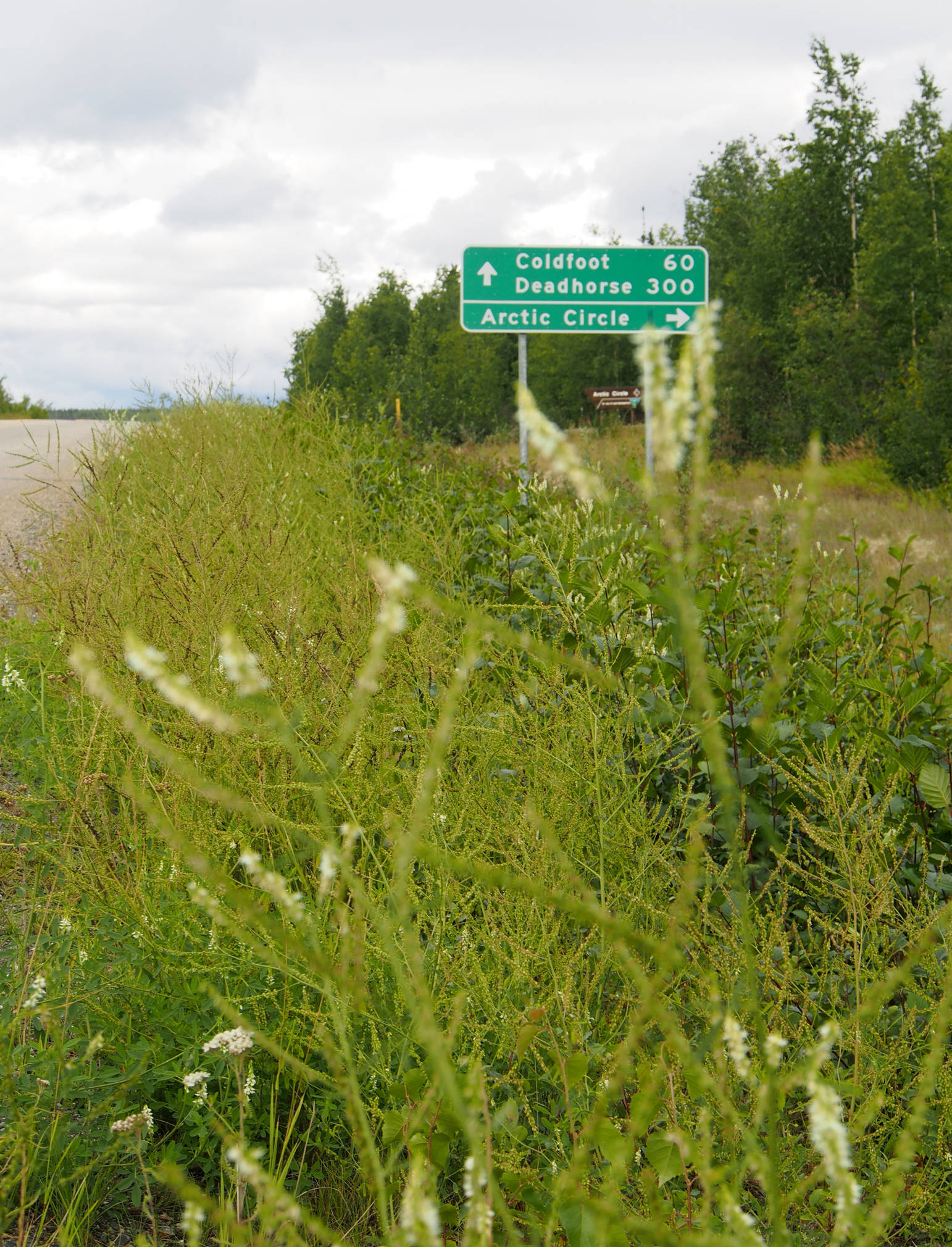
Abundant White Sweetclover lines the Dalton Highway at the Arctic Circle. (Photo by John Morton, Kenai National Wildlife Refuge)
