
While traffic rushed incessantly up and down the Sterling Highway on a glorious June day, a male Barclay willow flourished in the full sun on the road shoulder, reaching up his leafy, tender new stems to escape the shade of the lush grass and fireweed.
Eight months later on a crystalline Februrary morning well before the sun rose, a cow moose relentlessly hungry for calories to keep her fire burning made quick work of the willow’s tasty, young stems, munching his branches back down to the snow line, then moving along to the next willow.
As snowmelt wetted the soil and the sun warmed the willow’s branches in spring, he prepared to make another run toward the sky. Buds burst, pushing off their brown bud scales that had protected them over the winter. Last summer when each willow bud had formed, it had already divided into all the structures of a willow stem. Inside that tiny bud were the beginnings of a central stem and a spiral of leaves all around it, ready to expand rapidly at the beginning of the short growing season.
A tiny, hairy midge named Rabdophaga emerged from her winter hiding place at just this time. Now she flitted about the willow. In her few days as a winged fly she sought the most vigorous, fastest-growing buds for her offspring, selecting this willow in the sunshine that had been browsed by a moose over the winter. Here she alighted, depositing one egg on each chosen bud before flying off to find the next willow.
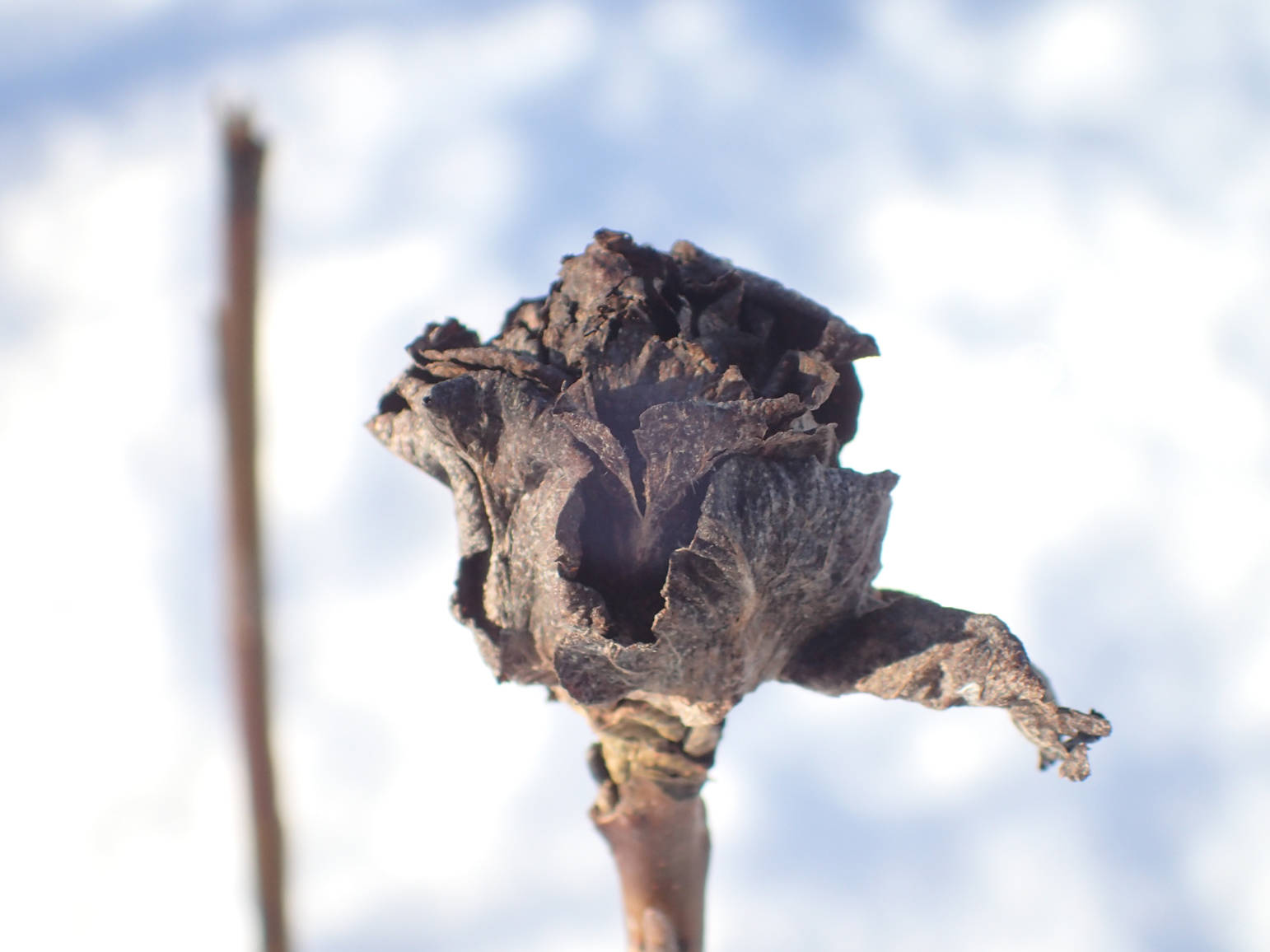
Days later the eggs hatched and the miniscule larvae immediately began feeding, but somehow they had been programmed to eat in a special way. Each larva nipped only the central tissue of the bud, the part that would have elongated to become a new length of stem. This caused the stem to cease growing while allowing the leaves to develop. On this foreshortened stem the leaves overlapped one another, forming a rose-like home around the growing midge larva. Inside this rose gall the larva ate and grew.
In June a tiny wasp named Gastrancistrus took flight in search of Rabdophaga midges. Upon finding one she injected an egg through the still small and fleshy gall into the young midge larva. The egg hatched, releasing a voracious wasp larva within the developing midge. If there was more than one Gastrancistrus larva, they killed each other until only one remained.
A dazzlingly metallic wasp named Torymus appeared later in the summer, also searching restlessly for midge larvae. With her long ovipositor she pierced the now mature rose gall, laying an egg alongside the fat midge larva. From this egg came a larva that slowly consumed the midge from the outside, also eating any Gastrancistrus that happened to be inside the midge larva.
A midge larva overlooked by wasps grew, molting twice over the course of the summer. The vigorous bud his mother had chosen formed a large gall that afforded him more protection from wasps than a smaller gall would have. As the frosts came he spun a silken cocoon around himself.
Snow fell and days shortened while Gastrancistrus, Torymus, and Rabdophaga rested in their willow rose homes. A young bull moose meandered through the willow patch, chomping nearly every new willow stem but leaving the rose galls. He disliked something about those dry, papery galls.
One night a snowshoe hare nibbled willow stems left by the moose. She bit off and chewed up most of the stem, but like the moose she rejected the willow roses, letting them drop onto the snow.
After wintering as a plump larva, the midge became a pupa as he felt the warmth of spring. Soon he would exit his willow rose. He would spend his short time as a winged fly looking for a female of his species. Meanwhile, Gastrancistrus and Torymus larvae were finishing their meals of gall midges. Soon they, too, would be winged adults.
I chose here to use a narrative form, but the relationships portrayed reflect our understanding of reality. Studies have indicated that moose and hares avoid rose galls, meaning that gall midges are competing with these mammals for the same food resource. Willows do exist as separate male and female plants and both are galled by Rabdophaga flies.
Our local willow rose insects make one of the better study systems to share with children. They can be reared simply as follows. Clip galled willow stems late in winter. Bring them inside to dry for a day or two. Once they are dry on the outside, place the galls in resealable plastic bags. After about a month at room temperature most of the gall midges and wasps will have emerged and can be examined.
Matt Bowser serves as Entomologist at the Kenai National Wildlife Refuge. Much of what we know about local willow rose gall insects is due to the work of local naturalist Dominique Collet. Find more information at http://www.fws.gov/refuge/kenai/ or http://www.facebook.com/kenainationalwildliferefuge.
