
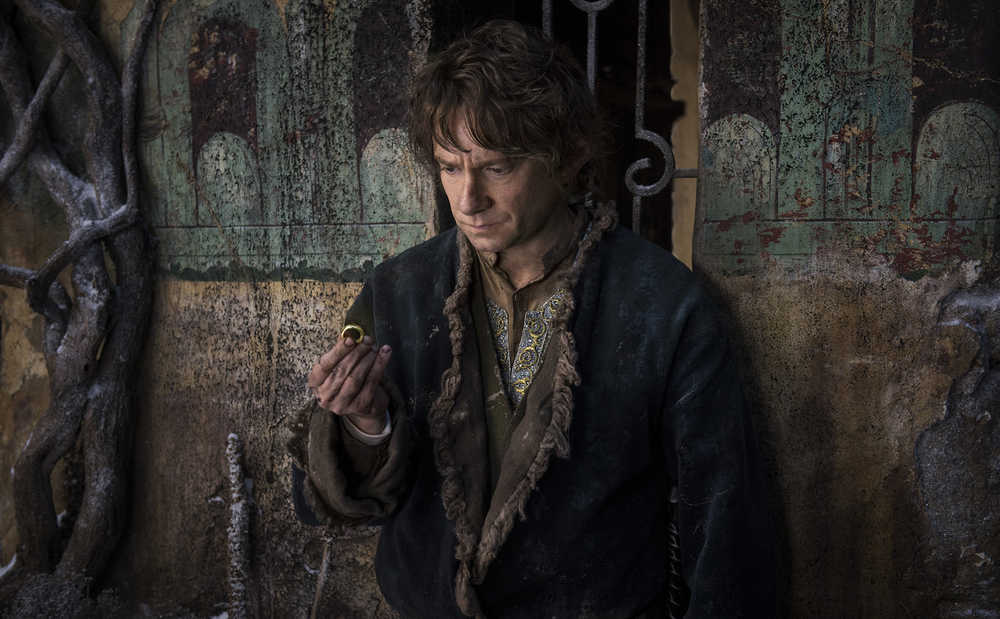
“The Hobbit: The Battle of the Five Armies”
New Line Cinema
2 hours, 24 minutes
After watching the final scenes of an almost nine-hour trilogy, crammed with stuff most movie-goers agree could have easily been left on the cutting room floor, I was surprised to be left with a sense that it was incomplete. Not that I wanted more, mind you, but I was surprised that after all that, director Peter Jackson leaves a handful of threads from his “Hobbit” films hanging.
I know people complained that the last “Lord of the Rings” movie ended something like nine times, but couldn’t this series at least wrap it all up?
“The Hobbit: The Battle of the Five Armies” begins immediately after the previous film so abruptly ended, with the rain of destruction on Laketown by the dragon Smaug. I’m bewildered by both this beginning and the previous ending because it means neither movie can ever be looked at as a stand-alone film. Smaug, as a character, is barely in this film, but it all starts out with him.
After he’s killed (spoiler alert) by Bard, the people of Laketown start looking around for a.) someone to blame, and b.) somewhere to stay. Both answers are the same, in fact, pointing to the dwarves now hold up in the Misty Mountain with all of Smaug’s gold. Thorin, previously grumpy but basically honorable, has now become a real tool, lusting for gold and berating his fellows for being unable to find the Arkenstone, a pointless maguffin that I’ve yet to understand the importance of.
It’s no wonder they can’t find it, however, because Bilbo Baggins, hired as a thief, after all, has stolen it and is now carrying it around in his coat.
Back outside the mountain, with little or no foreshadowing, an army of Woodland Elves from the forest of Mirkwood have arrived to challenge the dwarves. Apparently they are very anxious to retrieve some ancient jewelry that no one has ever mentioned before. Because Thorin is now a jerk, he refuses to help the humans or to barter with the elves and basically resigns himself to war.
Elsewhere, because orcs are forever on the march from somewhere to somewhere else, an army of orcs is on their way to capture the mountain and its treasure. If you’re counting, we’re up to four armies (later, for no real reason, the giant eagles show up and join the fray, though they’re barely mentioned.)
I was pretty frustrated with the way this is all set up and the fact that one battle has an entire movie devoted to it, but there were a few interesting things going on elsewhere. In the frightening castle of Barad Dur (or something like that — to be honest, all these names are starting to run together) Gandalf is being held prisoner by some other evil orcs. He has discovered that the evil Sauron, soon to be the big bad in “Lord of the Rings,” is attempting a return to both power and corporeality.
Luckily the Lady Galadriel, along with the wizard Saruman and the elf king Elrond arrive to rescue him, fighting both the ring wraiths and eventually Sauron himself, Cate Blanchett as Galadriel getting to be the biggest bad-ass of the entire trilogy.
In the meantime, elves Legolas and Tauriel are flitting around Middle Earth knocking off orcs and bearing witness to the futility of war. I like these two characters, as well, and their part of the film was pretty gripping, if ultimately unsatisfying.
When it’s all said and done, “Battle of the Five Armies” feels both slight and too long at the same time. Most of the film involves the titular battle, but abruptly the action leaves the battle to focus on the fates of Thorin, and fellow dwarves Fili and Kili, and never returns. Much is made of the character of Dain, Thorin’s cousin and a fierce warrior, but after a few witticisms by Billy Connolly, the character is never heard from again. I was somewhat interested in the fate of Thorin, but by completely abandoning the rest of the company for the majority of the film, Jackson and co. are basically saying none of the other dwarves matter and the fact that you couldn’t remember who was who isn’t a story problem, but rather is a consequence of those characters being inconsequential.
I’m particularly frustrated because the previous two films in this trilogy have been passable but not great. I was hoping this would be the moment they nailed it, but this feels to me like the weakest in the series.
Most frustrating of all, however, is how Jackson, after Thorin’s story is finished, abandons the rest of the plot points he’d spent the last two films setting up. The Arkenstone? Who knows what that thing was ever supposed to be. Tauriel? I don’t know — she’s not in the “Lord of the Rings” films, so something must have happened to her. Bard and the people of Laketown? I’m assuming some of them survived, not that we ever bother checking back in with them. We never even find out what happens with the mountain and everything inside, even after Gandalf makes a point to tell us how vitally important it is as a strategic stronghold in the troublesome days to come.
Bilbo does get to finally finish his journey, and the film does, as expected, end at the same moment the original films start, but compared to the later adventures of Frodo and his merry men, this visit to Middle Earth is a mess.
Grade: C+
“The Hobbit: The Battle of the Five Armies” is rated PG-13 for fantasy violence and battle sequences.
Chris Jenness is a freelance graphic designer, artist and movie buff who lives in Nikiski.
