
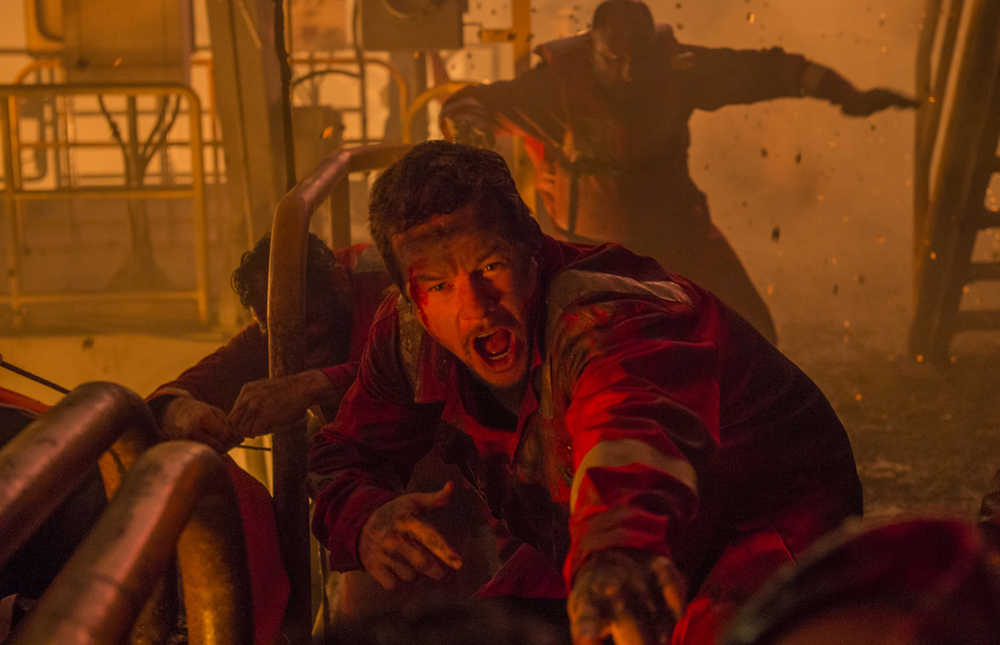
“Deepwater Horizon”
Summit Entertainment
1 hour, 47 minutes
One of the most interesting, and dramatic choices director Peter Berg makes in this week’s disaster-at-sea thriller “Deepwater Horizon” is having Kurt Russell’s gruff, tuff Mr. Jimmy confront the initial destruction not heroically head-on, but naked and in the shower. I sound like I’m making a joke, but it’s one of the more memorable scenes in the film, reminding us that stuff doesn’t always happen when we’re ready for it.
If you want another good example of this, watch the shower room fight in “Eastern Promises.” The shower explosion is one of those facts that’s too wacky to be made up, but good on Berg for including it. It’s just one example of how “Deepwater Horizon” is a cut above your typical disaster movie — a fact that’s both good and bad.
Mark Wahlberg is Mike Williams, a maintenance supervisor aboard the exploratory rig, Deepwater Horizon, off the coast of Louisiana. When Mike arrives for the first day of his three-week shift aboard the platform, he is told that the well has been dug, and the rig is going to be moving — that the job is, for all intents and purposes, over. This doesn’t sit well with Mike, who feels the rig has serious maintenance issues, nor with his supervisor, Jimmy Harrell, who fears that all the tests haven’t been done properly to ensure the well can be left safely.
Unfortunately, our two common sense heroes are up against that oldest of villains, corporate cronies. John Malkovich, with the strangest accent I think I’ve heard in a long time, plays Don Vidrine, BP representative and well supervisor on duty. This job is already way over budget and off schedule and the implication is that corners are being cut to save money. Day turns to night, Mr. Jimmy heads off to the shower, and Mike turns to his nightly Skype call to his doting wife, played by Kate Hudson, a character who doesn’t have a lot to do, but at least gets more of a role than poor Laura Linney in “Sully.”
One of the procedures in finishing a job like this is to “offload the mud.” I don’t know what that means, but it’s lucky they did. A large tanker is anchored nearby, ready to take the mud, but soon they’ll collect a different kind of cargo once people start leaping off the rig into the water. Apparently, the well wasn’t as prepped as they thought, and before you know it, first mud, then oil, then flames are shooting high into the sky.
I’m a huge fan of disaster movies. I don’t know why exactly. I’m not some nihilistic weirdo pining for the end of the world, but I do enjoy these stories, whether they’re big splashy affairs like “The Towering Inferno” and “Deep Impact,” or long drawn out narratives like Larry Niven’s “Lucifer’s Hammer” or one I’m reading now, a massive three book series called “The Passage,” by Justin Cronin. I even like Roland Emmerich’s “2012,” and that’s not a good movie.
I think what I like about these kind of tales is the vast canvas they’re painted on — dozens of different characters, spread all over the globe or the city, living their lives oblivious of one another until fate shoves them together. That’s good stuff.
I bring this up because much of both the praise and the criticism of “Deepwater Horizon” revolves around how much of a good old fashioned disaster movie it is. As much as I did enjoy this film, I have to whole heartedly disagree. There are several reasons for this, but most importantly, this is a real event, about real characters, many of whom died a relatively short time ago. Disaster movies are, by and large, fictional, allowing us to feel the thrill of the danger vicariously, but not have to feel guilty about being entertained when so many die.
Now, I know what you’re thinking, “What about ‘Titanic? Wasn’t that a disaster movie?’” Yes, but it benefits from being cast with largely fictional characters, and besides, it took place over 100 years ago. “Horizon” has less in common with disaster movies and more in common with movies like “United 93” or “World Trade Center.”
All in all, the film plays it straight up the middle, with good acting, spectacular action, and a tearful ending that could soften the hardest of hearts. This is fine, but it also robs much of the cheesy fun you get from a, say, “Dante’s Peak” for example.
My one complaint is that the movie really shies away from looking at this disaster in context. I understand that Berg wanted to take a relatively intimate look at the lives of the actual people who were impacted, and that’s great, but this spill had a massive environmental and economic impact that is never addressed aside from a quick text tag at the end about it being the worst oil spill in U.S. history.
BP, as a company, is similarly let off the hook. The movie puts Don Vidrine and his partner Robert Kaluza front and center as far as blame goes, but barely mentions the corporate culture at the company, nor does it address the impact this disaster had on BP or on the wider petroleum industry. Obviously, Peter Berg has the right to tell the story he wants to tell, and as far as that goes, he does it well. He’s a talented filmmaker, but I wish this film had just a bit more activism amidst the action.
For the story it’s telling, however, “Deepwater Horizon” is a powerful testament to the resiliency and dedication of those workers, who risked their lives trying to shut off the oil before the spill got out of control. It’s also a testament to the unstoppable Kurt Russell who would never let a little thing like getting blown up in the shower stop him.
Grade: B+
“Deepwater Horizon” is rated PG-13 for language and intense disaster sequences.
Chris Jenness is an art teacher, freelance graphic designer, artist and movie buff who lives in Nikiski.
