
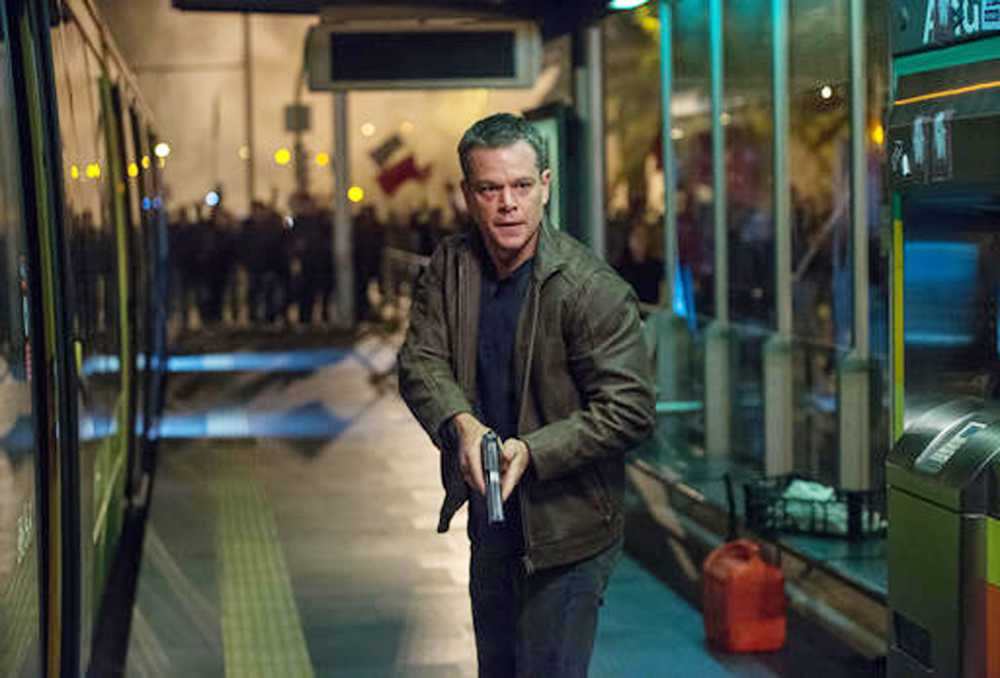
“Jason Bourne”
Universal Pictures
1 hour, 53 minutes
“The Legend of Tarzan”
Dark Horse Entertainment
1 hour, 50 minutes
Sometimes it feels like Hollywood is a giant ship on the ocean, lumbering along – slow to steer, and even slower to course correct. This weekend I saw two sequels, of sorts. Call them continuations of a franchise, but continuations I’m not sure anyone was clamoring for. For one of these films, the result is an unexpected treat, for the other, an unwelcome bore. Guess which is which.
The last film in the “Bourne” series was actually 2012’s “The Bourne Legacy,” a Jason Bourne movie that didn’t even feature Jason Bourne at all. For the uninitiated, Jason Bourne is an American su-per-secret assassin who, in 2002’s “The Bourne Identity,” turns up with amnesia, prompting his super-secret agency to try and rub him out before he does something, I can’t remember what. Anyway, it spawned two sequels and was a fairly successful foray into action for Matt Damon. With “Legacy,” the powers that be, unable to get Damon to return to the character, tried to reboot the series, unsuccessfully, with Jeremy Renner playing a different super-secret assassin in the same agency. I think the connection is that he’d heard of Bourne. With “Legacy” a bomb and Damon not having played the character in a dec-ade, I think most people thought the “Bourne” series was done – which is fine. Not everything has to go on and one. Universal Studios, however, has been working on getting this “Bourne” franchise going again and no amount of logic or disinterest will dissuade them.
Watching the movie, it feels as though the audience isn’t the only ones checked out. Damon, per-haps pondering the boatload of money they must have paid him to come back to this, just seems weary and distracted. The plot, wherein Jason Bourne has to delve deeper into his past discovering, in the way of all pointless sequels, that his father, who we’ve never heard of before, was actually the man to dream up the super-secret assassin program in the first place, is tired at best. Along the way Damon and returning director Paul Greengrass follow the same path from the first three movies, mixing and matching plot ele-ments but wholly failing to come up with anything new. Forcing the series to continue past its natural end also means adding to and misunderstanding the original character of Bourne who, by the end of the third movie, was a guy at peace with his place in the world who just wanted to be left alone. In this film we see a Bourne again tormented by his past, but this time considering a return to the agency, which makes no sense whatsoever. Unless, that is, you’re a movie studio hoping to bolster a new franchise. Well, maybe they’ll get their wish. “Bourne,” despite tepid reviews, is making money. Maybe not blockbuster money, but money nonetheless. A new “Bourne” movie could be on the horizon sooner than we think. Maybe someone better give Jeremy Renner a call. Grade: C
“The Legend of Tarzan” is just the latest in over 150 times the titular Lord of the Jungle has made an appearance on screen. Author Edgar Rice Burroughs had only recently published his first tale of Tar-zan when the first film, “Tarzan of the Apes” was released in 1918. Recently, however, most of the Tar-zan related properties have been kind of a bust. In 1981 there was a cheesecake Bo Derek version, fol-lowed in 1984 by a serious attempt in “Greystoke: The Legend of Tarzan, Lord of the Apes,” which, de-spite it’s really long title, failed to set the world on fire. A few years later Disney offered an animated re-telling, signaling that their 1990’s creative renaissance was officially over. Since then there’ve been a couple of TV series and a direct to video version, but I’ve never met anyone who watched them. Despite Hollywood’s bottomless enthusiasm for the character, I don’t know that the general public really wants much to do with it. Let’s face it, in the supposedly more culturally sensitive 21st century, there’s some-thing vaguely problematic about a wealthy white colonial Brit who can out-Africa a whole continent of actual Africans. This latest screen version, however, does have some fun with the character and winds up being surprisingly entertaining. The story of Tarzan goes like this: When the Earl of Greystoke and his pregnant wife are shipwrecked and stranded somehow in the jungles of Africa, the man does his best to protect them. His son is born, but his wife dies in childbirth. Soon thereafter, the Earl is killed by a go-rilla. The baby boy, John, however, is adopted by a female gorilla and is then raised as a part of the group. Eventually, he comes across a white American woman lost in the jungle, saves her, makes contact with humans, and eventually returns to England. This film, wisely, begins after all that. The King of Belgium, in an effort to raise money from other European powers, offers the now famous former “Lord of the Apes,” a chance to return to his native land as a celebrity witness to all the anti-slavery reforms he’s insti-tuted in his colony. He fails to mention the involvement of the villainous Leon Rom, played by Christoph Waltz, the angry and savage tribe who wants Tarzan’s head, the diamonds that tribe will provide to Rom upon receipt of Tarzan, nor the fact that the entire country is actually enslaved. Don’t worry, though. Our man Tarzan will sort all that out in due time.
Assisting with the sorting is Samuel L. Jackson. In the film he plays George Washington Wil-liams, a former Civil War soldier, tracker, and fighter who’s out to expose the Belgian King for the slaver he is. He’s really just there to be Samuel L. Jackson, however, and all that implies. The film is actually much lighter in tone than I expected, and Jackson is a big part of that. Also great is Margot Robbie as Jane. Robbie is funny and sharp and her character is full of agency. Christoph Waltz adds a touch of weirdness – I liked him, although he really seems like he’s performing an amalgam of the characters he played in “Inglorious Basterds” and “Django Unchained.” Of all the leads, my least favorite was Tarzan himself, played by the hunky Alexander Skarsgård, who you might know from “True Blood.” Skarsgård comes off a little too wispy at first, but he grew on me. The film deals with serious issues, but doesn’t take itself too seriously. I was really reminded of “The Mask of Zorro,” or “The Count of Monte Cristo,” or any number of fun 90’s swashbucklers that required very little of the audience and also left you with very little besides a pleasant couple of hours in the theatre. This Tarzan has everything you’d want – the jungle acrobatics, the gorilla wrestling, the crazy echoing yodel, and never slows down long enough to get boring. It’s nothing like reality, and the language is crazily anachronistic, but so what? It’s pulpy and silly and fun. Everything Tarzan should be. Grade: B+
“Jason Bourne” is rated PG-13 for language and violence.
“The Legend of Tarzan” is rated PG-13 for brief language, animal battles, violence, and shirtless vine swinging.
Chris Jenness is a freelance graphic designer, artist and movie buff who lives in Nikiski.
