
A family trip in the Alaska wilderness can turn sour in a hurry if the proper precautions are not taken against the unassuming but dangerous plant known as “pushki.”
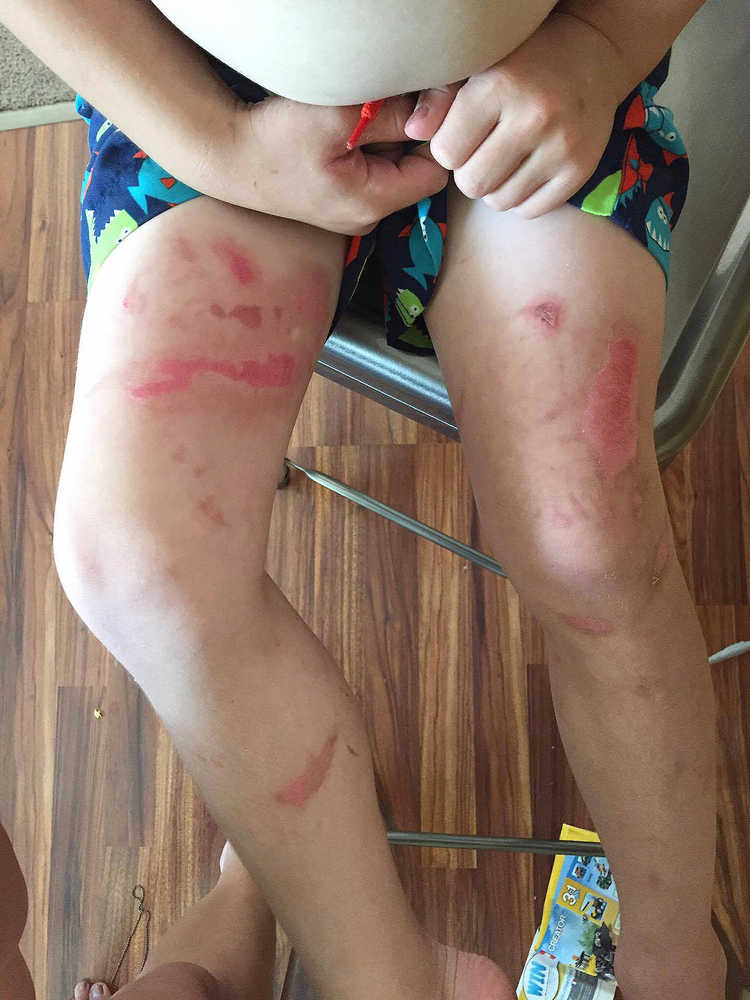
For Fairbanks resident Amanda Tweed, a family vacation to Seward for the Fourth of July holiday ended up a learning experience when 5-year-old son, Lucas, discovered the unpleasant touch of cow parsnip. Amanda was hiking the famous slopes of Mount Marathon as her husband and Lucas waited at the base, and said her son was out playing in the brush that coats the lower portions.
“On the morning of the fourth, he woke me up in our camper and was complaining, ‘Mom, my legs are itchy,’” Tweed said. “I put my glasses on and it was a blister, and I thought, ‘Oh no,’ and was a little panicky.”
Consulting with a nursing friend in Soldotna, Tweed texted pictures of the outbreak, asking if she ought to take young Lucas to the emergency room.
Instead of rushing to the hospital, which already sees multiple race participants throughout the day, Amanda let Lucas relax in the stroller, but watched as the blisters soon formed and became bigger.
“I think it was a little scary for him, he kept saying, ‘My legs are broken,’ and we said, ‘No, they’re not,’” Tweed said.
Anchorage runner Matthew Waliszek fell victim to the plant while training for the Crow Pass Crossing in 2013.
Waliszek awoke early with 10 others to put in a practice run for the upcoming event, a roughly 24-mile backcountry marathon that starts at the trailhead near Girdwood and finishes at the Eagle River Nature Center. In between lies two valleys full of pushki, which in that terrain is not the most dangerous animal.
On a gorgeously sunny day, Waliszek and company found a trail crew that were graciously cutting down the cow parsnip.
However, even that generous clearing would not be enough for Waliszek to avoid the dreaded pushki.
“I knew that I was sensitive to it, but had no idea that my legs were going to swell up like elephant stumps,” Waliszek said.
Emily Capra, a Seward native who currently lives in Eureka, California, felt the nasty sting of pushki one summer while exploring Thumb Cove in Resurrection Bay. While camping on a small beach that provided views of Fox Island, Capra and a few friends decided to take a hike up an unnamed mountain on the western end of the beach.
The effects did not show up until after Capra had spent over three hours sunbathing after the hike.
“I got blisters all over my arms and legs from bushwhacking,” Capra said. “Moral of the story: It’s photosensitive.”
Capra added that she had never had a reaction to it until she was 15, even after years of playing around in it.
Also known as Indian celery or hogweed, cow parsnip has blossomed on the Kenai Peninsula and other areas in Southcentral Alaska this summer, and has been prevalent on even well-used hiking trails like Skyline or Juneau Falls.
Todd Eskelin, a wildlife biologist at the Kenai National Wildlife Refuge in Soldotna, has fallen victim to the plant’s effects as well.
“We encounter it when we’re out doing bird surveys,” Eskelin said. “With the early spring we had, it was probably able to respond earlier.”
Eskelin said pushki typically can be seen closer to the coast, from Nikiski to Homer, which likely is due to the prevailing winds that bring moisture to the area.
A tall, bristly stem that crowns at the top with thin stalks that end in white blossoms, cow parsnip conveys an elegance that belies its danger. The “Heracleum maximum,” which is part of the carrot family, can grow up to 7 feet tall and spread 8 inches wide at the top.
Broad, irritating leaves nearer to the bottom can be 16 inches across, and can be easily confused for the devil’s club plant, which features large leaves, but with thorny stalks and red and orange berries growing upward from the center.
The effects of the plant are not easily forgotten. All it takes is a slight brush against the bristly leaves, which leave behind chemicals called furanocoumarins. The plant developed its harmful chemical compound to fight off various worm and insect species. Its effect on humans is simply an unintended consequence.
The chemical absorbs into the skin and unites with the DNA in skin cells to create photosensitive compounds. It is those compounds that react to the ultraviolet rays in sunlight, which cause blisters to ignite in fiery anger on the surface.
For some, the reaction is harsh. The skin reddens and basically “boils” in the sunlight like photographic film developing. The skin becomes dry and scaly in the aftermath and can take weeks to disappear.
After making it to the final destination of Crow Pass in Eagle River, Waliszek soon began feeling the effects. Blisters began popping up on his legs and he said the water retention in the blisters accounted for 8 pounds.
Waliszek said he eventually did end up running the race two weeks later, after the blisters faded away.
“Not even horrible cow parsnip can stop me from running that race,” he said.
“(But) it messed with my blood chemistry. (It) just felt weird for two weeks.”
Down in Seward, Tweed was running out of options. Eventually, the 30-year-old from Fairbanks returned home and rushed Lucas to a First Care clinic. By that point, the biggest blisters were an inch and a half tall from the surface of the skin.
The physician drained her son’s blisters and applied some Bacitracen antibiotic ointment on the burns.
“She wrapped up his legs and said change the bandages every day,” Tweed said. “Right now, everything is scabbed over and starting to heal, but my daughter’s skin didn’t even blister, she just got a dark pigmentation.”
For both Lucas Tweed and Waliszek, the exposure created a greater susceptibility.
So how can those who venture out into the brush avoid the burn?
A simple fix is to wear long sleeves and pants. If the plant can’t touch you, you won’t feel it.
“I initially didn’t have trouble with it when I moved here in 2005, but it’s gradually gotten worse and exploded in 2013,” Waliszek said. “Now if I look at it, I get blisters. I run fully covered now.”
Eskelin said the best thing to do after coming into contact with pushki is to rinse off the skin with running water. Taking a bath could actually worsen the condition, as the oils and chemicals from the plant will float on the surface and could cover the entire body.
“It’s photo reactive, and I think it’s an oil that is produced,” Eskelin said. “If you wash it off right away, it tends to not have any lasting effects.”
Another option is using a standard topical ointment or anti-itch cream to soothe the rash. Eskelin suggests standard first aid to clean the site and covering it with loose gauze.
joey klecka can be reached at j.klecka@peninsulaclarion.com.
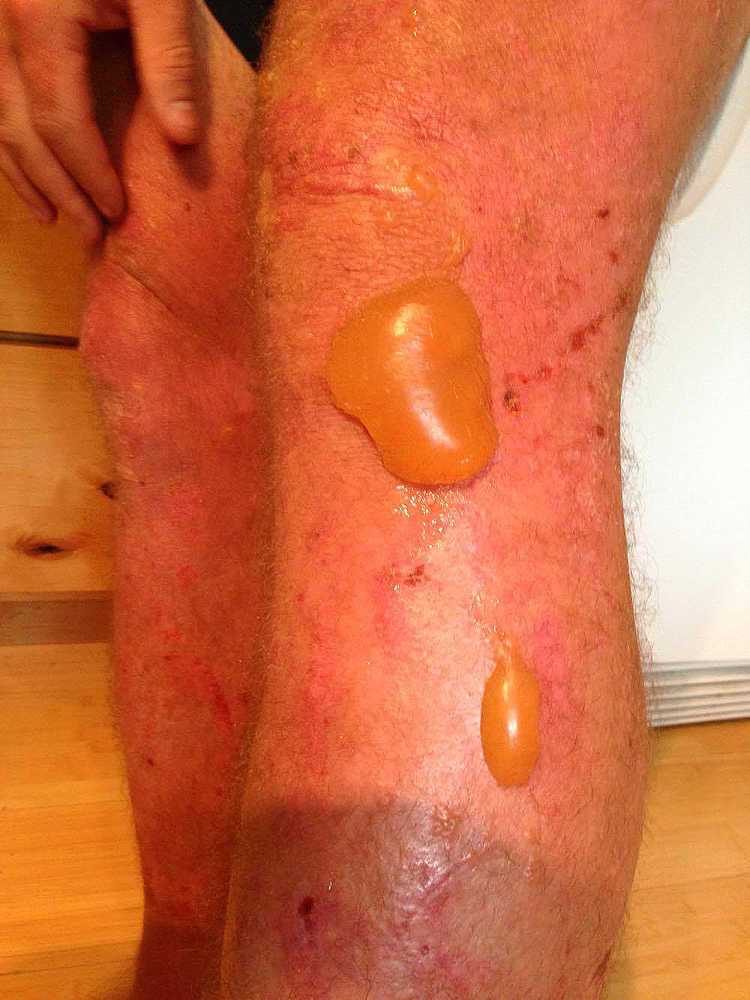
Photo provided by Matthew Waliszek
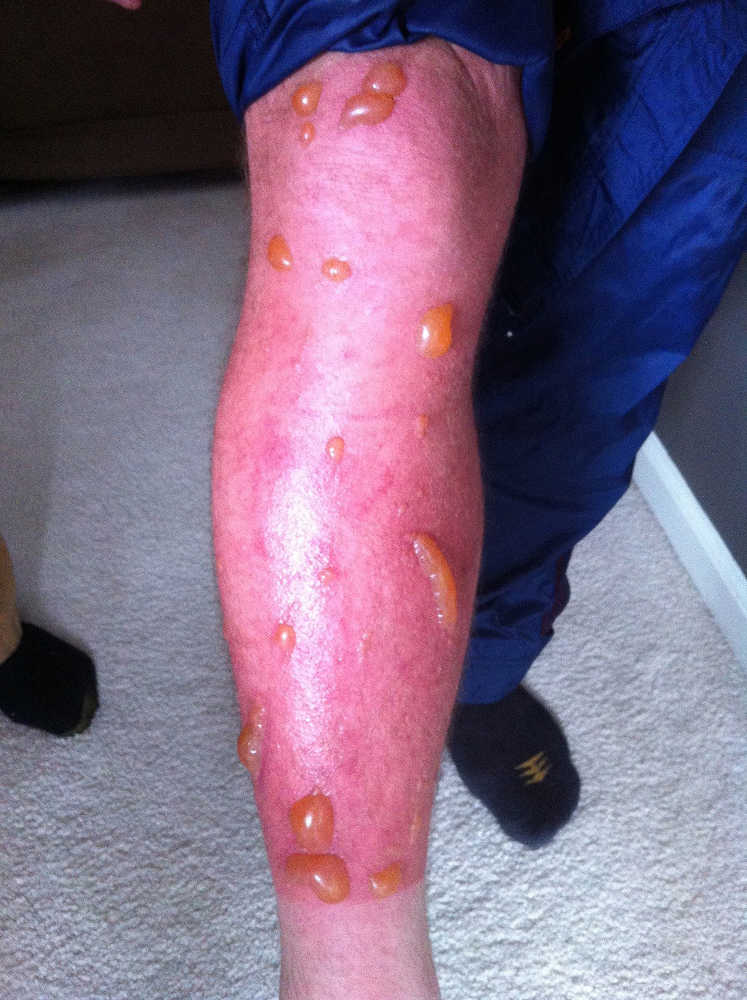
Photo provided by Matthew Waliszek Severe blisters plagued the legs of Matthew Waliszek after coming across the pushki plant on a 2013 training run on the Crow Pass trail.
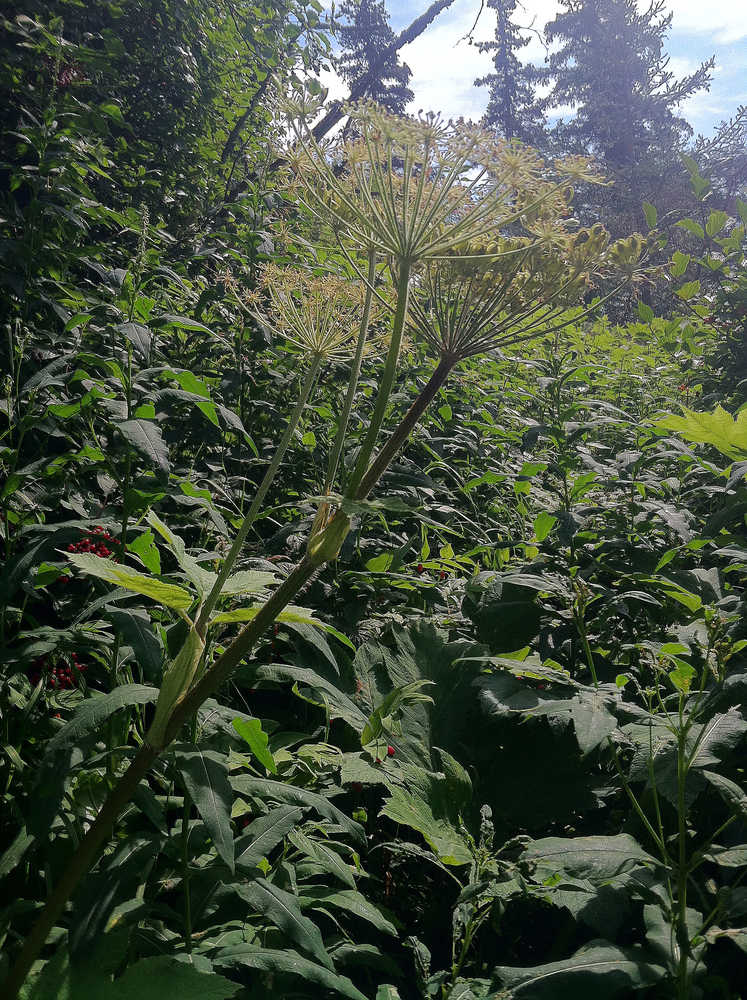
Photo by Jeff Helminiak/Peninsula Clarion Cow parsnip, or “pushki”, can grow up to seven feet tall on the Kenai Peninsula, but once the burning symptoms take effect, there is not much that can be done.
