
GREAT FALLS, Mont. (AP) — Bob Marshall hiked 288 miles over eight days through the northwestern Montana wilderness in 1928.
Marshall would average 36 miles a day during the epic hike, and The Bob Marshall Wilderness would officially be created 36 years later, after Marshall.
“Averaged,” says Chris Peterson of Marshall’s daily walks. “I averaged 10, and I didn’t bag the peaks he did.”
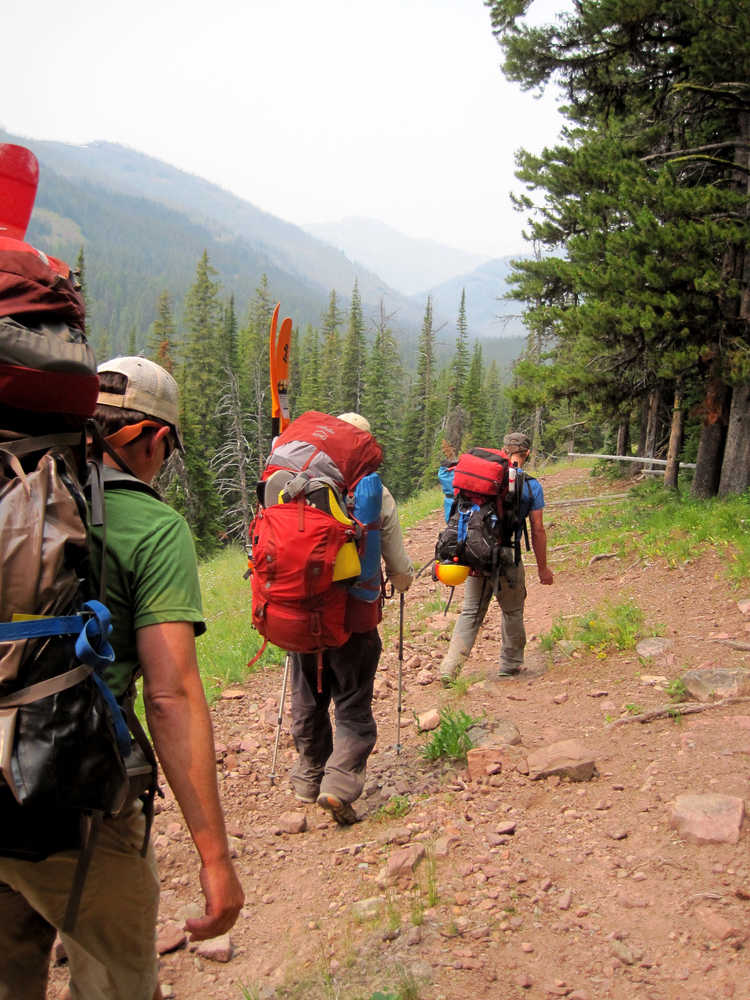
In 2014, 86 years after Marshall’s journey, Peterson retraced Marshall’s large footsteps, with a few modifications, through the Swan Range, The Bob Marshall and Mission Mountains, traveling about 200 miles in 20 days.
Peterson, admittedly a slow hiker, didn’t move as quickly as the fleet-footed Marshall, and he was lugging enough camera gear to “choke an elephant.”
But he returned with incredible wilderness and wildlife photographs and material for a book he would call, “A Walk on the Wild Side.” Peterson hand-wrote the photo captions for a sole-copy hard-cover collector’s edition that was auctioned for $500 to benefit the Bob Marshall Wilderness Foundation. Another 50 soft-cover books were printed and sold.
“He’d be an ultra-marathoner today,” Peterson says of Marshall. “The stuff he did was pretty incredible.”
On one “day hike” alone, Marshall scaled three mountains.
Marshall, the co-founder of the Wilderness Society, was an early crusader for wilderness protections.
The Bob Marshall Wilderness is named after him.
He was 28 years old when he made the trip through what would become the Bob and areas surrounding it.
Peterson, the editor of the Hungry Horse News, was 47 when he made his.
“I did the part where he was running around in what would become the Bob,” Peterson said.
He decided to take the walk on the wild side in late August and early September in 2014, the same week Marshall did the same in 1928.
Timing was right with it being the 50th anniversary of the Wilderness Act, which created the million-acre Bob Marshall Wilderness on the Flathead and Lewis and Clark national forests in 1964.
The purpose of the trip, he writes in his three-chapter book recounting it, was to get good photographs and spend nights in memorable places. And enjoy.
“It’s what I call a perfect quiet,” Peterson said of his experience retracing Marshall’s route in the Bob.
The Bob, he notes, is a much different atmosphere than a national park such as Glacier, he said.
In 94 miles, he saw three hikers.
At the time of his Montana hike, Marshall worked for the Forest Service. Marshall explored the areas he thought should become wilderness, Peterson said. He and other early wilderness advocates believed there should be wilderness just for the sake of having wilderness.
In “A Walk on the Wild Side,” Peterson writes that the “wilderness soaks you up, makes you insignificant.”
“You learn what really matters,” Peterson said in an interview.
The trip also taught him that a place can’t be judged by its name. Take Brushy Park in the heart of the Bob, for instance.
“You’re thinking it’s going to suck, and it was gorgeous,” Peterson said
Peterson first learned about Marshall’s impressive walk from a few paragraphs in Marshall’s biography. His journal, kept by the Bob Marshall Wilderness Foundation, offered more information.
“The journal is a very well detailed journal of where he goes,” Peterson said.
Peterson didn’t retrace Marshall’s exact steps.
Marshall started in the Spotted Bear of the Flathead National Forest and went south to Holland Lake, including a massive “day hike” where he went up and over Pagoda Pass from Helen Creek to the Continental Divide to Salt Mountain on the Chinese Wall and back again. It was 42 miles.
Peterson reports in his book that Marshall also did another 34-mile day hike from the Big Prairie ranger station to White River and Prisoner Lake lookouts that included another mountain climb.
Peterson’s hike began at Holland Lake and headed north, over Gordon Pass, White River Pass, along the Chinese Wall to Larch Hill Pass, down to Brushy Park to Pagoda Pass, then down Helen Creek to Black Bear, up Picture Ridge and down into Gorge Creek to the Bunker Creek Trailhead.
Peterson, now, 48, added the Picture Ridge diversion to get better photos and it paid off with a 360-degree view of the wilderness. Before arriving at the Hungry Horse News 18 years ago, Peterson wrote for a daily newspaper in New York where reporters also had to shoot their own pictures. Peterson began shooting Buffalo Bills NFL games and became adept at shooting photos, which has served him well working in Montana.
“I always wanted to move to Montana,” he said.
On his trip retracing Marshall’s route, Peterson lugged an eight-pound telephoto lens and camera on top of a full pack as he logged 200 miles in roughly 20 days, capturing stunning shots including a goat overlooking a vast wilderness valley like a sentinel.
He spent nine days of the trip traveling 94 miles in the Bob Marshall Wilderness.
Marshall traveled 182 miles in the Bob over five days as part of his eight-day, 288-mile journey.
It was rough going for Peterson.
He pulled a calf immediately.
And the mud was brutal, especially in trail running shoes.
He reached the Chinese Wall, the showcase of the Bob, on Sept. 4. It was his birthday.
“I busted hump to get up there and it started to rain that night and it was snowing so hard I couldn’t even see the way,” he said. “It was miserable, and I had sneakers on.”
Once, he met a man on a horse on a narrow trail on a blind bend at White River Butte. The man and his horse, whom he later learned packed for the Forest Service, went off the steep slope and Peterson thought they were goners. But they managed to ride it out without tumbling and retake the trail.
“The hike itself was at times a grunt, others times pure joy and even deeply saddening,” Peterson wrote in his book. “On one of my off-trail routes, I found a memorial — a cross with a horseshoe tacked to it and the man’s boots beside the cross. The cross had the year “2014” written on it in black ink, but there was no person’s name. The boots were well worn, the person had gone many miles in the Bob. It was a fitting tribute and in retrospect, one I was glad to experience.”
