
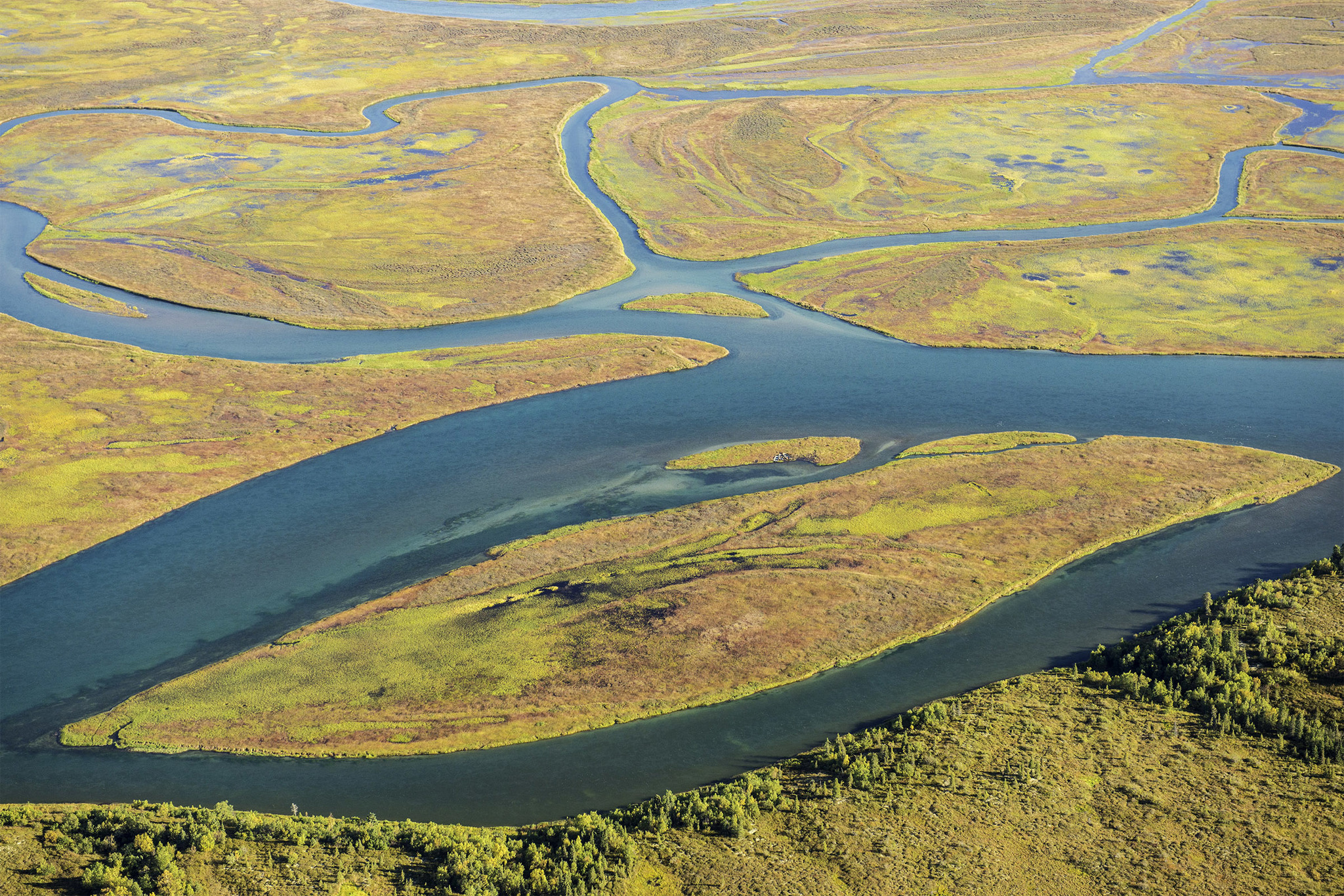
During photographer Carl Johnson’s trips to document subsistence life in the river-laced Bristol Bay region west of Cook Inlet, he said the subject of wealth occasionally came up in conversations with locals.
“Something along the lines of, ‘How wealthy are you?’” Johnson said at a Friday presentation at Kenai Peninsula College. “And the response would be like, ‘Well, my freezer’s full, my elder’s freezer is full.’ And a lot of that wealth comes from the water.”
This idea, he said, inspired the title of his new book on the region: “Where Water is Gold: Life and Livelihood in Alaska’s Bristol Bay,” released in 2016.
Bristol Bay is filled with wealth and potential wealth, in one sense or another. All five Pacific salmon species spawn there, giving rise to what a 2013 University of Alaska Institute of Social and Economic Research report called “the world’s most valuable wild salmon fishery,” which supplied almost half the world’s wild salmon that year for a total sales value of $1.5 billion.
Under the glacier-sculpted ground lie deposits of gold, copper and molybdenum. The Pebble Partnership, owner of one of the several undeveloped mining claims that checker the area, estimated its deposit’s worth at about $300 billion in 2014 metal prices.
The people who live among this wealth are few — the 46,000-square-mile watershed is home to approximately 7,400 permanent residents — many of them Yupik, Dena’ina or Alutiiq Alaska Natives — in addition to the visitors and tourists brought by the region’s proximity to Anchorage (roughly 200 miles) and the Kenai Peninsula.
Johnson — who in college studied political science and went on to a career in environmental law — first got to know the region as an attorney working for the nonprofit environmental law firm Trustees for Alaska, which in 2009 represented a group of individuals and Bristol Bay village corporations suing the Alaska Department of Environmental Conservation over the Pebble Partnership’s permits to drill exploratory holes in the area north of Lake Illiamna, where they had planned an intensely controversial open pit gold and copper mine.
After the court ruled in favor of the state in 2011, Johnson left law and set out to deal with Bristol Bay in a less abstract way. He sold some old camera gear to fund a photography trip with Togiak commercial herring fishermen. With those photos he pitched his idea for the book that would become “Where the Water is Gold” to publishers at Braided River, the conservation-themed imprint of The Mountaineers Books.
With Braided River’s support and additional crowd-sourced funding, Johnson returned to Bristol Bay to continue photography. While making the book, Johnson said he visited nine of the 34 villages in the region, including Nondalton, Newhaven, Dillingham and Allegniak.
Though many of the book’s photos were taken from the decks of driftboats and two of its essays chronicle the history of the region’s sport and commercial fishing, Johnson — who presently works for the U.S. Fish and Wildlife Service’s Office of Subsistence Management — wanted to look beyond fishing to other life-sustaining work in the region — gardening, gathering, hunting and trapping. He said he included aspects of subsistence work that “might be hard for folks in the Lower 48 to see.”
“Like 9-year-olds carrying .22 rifles,” Johnson said, referring to an Iguigig boy pictured in his book during just that. “Because that’s what they do after they finish their homework — shoot hare and ptarmigan, because they believe it’s important to feed their families, too.”
Alongside its fishermen, hunters, animals, and vibrantly colored landscapes, “Where Water is Gold” shows people tending greenhouses, cutting salmon jerky and plucking wild onions from the shore of Lake Clark, as well as Nondalton villagers pulling a gillnet through a hole in lake ice, a fur harvester flexing a fox trap in King Salmon, a lodge chef preparing salmon, and hands holding a basket of berries. Making striking images of more mundane necessities of Bristol Bay life was an artistic challenge, Johnson said.
“You have to work harder to get good subsistence photos because things don’t happen as quickly,” Johnson said. “It’s not like commercial fishing, where there’s things going on constantly. It’s a lot of slow, repetitive work. Compared to commercial fishing, it’s like hockey versus baseball. Baseball is my least favorite thing to shoot in the world — there’s only so many pictures possible of a guy hitting the ball. But there are pictures there if you work for them.”
The challenges of the book weren’t just artistic.
“I knew going into this program that at some point I’d have to address the elephant in the room,” Johnson said to his KPC audience, referring to the controversial mine project that is still being planned.
Johnson also felt the weight of the Pebble Mine elephant while making his book. Some Bristol Bay village residents predominantly support developing the mine, while other villages predominantly oppose it, Johnson said, and when planning visits he had to walk a fine line when explaining his purpose.
“I just wanted to tell the story, not do a hit piece,” he said. “But I had to address it.”
Many of the book’s essays and interviews are from Pebble opponents, either citizens or activists, who feature in several photos as well. One essay — by Erin McKittrick, a co-founder of the natural resource conservation advocacy nonprofit Ground Truth Trekking — is directly about the mine, detailing the history of its exploration and investment, the effects of copper mining byproducts on streams and fish, and concluding that its minerals are best left in the ground.
Johnson said the book’s anti-Pebble tone was “a byproduct of access.”
“To be honest, the anti-Pebble people were the only ones who would talk to me,” he said. Johnson said he had contacted representatives of the Pebble Partnership about visiting the mine’s study sites to photograph and talk to workers. The response, he said, “was enthusiastic at first, but they didn’t follow up.”
Though the book is finished, Johnson plans to take more trips to Bristol Bay, visiting villages he hasn’t yet been to, and to continue updating his website with the resulting photos and video “as a companion to the book,” he said.
Johnson has at least two more long-term photo projects in mind. The first is focused on Arctic Circle countries, where he said “there’s a unique quality of light.”
The other is far closer to home — a portfolio of the wild spaces, green belts and waterways of his home city of Anchorage, with essays about their urban ecology and the policy decisions made to preserve them.
“The gist of the book will be very similar to (“Where Water is Gold”) — celebrating the natural beauty and highlighting the economic importance that such habitat brings to the city, much like I celebrate the value of the commercial fishery and the recreational values of Bristol Bay,” Johnson wrote in an email.
