

The trails that twist through the forest surrounding the Pratt Museum, just off Pioneer Avenue, provide a brief respite from this noise and clamor of Downtown Homer, which has been bustling with tourists, snowbirds, and the steady trickle of fishermen returning from Bristol Bay this week.
Tall, gently swaying alders line one portion of the trail, while sentry-like spruce trees stand guard over another. A creek gently rolls down the hillside as the path twists around the small hills and between private yards. In the COVID years, Pier One Theatre hosted large-scale productions within the forest, sheltering theatergoers under the tree’s natural canopy and putting on productions that included an adaptation of “Pride & Prejudice” and stories of Robin Hood and his exploits.
But on Friday, intentions in the forest were different. Throughout this summer, the Pratt has offered guided tours centered on the “science and spirit of the forest,” drawing from both botanical science and folkloric spirituality to help connect visitors and residents alike with the natural world immortalized within our urbanized, downtown area, thanks to conservation efforts of the Pratt Museum.
Elizabeth Pileckas has been facilitating the storytelling collaboration. A former teacher, she enjoys interacting with the natural world in a way that “sees it as a person, for a being of all of us,” and exploring how story, metaphors, and symbolism can tell us more about ourselves. Yarrow Hinnant is the curator of botanical exhibits at the Pratt Museum. With a background in anthropology and guiding, Hinnant said he’s always had an interest in Indigenous perspectives and the ideas that “we kind of summarize as animism,” matched along with science-based knowledge. He said that ethnobotany — the uses of plants by people — has always been the core of what he’s studied.
Hinnant started off the walk by discussing the trees that make up the forests of the lower Kenai Peninsula. He noted that it’s hard to classify the forest scientifically, as most of it is not quite a physical rain forest, but also not quite a boreal forest. After discussing the matter with local academic Ed Berg, Hinnant said that Berg described the area as “a coastal rainforest, boreal transition forest.”
“I was frustrated,” said Hinnant. “But that’s actually beautiful that it doesn’t quite fit any set definition. The best we can do is say that it’s a mash-up of several things, though it’s also a very unique forest area.”
Hinnant said the combination of different spruce trees and the presence of the hybrid Kenai birch tree — a distinct species in and of itself, only present on the Kenai Peninsula — defines the forest presence here.
“Both represent that uniqueness and how special and different this place is,” he said.
On the edge of the forest, Pileckas asked us to pause before entering. She said there are different ways of working with the forest and different ways of using traditional stories to speak to what you are going through at that moment in time.
“The themes that many of these stories are playing with is what happens when you put the wild next to the domestic, and how do they interact with each other? Quite often, these stories are a way of telling us how we banish something into the wild because we don’t know how to incorporate it or trying to work through how we bring that wild into these domestic spaces. And not all of these stories work that out perfectly,” Pileckas said.
The idea of thresholds as both present in nature and as an archetype in storytelling was also mentioned by Pileckas, who said that often when she enters the forest, she does so with one guiding, open-hearted question: “What are you teaching me today?”
As we weaved through the forest, the harsh sounds of traffic and rushing wind were dampened by the spruce, our footsteps muffled by the thick layers of spruce needles underfoot and the gentle birdsong floating above us. Curious, feral rabbits peeked out from behind bushes and playfully approached us as we paused beneath the alders at the end of one branch of the trail system.
“I immediately notice the sensations that are different when I am amongst the alders,” Pileckas said.
Hinnant said alders serve an essential purpose on a biological level. As a nitrogen-fixer, they take nitrogen from the air and process it back into the soil for other plants to utilize. Additionally, the leafy, wide-spanning branches of the trees help provide vital shade for plants growing alongside them.
“You may think of a plant as needing sunlight, and most of them do, but they also need some protection, especially in the seedling phase,” Hinnant said. “Alders create this gentle shade that actually provides more sun in the winter, so the ground can be warmed by that, and the leaf matter makes incredible soil.”
Above us, the alder canopy gently shuddered.
Pileckas ended the walk with a creekside reading of a poem entitled “Lost” by David Wagoner. Wagoner cautions, with instruction-like prose, that when you may find yourself lost in the woods, the forest still knows where you are; all you have to do is let it find you.
The Pratt Museum trails are open to the public throughout the year. Trailheads are accessible from both the Pratt Museum and Zen Den parking lots.
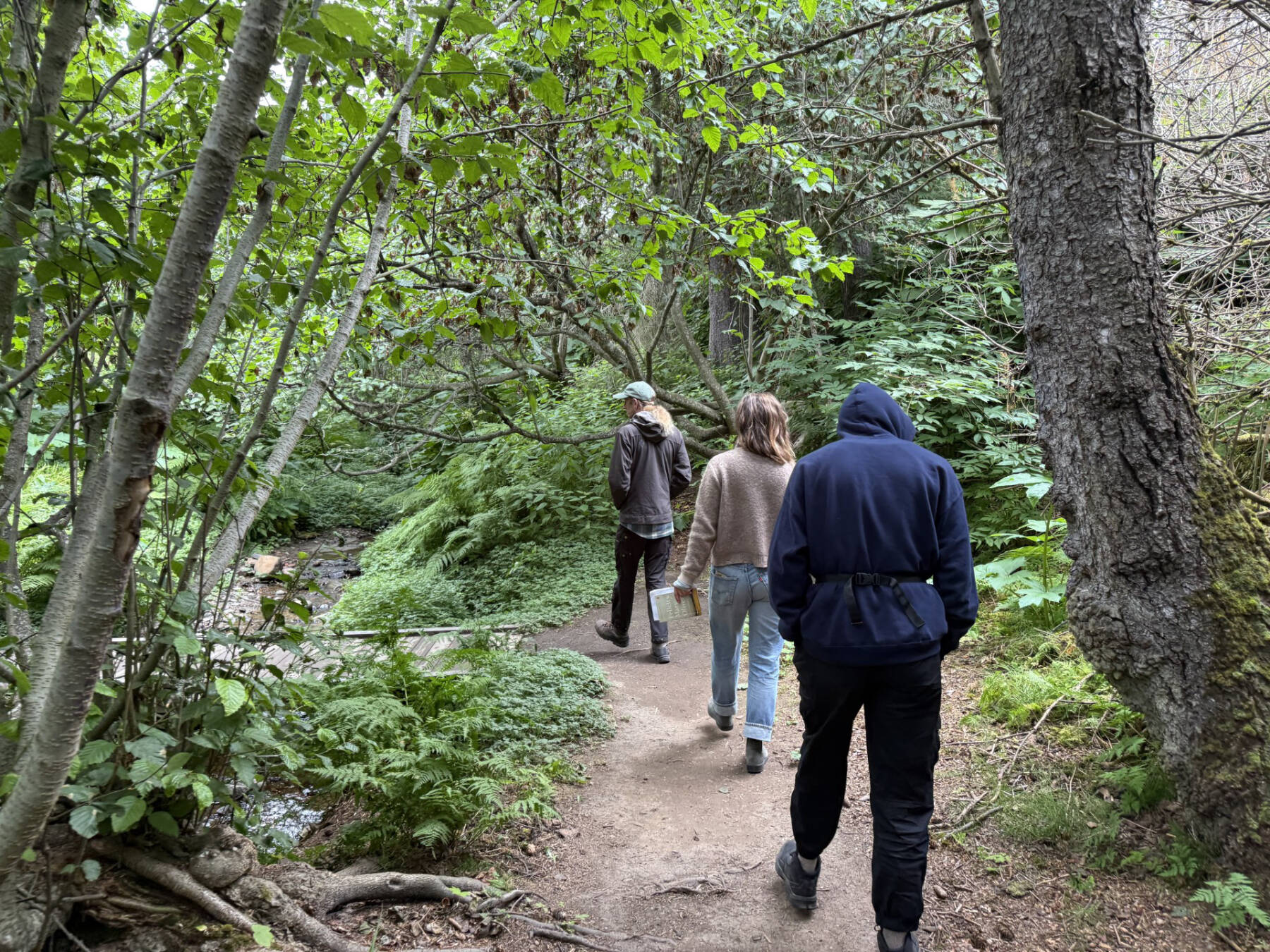
Yarrow Hinnant, Elizabeth Pileckas and Kim McNett walk the Pratt Museum Trail on Friday, July 25. (Chloe Pleznac/Homer News)
