
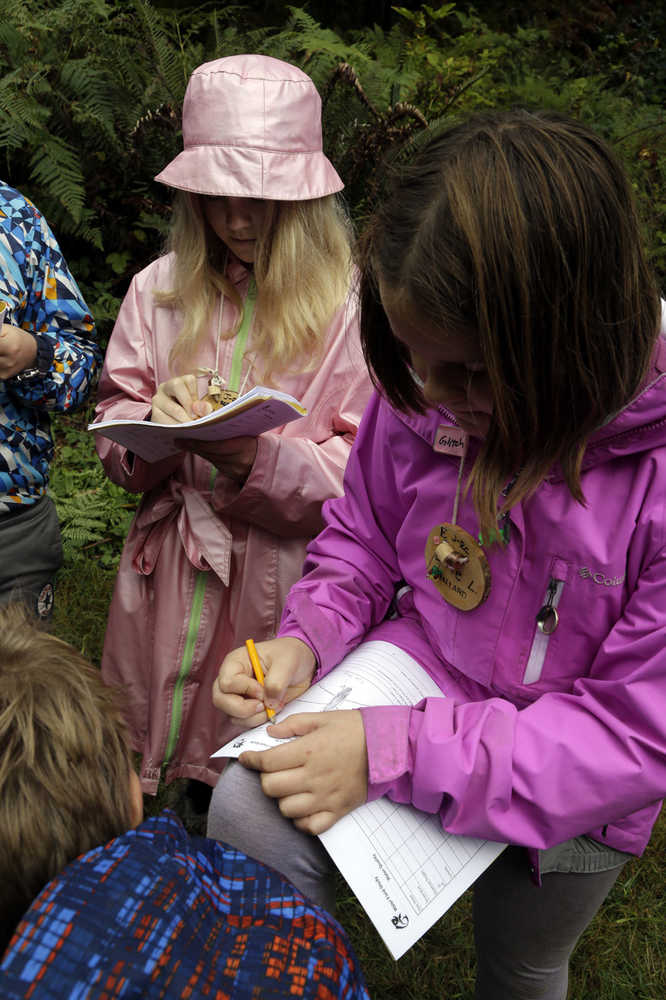
MOUNT HOOD NATIONAL FOREST, Ore. — Each year, thousands of Oregon parents hug their kids goodbye and send them tramping into the wilderness for up to a week to learn about their state’s natural wonders.
The Outdoor School program was groundbreaking when it started more than a half-century ago. Since then, more than 1 million children have enjoyed — or endured — this rite of passage at campsites scattered from Oregon’s stormy coast to its towering evergreen forests to its rugged high desert.
At the program’s heyday, 90 percent of sixth-graders spent the week testing water samples, studying fungi and digging through topsoil. Today, just half of Oregon’s 11- and 12-year-olds take part, mostly through a patchwork of grants, fundraising, parent fees and charitable donations. Caps on property taxes, plus the recent recession, have forced many school districts to scrap the program or whittle it down to just a few days.
Now, backers of a statewide ballot measure want to use a slice of lottery proceeds to guarantee a week of Outdoor School for all children. If it passes, the measure would make Oregon the only state with dedicated funding for outdoor education, including students in charter, private and home schools, said Sarah Bodor, policy director for the North American Association for Environmental Education.
Opponents, however, say its passage would mean deep cuts to a state agency tasked with economic development by siphoning away millions in lottery money critical to expanding Oregon business. And at least one outspoken state lawmaker worries Measure 99 would impose liberal Portland’s values on children in rural Oregon where farming, mining, logging and fishing are a way of life.
The push to fund Outdoor School dovetails with a national trend toward outdoor learning, Bodor said. More than two dozen states have developed environmental literacy plans as educators realize the importance of outdoor time for developing critical thinking and leadership skills, she said.
“But these are really unfunded mandates and … the outdoor component is the piece that very often gets left behind,” Bodor said.
Measure 99 would cover that unfunded cost by taking up to $22 million — or 4 percent a quarter — from the state lottery’s economic development fund to send 50,000 fifth- or sixth-graders to Outdoor School each year. The Oregon State University Extension Service would dole out the money to school districts using a process that will be determined if the measure passes.
Applying for the lottery funds would be voluntary, and schools, educational districts and nonprofits that already run Outdoor Schools around the state could continue to do so.
To get the state funding, programs would have to meet certain criteria, including a curriculum that includes the study of plants, animals, soil and water; discussion of the role of natural resources in the state economy; and lessons on the relationship between economic growth, natural resources and conservation.
“This is not a mandate — it’s an offer. And we wanted to make sure it was a real one, which means providing sufficient funding to cover the cost of a good, high-quality program,” said Rex Burkholder, chairman of the Measure 99 campaign committee.
With two weeks to go before the election, Measure 99 has no organized opposition, and polls indicate it will pass — but not everyone is buying it.
State Sen. Betsy Johnson, a Democrat who represents a rural district northwest of Portland, says lottery proceeds are for economic development, not camp. She worries Oregonians who remember their own Outdoor School experience will vote for the measure out of nostalgia without understanding it could hurt other programs.
Economic Development for Central Oregon, a nonprofit that promotes job growth, says the money for Outdoor School would be equivalent to 70 percent of the budget for the state’s economic development agency, which relies on lottery money. Efforts to bring television productions like “Grimm,” ‘’Leverage” and “Portlandia” to Oregon could suffer as a result, it said.
“It’s so feel-good, it’s so ‘Oregon’ that I just worry that people are not going to give it the level of scrutiny it deserves,” Johnson said. “The assumption is Outdoor School … will produce better citizens and good Oregonians. What’s my metric to know if that really happens?”
Supporters point to a Portland State University study that found students who participated in Outdoor School had improved attendance. They also highlight surveys by the Multnomah Education Service District — which provides 7,000 students a year with Outdoor School — that show the program boosts self-confidence and interest in math and science.
At a recent five-day camp in Mount Hood National Forest, sixth-graders from Portland’s Jackson Middle School seemed unaware of the politics surrounding their adventure.
As a light drizzle fell, they dipped nets into a fog-cloaked pond surrounded by stands of Douglas fir trees, sketched water bugs in notebooks and tested the water’s acidity and turbidity as rainbow trout jumped just a few feet away. Each child wore a “wood cookie” — a cross-section of a small log — emblazoned with their name and cabin assignment and decorated with beaded pins to denote their completion of field studies on plants, animals, soil and water.
“It’s definitely better out here,” said 11-year-old Maya Herring, showing off her wood cookie festooned with beads and bling awarded by her counselor. “You can actually feel the nature. It’s not just saying, ‘This is what this fern looks like.’ You can actually feel the fern for yourself.”
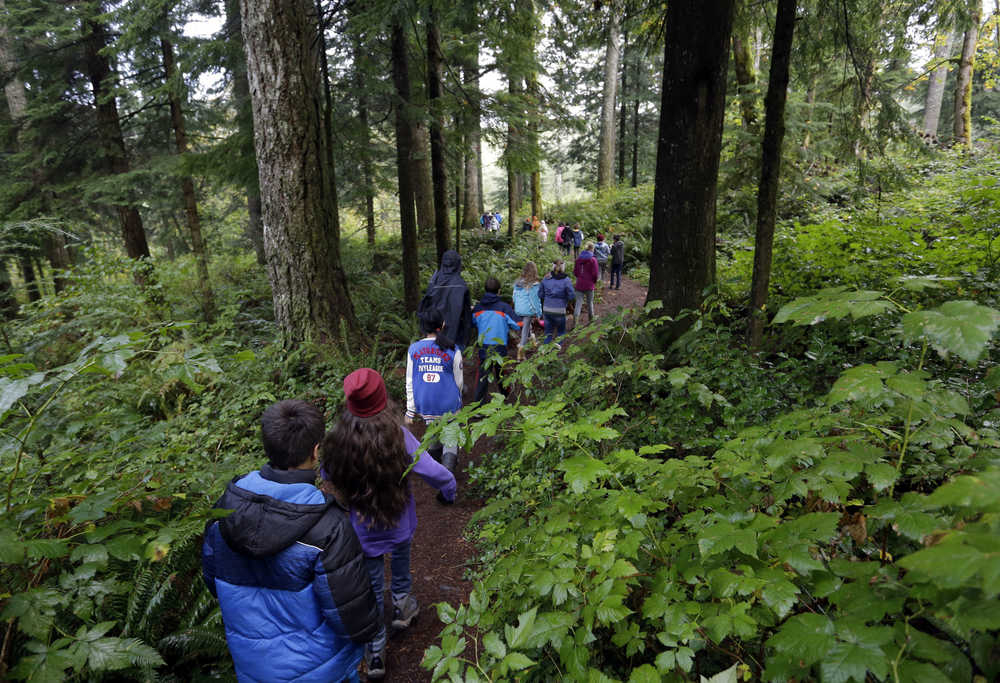
In this Oct. 6, 2016 photo, Outdoor School students walk through the dense forest on their way to a lesson at Camp Howard in Mount Hood National Forest near Corbett, Ore. The outdoor education is unique to Oregon and is a rite-of-passage for public school students that’s meant to instill a respect for nature in each generation–studies show it improves attendance and boosts test scores. (AP Photo/Don Ryan)
