
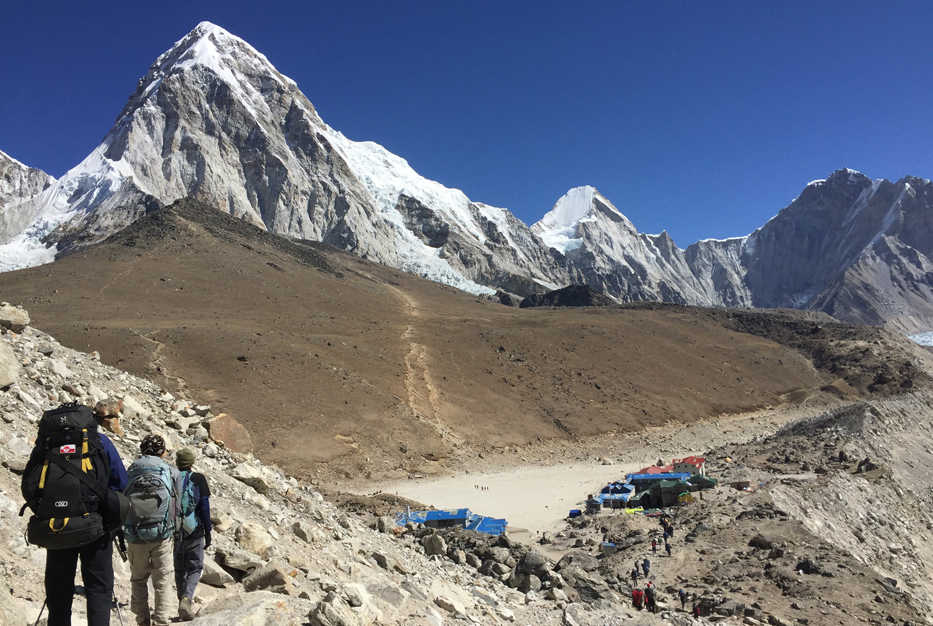
EVEREST BASE CAMP, Nepal — We reach Everest Base Camp on a sunny but chilly afternoon, after an eight-day trek that stretched our physical and mental limits.
Aching knees from steep descents and headaches from mild altitude sickness are forgotten as the yellow and orange tents for the summit-bound — framed by some of Himalaya’s highest snow-capped peaks — come into view.
We stay for only about an hour on a hill overlooking the camp, pitched near Everest’s Khumbu icefall. We take photos, along with dozens of other amateur trekkers from across the globe, before hiking to the nearest lodge, about three hours away.
We’re proud. We reached 5,364 meters (17,598 feet). That’s roughly 550 meters (1,800 feet) higher than Mount Blanc, the tallest peak in the Alps. Getting to one of Nepal’s most popular trekking destination also brings home a simple truth — it’s the journey that matters.
The 90-kilometer (56-mile) hike to Base Camp from an airstrip in the mountain village of Lukla was a “real pain,” says Wayne Pedersen, 57, a South African who works in Dubai. “But I never would have missed it because of what I got out it — the scenery, the beauty, the comradeship.”
Our journey starts in early April, at the Shanker Hotel, a former 19th century royal palace in Nepal’s capital, Kathmandu. We each get a water-resistant duffel bag, sleeping bag and down jacket.
Some of these trekkers came to Nepal last year, but abandoned their plans when an April 25, 2015 earthquake killed nearly 9,000 people and destroyed hundreds of thousands of homes.
The trekking industry — a key money-maker for the country — was hit hard. A year later, bookings are still down 40 percent, said Narayan Regmi of our tour company, Himalayan Glacier.
“Please come to Nepal and help the destroyed economy,” he says.
Now my fellow trekkers, most in their 40s and 50s, are back for a second try.
From Kathmandu, we fly 40 minutes northeast to Lukla, where the tiny Tenzing-Hillary airstrip — named after Edmund Hillary and Tenzing Norgay, the first to summit Everest — is considered one of the world’s most dangerous. Its stunted runway is bookended by a mountain wall and steep drop.
In the mountains, the only modes of transportation are our feet, yaks, donkeys and — in an emergency — helicopters. We don’t see a car for two weeks.
During our first downhill hike from Lukla, my left knee starts hurting.
At the first overnight stop, I realize I’ve underestimated the physical challenges. In coming days, I take anti-inflammatory pills to get through steep descents.
Coping with the rising altitude is the biggest challenge. A hasty ascent into air with less oxygen can lead to mountain sickness, with headaches and vomiting. Our Nepali head guide, Tulsi Bhatta, exhorts us to “go slow and drink lots of water.”
A few days into the trek, he begins measuring oxygen levels — we stick a finger into a small gadget — and offers those with poor readings a diuretic to alleviate symptoms.
I get a headache at around the 4,000 meter (13,000 feet) mark. By the time we reach the night’s stop in the village of Dingboche, I take one of Bhatta’s pills and crawl into my sleeping bag.
Unfortunately, a side effect involves frequent bathroom trips, which in our no-frills lodge means stumbling down a cold hallway with a flashlight.
I’m better the next day. Others also suffer from minor bouts, but everyone recovers.
We soon realize that pushing through exhaustion creates a special kind of satisfaction.
The scenery is truly spectacular. It includes sightings of Everest, the world’s highest mountain at 8,850 meters (29,035 feet), and of Ama Dablam, a snow-topped peak flanked by long ridges that make it look like a giant ghost raising his arms.
We repeatedly cross gorges cut by roaring white-water rivers, using wobbly suspension bridges adorned with colorful Buddhist prayer flags. Rhododendron trees with bright magenta blooms, green fields of onions and low rock walls line our path.
Villagers occasionally greet us with a smile and a “Namaste.” No one pushes goods on us.
“You get a culture and one of the most amazing environments at the same time,” says Steven Wilson, 49, a pastor from Lexington, Massachusetts, who is trekking with a different group. “I think that’s the gift.”
Spring and fall are peak seasons. The trail to Base Camp is more crowded than expected.
Hikers make way for load-carrying yaks. Bells strapped around their necks announce their arrival.
Porters, some in their early teens, have right of way. Hunched forward, they carry trekkers’ heavy duffel bags and goods for local communities. This includes stoves, cooking gas, Coke and plywood for construction. Loads are suspended from headbands and cushioned with foam rolls pressed against lower backs.
Bhatta, 32, who started as a porter, then learned English and became a guide, says he’s been fortunate.
“I didn’t have any options,” Bhatta, whose home was destroyed in the earthquake, says of his load-carrying days. “In Nepal, we don’t have industries, nothing.”
It is always a relief to reach the teahouse — simple lodges — where we spend the night.
Teahouses become more basic as we push up the mountain. Prices for bottled water increases, reflecting higher transport costs at rising elevations.
Typically, a stove in the dining room burns dried yak dung for warmth and heats water in huge kettles. Weary trekkers play cards or read books as cookies are passed around.
Dinner staples include egg dishes, soups, stuffed dumplings and the local specialty, dal bhat — lentil soup over rice and vegetable-potato stew.
Searching for protein, I buy cans of tuna, seek peanut butter for breakfast and eat yak steak twice. It’s chewy, but edible when mixed with a sauce.
Unheated rooms have wooden bunks with thin mattresses. Communal toilets and wash basins are common. Hot showers are increasingly rare at higher elevations.
In a nightly ritual, I roll out my sleeping bag, cover a pillow with my own case and place a flashlight next to my head.
There’s little to do after nightfall except read. An 8 p.m. bedtime is not unusual.
Bhatta and his assistants, always cheerful, come around with “bed tea” in the mornings, to make sure everyone is awake and ready to pack their bags.
The rewards of the 12-day trek become more apparent toward the end.
I’m stronger and more sure-footed. I fall into a rhythm as I plant my trekking poles on steep steps and push up without gasping for air.
The sights and sounds of the trail make up for any remaining discomfort.
Colorful prayer wheels whirl, powered by a small stream. Maroon-robed monks chant religious verses in the region’s largest Buddhist monastery. A bird of prey glides above a canyon. Elsewhere, a group of Nepali men sit on the ground, gambling with dice and small shells.
We walk in silence at times, single file. There are no pinging iPhones here, no distractions. It’s a chance to contemplate issues that get pushed aside in the day-to-day busy-ness of life.
In the best moments on the trail, it’s peaceful.
