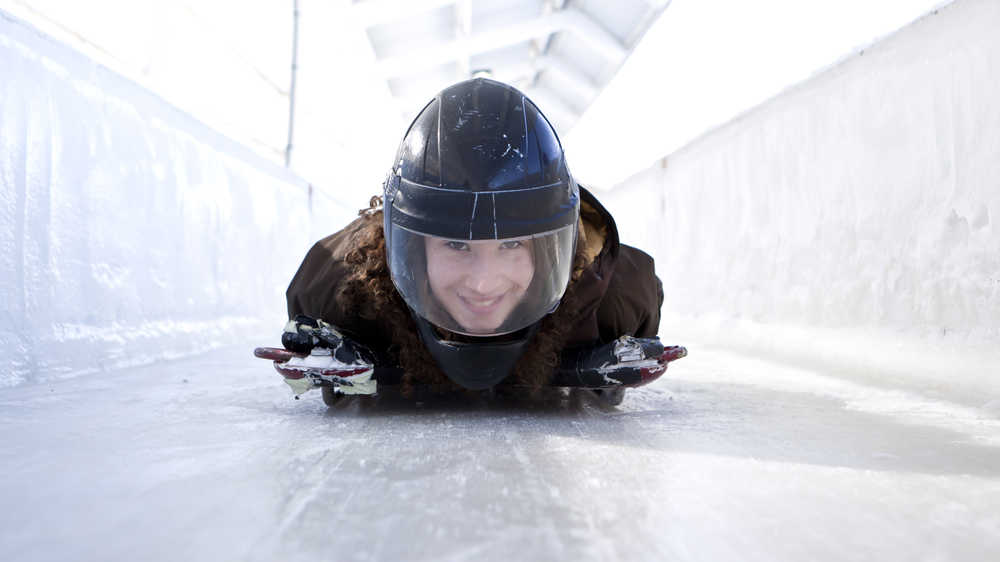
This undated photo provided by the Olympic Regional Development Authority shows  a person taking a skeleton ride at Mt. Van Hoevenberg in Lake Placid, N.Y.  For $75, visitors on winter Saturdays can take a sled ride belly down, head first on a sled the size of a throw rug. While racers take running jumps onto their sleds and can exceed 80 mph, visitors are pushed off about halfway down the run and can hit 30 to 40 mph.  (AP Photo/Olympic Regional Development Authority)

This undated photo provided by the Olympic Regional Development Authority shows a person taking a skeleton ride at Mt. Van Hoevenberg in Lake Placid, N.Y. For $75, visitors on winter Saturdays can take a sled ride belly down, head first on a sled the size of a throw rug. While racers take running jumps onto their sleds and can exceed 80 mph, visitors are pushed off about halfway down the run and can hit 30 to 40 mph. (AP Photo/Olympic Regional Development Authority)

On the wild slide: Lake Placid site offers skeleton rides

LAKE PLACID, N.Y. — Sledding can be pleasant and pastoral, with big toboggans, snowy hills and rosy cheeks. And then there’s skeleton sledding: belly down, head first on a sled the size of a throw rug, hard ice whooshing by your face.

The site of the 1980 Winter Olympics at Lake Placid offers the rare chance to try this lesser known sliding sport on its twisting sled run. For $75, visitors on winter Saturdays can take a skeleton ride on the wild slide. While racers take running jumps onto their sleds and can exceed 80 mph, visitors are pushed off about halfway down the run and can hit 30 to 40 mph.

Still, the 40 seconds zip by on the little sled.

“A lot faster than I thought it was going to be,” said Scott Hayes of Toronto. “You think, ‘Ah well, I mean it’s a public ride, how fast can it go?’ But it went really fast.”

Hayes was among more than a dozen thrill-seekers who showed up recently at the Olympic Sports Complex down the road from the village of Lake Placid. Riders were driven midway up the run and fitted for helmets and sleds, which are low to the ground and stretch from riders’ shoulders to knees.

Coach Rebecca Sorensen gave instructions: grab handles on side, elbows straight, shoulders down, the less you move the better.

“Hold on to the sled at all times,” Sorensen added, as if this would ever be an issue.

Then she pushed riders off. Gravity does the rest as the sleds snake through the U-shaped track. Riders are sort of like human missiles, able to lift their chins to see the upcoming twists closing in fast. One last turn and then a gentle upgrade slows the sleds down.

Sleds are trucked back up the hill for the next amateur. Riders work through their adrenaline rush. Jillian Frascoia of Richmond, Vermont, raised her arms and cheered after her run.

“It was so fast, much faster than I thought, much scarier than I thought,” she said. “It was great!”

Skeleton reportedly got its name from the “bony” appearance of early sleds from the late 19th century. Often eclipsed by bobsled and luge, skeleton returned to the Olympics in 2002 after a 54-year hiatus.

In fact, far more people show up later in the morning when the Olympic center switches to offering bobsled rides.

The bobsled riders get to climb into a more substantial sled with other passengers. And they get to sit. Last year, there were 10,917 bobsled rides at the complex, versus 1,166 skeleton rides.

The bobsled crowd seems more family oriented. Skeleton riders seem to like their thrills closer to the bone.

“You can go tobogganing or sledding and it’s not the same thing,” said Karen Lonnstrom of Voorheesville, New York, “so this will be a once-in-a-lifetime kind of experience.”

More in Life

Historic Elwell Lodge Guest Cabin is seen at its new spot near the Kenai National Wildlife Refuge’s Visitor Center. (USWS)
Around the peninsula

Local events and happenings coming soon.

Nián gāo is a traditional Lunar New Year treat enjoyed in China for over two thousand years. Photo by Tressa Dale/Peninsula Clarion
A Lunar New Year’s treat

This sweet, steamed rice cake is chewy, gooey and full of positivity.

This excerpt from a U.S. Geological Survey map shows the approximate location of Snug Harbor on lower Kenai Lake. It was in this area that William Weaver nearly drowned in 1910.
Ben Swesey: More to the story — Part 2

AUTHOR’S NOTE: Michigan’s hard-luck Swesey clan sprang into existence because of the… Continue reading

File
Minister’s Message: Rhythms and routines

Your habits are already forming you.

This dish is creamy, rich and comforting, and gets dinner time done fast. Photo by Tressa Dale/Peninsula Clarion
Full of mother’s love

This one-pot dish is creamy, rich and comforting, and can be ready in 30 minutes.

This screenshot from David Paulides’s “Missing 411” YouTube podcast shows the host beginning his talk about the disappearance of Ben Swesey and William Weaver.
Ben Swesey: More to the story — Part 1

More than a hundred years after Ben Swesey and Bill Weaver steered… Continue reading

Photo by Clark Fair
This 2025 image of the former grounds of the agricultural experiment station in Kenai contains no buildings left over from the Kenai Station days. The oldest building now, completed in the late 1930s, is the tallest structure in this photograph.
The experiment: Kenai becomes an agricultural test site — Part 8

Over the past 50 years or more, the City of Kenai has… Continue reading

File
Minister’s Message: So your life story can be better

Last month the Christmas story was displayed in nativity scenes, read about… Continue reading

These gyros make a super delicious and satisfying tofu dish. Photo by Tressa Dale/Peninsula Clarion
A new addition to the menu

Tofu gyros with homemade lentil wraps are so surprisingly satisfying and add extra fiber and protein to a meal.

Death notice: Marvin “Ted” Dale Smith

Marvin “Ted” Dale Smith passed on Dec. 27, 2025 in his home.… Continue reading

Photo courtesy of the 
Arness Family Collection
L. Keith McCullagh, pictured here aboard a ship in about 1915, was a U.S. Forest Service ranger charged with establishing a ranger station in Kenai, a task that led him to the agricultural experiment station there and into conflict with “Frenchy” Vian and his friends.
The experiment: Kenai becomes an agricultural test site — Part 7

AUTHOR’S NOTE: After the agricultural experiment station in Kenai closed May 1,… Continue reading

These treats are full of fiber and protein and contain less sugar than a Nutri-grain bar, so you can feel good about spoiling yourself a little. Photo by Tressa Dale/Peninsula Clarion
A treat for a new start

These cosmic brownies are a healthier, homemade version of the usual cafeteria currency.