
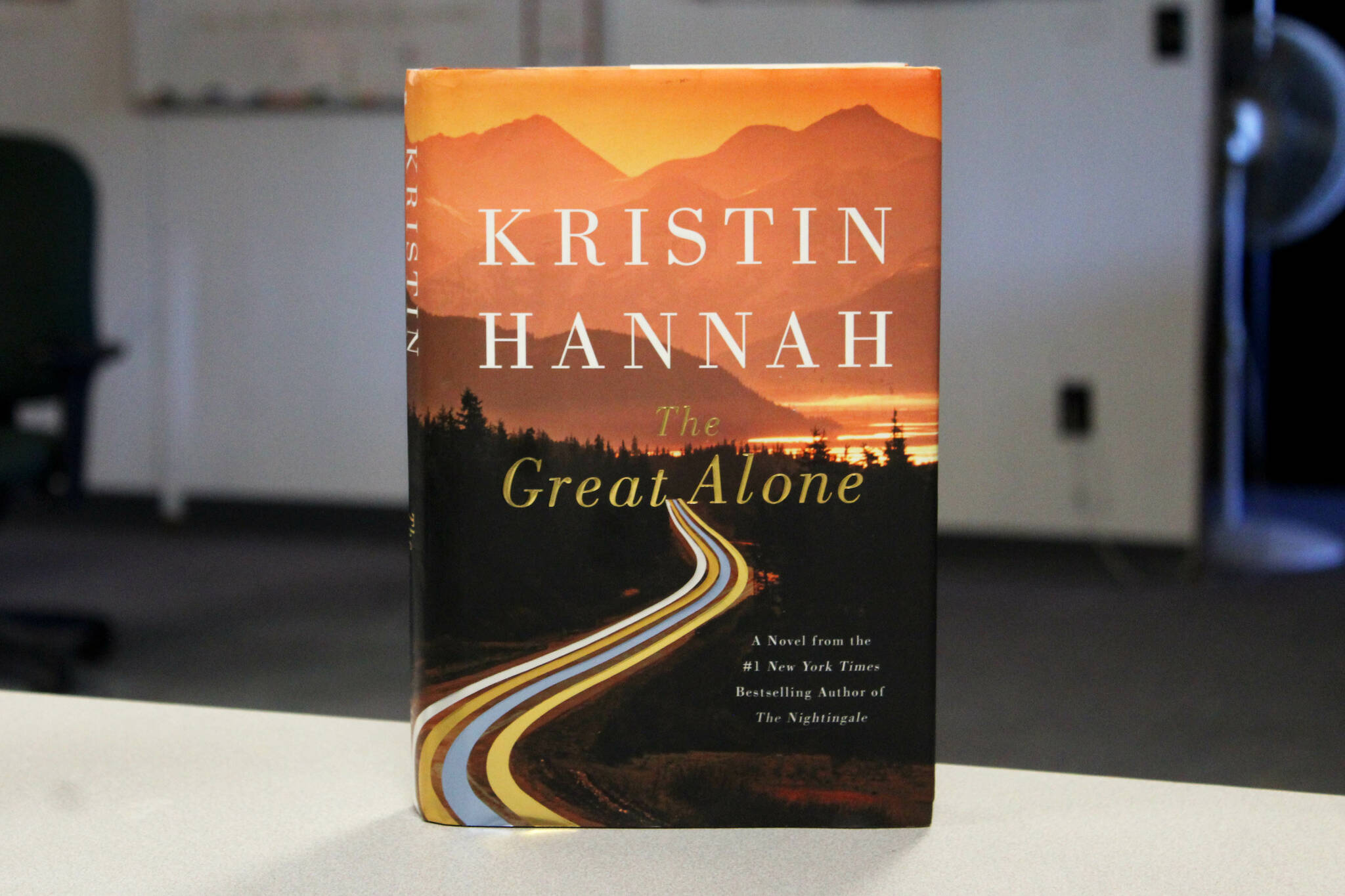
Every few years, I’ll read a book that awakens in me such strong feelings that I am compelled to throw it across the room or I find the page blurred by my tears.
I’ve had a copy of Kristin Hannah’s “The Great Alone” sitting in my closet since at least October 2021. I got a copy of the #1 New York Times bestseller for $3.99 at Title Wave in Anchorage, somewhat begrudgingly and with an oversized dose of skepticism about a book that I knew was widely loved among social media reading circles.
I put off reading it because of how much I’d seen it hyped up, because it is a long book and because I was skeptical about how it would represent life in Alaska. The joke was on me. I devoured all 440 pages in four days, and found myself reading into the wee hours of the morning, thoroughly riveted and hindered only by the battery life of my book light.
“The Great Alone” follows Lenora “Leni” Allbright, whose mom and dad move their family from Seattle to Alaska in 1974. The dad, Ernst, is a recently returned prisoner of war who was serving in Vietnam and inherited a chunk of land in Alaska from one of his fallen soldiers.
The book takes its title from a poem by Robert Service, the oft-called “Bard of the Yukon,” who in “The Shooting of Dan McGrew” asks: “Were you ever out in the Great Alone, when the moon was awful clear/And the icy mountains hemmed you in with a silence you most could hear.”
The Allbright homestead is said to be located in a remote part of the Kenai Peninsula, across Kachemak Bay. The town in the book is the fictional Kaneq, however, anyone who has spent time on the peninsula will surely recognize Hannah’s description as one resembling the layout and geography of Seldovia.
The book follows Leni through a crucial time in her life, from learning to homestead and making friends to growing up and falling in love, all the while trying to find her place in a family defined by her father’s PTSD, alcoholism and physical abuse. While there, Leni and her mom come to fear the winter — both for the challenges it brings and for the way it makes Ernst more violent.
A couple of community members, aware of Ernst’s abuse, send him to work on the Trans-Alaska Pipeline System as a way to get him out of the house. Over the years, tensions between Ernst and Kaneq residents rise, as he devolves more into an apocalyptic worldview that begins to cut Leni and her mom off from the town.
It’s hard to say much more about the plot without spoiling parts of the book.
Something that I found myself constantly thinking throughout the book was how spot-on some of Hannah’s details about Alaska were. She talks, for example, about fireweed and lupine bouquets, the window seat view on a plane ride from Anchorage to Homer and the teeming beauty of the Kenai Peninsula coast.
I learned after reading that the accuracy stems undoubtedly from Hannah’s own ties to the Kenai Peninsula, which I was unaware of before reading “The Great Alone” and which loosely follow the beginning of the book. Per the “Acknowledgements” section of “The Great Alone,” Hannah’s parents moved their family to the Kenai Peninsula in the 1970s after her dad found adventure on the Kenai River.
Hannah says her parents met homesteaders Laura and Kathy Pedersen, and the four opened what’s now known as the Great Alaska Adventure Lodge in Sterling. The lodge was listed for sale earlier this year and offers a chronology of its origins on its website’s about page. Hannah is shown in the first image on the webpage, of her family in their VW bus en route to Alaska, similar to the beginning of “The Great Alone.”
Isolation, in all its forms, is a central theme of the book. At times like bildungsroman, love story, family drama and thriller mystery, all characters in “The Great Alone” grapple with what it means to be alone on a vast and dangerous landscape.
That said, anyone particularly sensitive to descriptions or discussion of domestic violence may want to skip this book, as it is a central and graphically presented component. Ernst’s struggles with PTSD and alcoholism are also prevalent and at times disturbing.
For a lot of reasons, “The Great Alone” is my first five-star read of 2023, and a worthy addition to anyone who loves Alaska and a beautiful story.
Reach reporter Ashlyn O’Hara at ashlyn.ohara@peninsulaclarion.com. Off the Shelf is a bimonthly literature column written by the staff of the Peninsula Clarion.
