
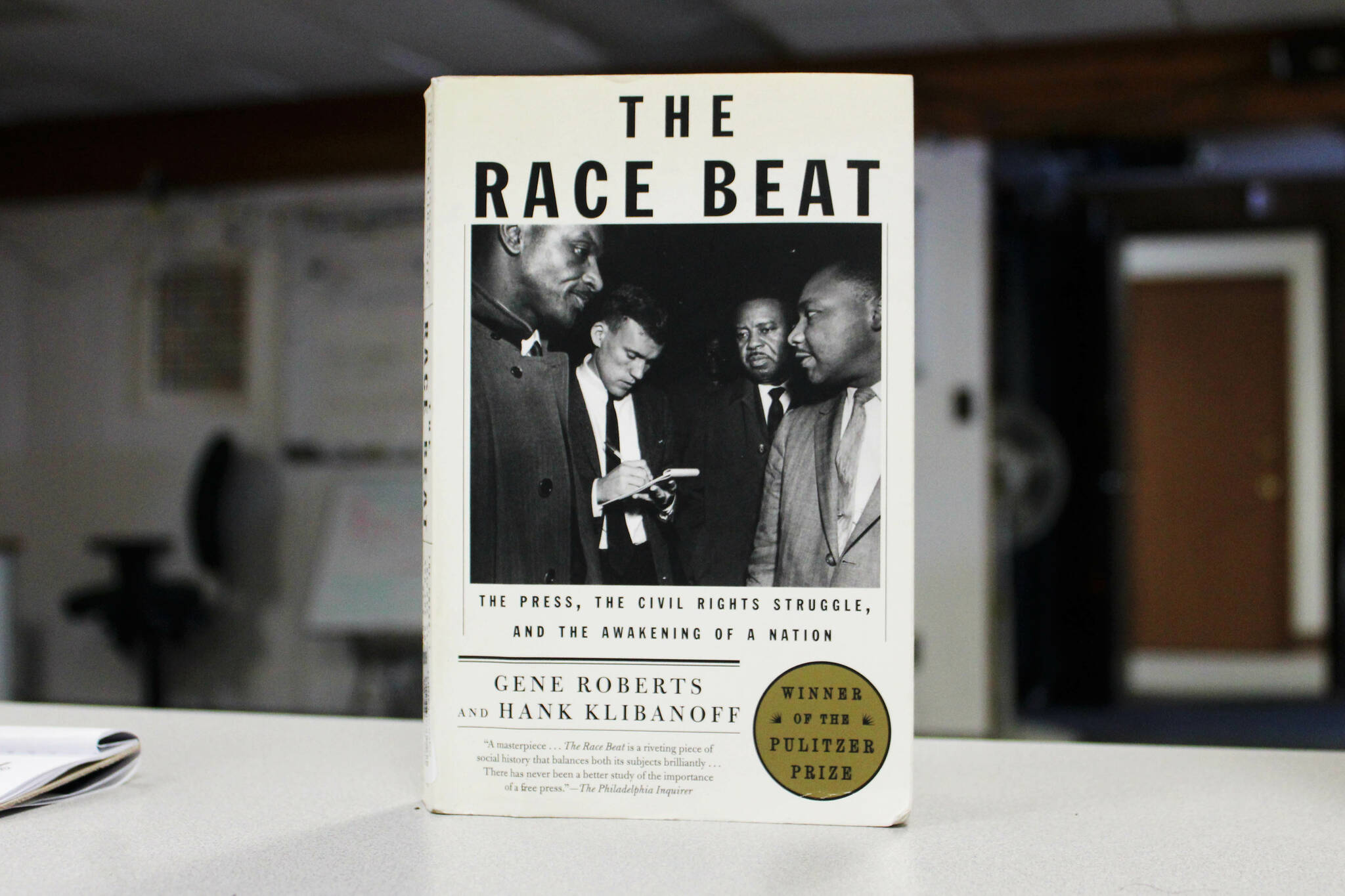
While it is important to know about and honor Black history every month, one title jumped to the top of my to-be-read pile at the beginning of this February.
“The Race Beat: the Press, the Civil Rights Struggle, and the Awakening of a Nation,” written by journalists Gene Roberts and Hank Klibanoff, is an extensive look at how coverage of the American civil rights movement changed public opinion on the issue. The work won the 2007 Pulitzer Prize in History.
I was sucked in by the book’s intriguing title, which ignited a curiosity about how people who do the same job as me carried out their duties during an important period in U.S. history.
In my experience, seeing a “Winner of the Pulitzer Prize” seal on a book’s cover is a reliable indicator of whether it will be a quality read. Even if the writing is dry, I figure I’ll at the very least learn something new. It felt like a good book to read during Black History Month as a way to learn more about Black history and about the role of my profession in that narrative.
“The Race Beat” covers seemingly all major civil rights milestones: the Emmett Till trial, Brown v. Board of Education, the Montgomery bus boycotts, Freedom Riders, the Little Rock Nine, riots at Ole Miss when James Meredith tried to enroll and, all throughout, the rise of Martin Luther King Jr. as the voice of a movement.
Indeed, the book checks off the things I was looking for when I picked it up: I learned more about the civil rights movement, I learned more about the history of journalism and I learned more about the history of the civil rights movement as covered by journalists. For those reasons alone, it is worth the read.
Still, the book is not without its faults. Foremost is that neither of the authors are Black, which made me question whether or not the book itself was lacking an important — maybe the most important — perspective. Helpful supplementary material may include Maloyd Wilson’s “The Black Chronicle,” which compiles 178 years of Black history as covered by African American newspapers.
Further, while the book’s structure follows the chronology of the movement, some chapters read more like fact files about the nuances of the relationships between who owned this newspaper or was aligned with this politician, in a way that sometimes drew attention away from the work’s underlying mission.
Those criticisms, though, do not take away from the power of the book’s more impactful scenes. Ones that come to mind are the launching of molotov cocktails into a Freedom Ride bus carrying demonstrators and reporters to Birmingham, bloodshed at the University of Mississippi after a Black man tried to enroll as a student and, throughout, the complicity of law enforcement and politicians.
It also reinforces the power of the pen and underscores the importance of a free press in helping disperse information, and the pushback that often comes with sharing uncomfortable truths. Black newspapers were covering Southern “race beat” long before any national outlets were paying attention, despite being victims of the same discrimination they sought to expose.
Suppression efforts were rife throughout the movement.
Segregationists in Alabama fought The New York Times in court with the goal of silencing its reporters, which was largely effective in eliminating the paper’s presence in that state. The book describes multiple instances of segregationist mobs becoming violent toward reporters after seeing them take pictures or notes.
A nice feature of the book is the inclusion of numerous photographs captured by photojournalists from the time, many of which are referenced or contextualized in other chapters.
Setting the mission statement of “The Race Beat” aside, it is, at the end of the day, a sobering and candid reminder of what life looked like for Black Americans in the Jim Crow South, the collective power of many voices standing up to injustice and the role a free press plays in shining a light on what some people would rather be kept in the dark.
“The Race Beat: the Press, the Civil Rights Struggle, and the Awakening of a Nation” was published in 2006 by Vintage Books, a division of Random House, Inc.
Reach reporter Ashlyn O’Hara at ashlyn.ohara@peninsulaclarion.com.
Off the Shelf is a bimonthly literature column written by the staff of The Peninsula Clarion that features reviews and recommendations of books and other texts through a contemporary lens.
