
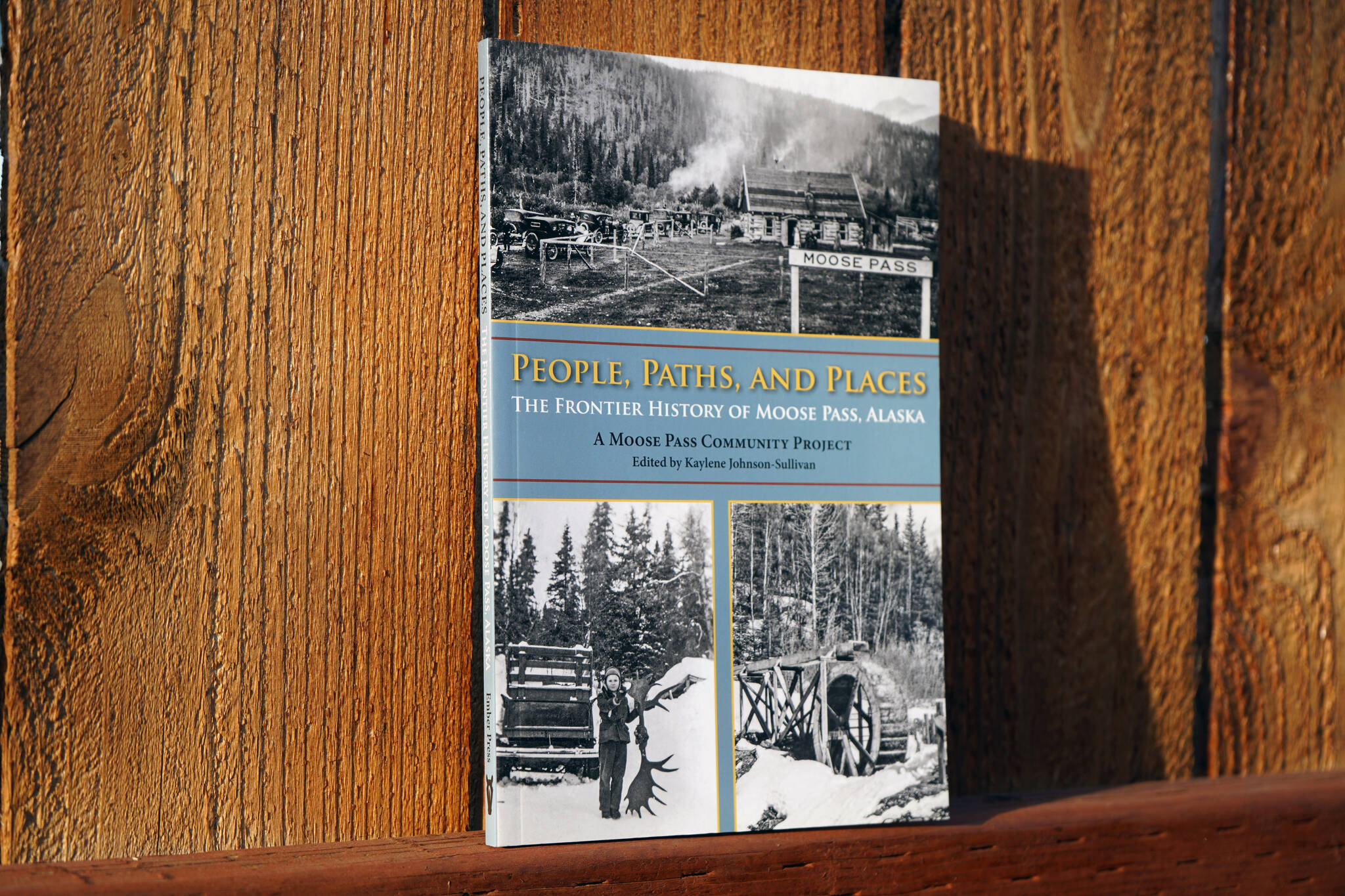
A copy of “People, Paths, and Places: The Frontier History of Moose Pass, Alaska” stands in sunlight in Soldotna, Alaska, on Friday, Sept. 29, 2023. (Jake Dye/Peninsula Clarion)

A copy of “People, Paths, and Places: The Frontier History of Moose Pass, Alaska” stands in sunlight in Soldotna, Alaska, on Friday, Sept. 29, 2023. (Jake Dye/Peninsula Clarion)

Off the Shelf: Community history project a colorful portrait of hometown

The book features the work of students at Moose Pass School and integrates further stories pulled from a community newspaper

Since reading Charlie Stephens’ autobiographical “Passion Over Pain” last year, I’ve been charmed by its depiction of his hometown, Moose Pass. That feeling solidified when I had a great time visiting the town — for the first time I can recall in my 27 years on the Kenai Peninsula — earlier this year. That’s why I was eager to read “People, Paths, and Places: The Frontier History of Moose Pass, Alaska,” an interesting primer on the community’s history made by the people who live there.

The book, described on its cover as “A Moose Pass Community Project,” features the work of students at Moose Pass School and integrates further stories pulled from a community newspaper published in the late 1930s through much of the 1940s. As the title suggests, its a glimpse at some of the largest figures, locations, and ways of getting around in Moose Pass, mostly confined to the 1930s and 1940s.

Introductory sequences in the text explain that the project came about initially as a series of informational panels installed at the Moose Pass Public Library, under a grant from the Kenai Mountains-Turnagain Arm National Heritage Area, their content written by students. The project grew, especially with the discovery of the Moose Pass Miner archives, and became a full book, published in 2021.

When I was taking journalism classes in Anchorage, I skipped magazines in favor of podcasting, but “People, Paths, and Places” feels to me like it invokes a similar feel. The book is stuffed with short stories about individual places or ideas, sandwiched between larger features.

Featured are names and locations I recognize, even from my relatively limited exposure to the community. It covers the origins of the town — including the different stories of its name — and the people who made it what it is, like Leora Roycroft, the first postmaster and a driving force behind opening the school.

As a reporter, I got a real kick out of the depictions of the small town newspaper and its editor Lois Allen. The book describes lines of people waiting to get their copies fresh from the press, copies traded for firewood, and reporting about all the hottest talk of the town — like a sprained wrist.

“May 12, 1939,” one excerpt in the book reads. “The Crown Point mining company is working the road to their property. That is the blasting you hear.”

While people and places are easy to understand, it was the “paths” that caught me off guard. The book describes the development of roads and railways, mining trails and ill-advised travel over ice in a way that makes the realities of history easier to grasp — if yet somehow harder to believe. Trips up the road to Cooper Landing or Hope in the 1940s didn’t resemble a modern drive on the Seward Highway.

“People, Paths, and Places” is a breezy read — I finished it in a sitting — and a special look at a distinct community. It’s easy to imagine similar treatment given to any community on the Kenai Peninsula, and I’d love to read that just as well.

“People, Paths, and Places: The Frontier History of Moose Pass, Alaska,” was published in 2021 by Palmer-based Ember Press. The copy read for this review was purchased from River City Books in Soldotna.

Reach reporter Jake Dye at jacob.dye@peninsulaclarion.com.

More in Life

Historic Elwell Lodge Guest Cabin is seen at its new spot near the Kenai National Wildlife Refuge’s Visitor Center. (USWS)
Around the peninsula

Local events and happenings coming soon.

Nián gāo is a traditional Lunar New Year treat enjoyed in China for over two thousand years. Photo by Tressa Dale/Peninsula Clarion
A Lunar New Year’s treat

This sweet, steamed rice cake is chewy, gooey and full of positivity.

This excerpt from a U.S. Geological Survey map shows the approximate location of Snug Harbor on lower Kenai Lake. It was in this area that William Weaver nearly drowned in 1910.
Ben Swesey: More to the story — Part 2

AUTHOR’S NOTE: Michigan’s hard-luck Swesey clan sprang into existence because of the… Continue reading

File
Minister’s Message: Rhythms and routines

Your habits are already forming you.

This dish is creamy, rich and comforting, and gets dinner time done fast. Photo by Tressa Dale/Peninsula Clarion
Full of mother’s love

This one-pot dish is creamy, rich and comforting, and can be ready in 30 minutes.

This screenshot from David Paulides’s “Missing 411” YouTube podcast shows the host beginning his talk about the disappearance of Ben Swesey and William Weaver.
Ben Swesey: More to the story — Part 1

More than a hundred years after Ben Swesey and Bill Weaver steered… Continue reading

Photo by Clark Fair
This 2025 image of the former grounds of the agricultural experiment station in Kenai contains no buildings left over from the Kenai Station days. The oldest building now, completed in the late 1930s, is the tallest structure in this photograph.
The experiment: Kenai becomes an agricultural test site — Part 8

Over the past 50 years or more, the City of Kenai has… Continue reading

File
Minister’s Message: So your life story can be better

Last month the Christmas story was displayed in nativity scenes, read about… Continue reading

These gyros make a super delicious and satisfying tofu dish. Photo by Tressa Dale/Peninsula Clarion
A new addition to the menu

Tofu gyros with homemade lentil wraps are so surprisingly satisfying and add extra fiber and protein to a meal.

Death notice: Marvin “Ted” Dale Smith

Marvin “Ted” Dale Smith passed on Dec. 27, 2025 in his home.… Continue reading

Photo courtesy of the 
Arness Family Collection
L. Keith McCullagh, pictured here aboard a ship in about 1915, was a U.S. Forest Service ranger charged with establishing a ranger station in Kenai, a task that led him to the agricultural experiment station there and into conflict with “Frenchy” Vian and his friends.
The experiment: Kenai becomes an agricultural test site — Part 7

AUTHOR’S NOTE: After the agricultural experiment station in Kenai closed May 1,… Continue reading

These treats are full of fiber and protein and contain less sugar than a Nutri-grain bar, so you can feel good about spoiling yourself a little. Photo by Tressa Dale/Peninsula Clarion
A treat for a new start

These cosmic brownies are a healthier, homemade version of the usual cafeteria currency.