
Spring for many brings to mind images of flowers blooming, snow melting, new life growing and a return of sunshine. Inseparable from spring imagery for me is economics. It probably has something to do with tax season, but every spring I find myself writing out (then rewriting out) my monthly budget, reevaluating my student loans and payments and — this year — applying for an Alaska Permanent Fund dividend.
Economics have always been a tad difficult for me to wrap my head around. The mathematics involved are usually straightforward but the system’s susceptibility to public confidence is a tad trippy for my taste. A moment in economics history that frequently keeps me up at night is the 2008 financial crisis.
I was still in elementary school at the time and lack a lot of memories from that year, but I do remember walking to school with my parents and every house on the block having a “for sale sign” or “foreclosed” sign in the yard. No matter how much I study the issue, I have difficulty understanding the magnitude of the crisis’ underlying problem and how it was allowed to fester for so long.
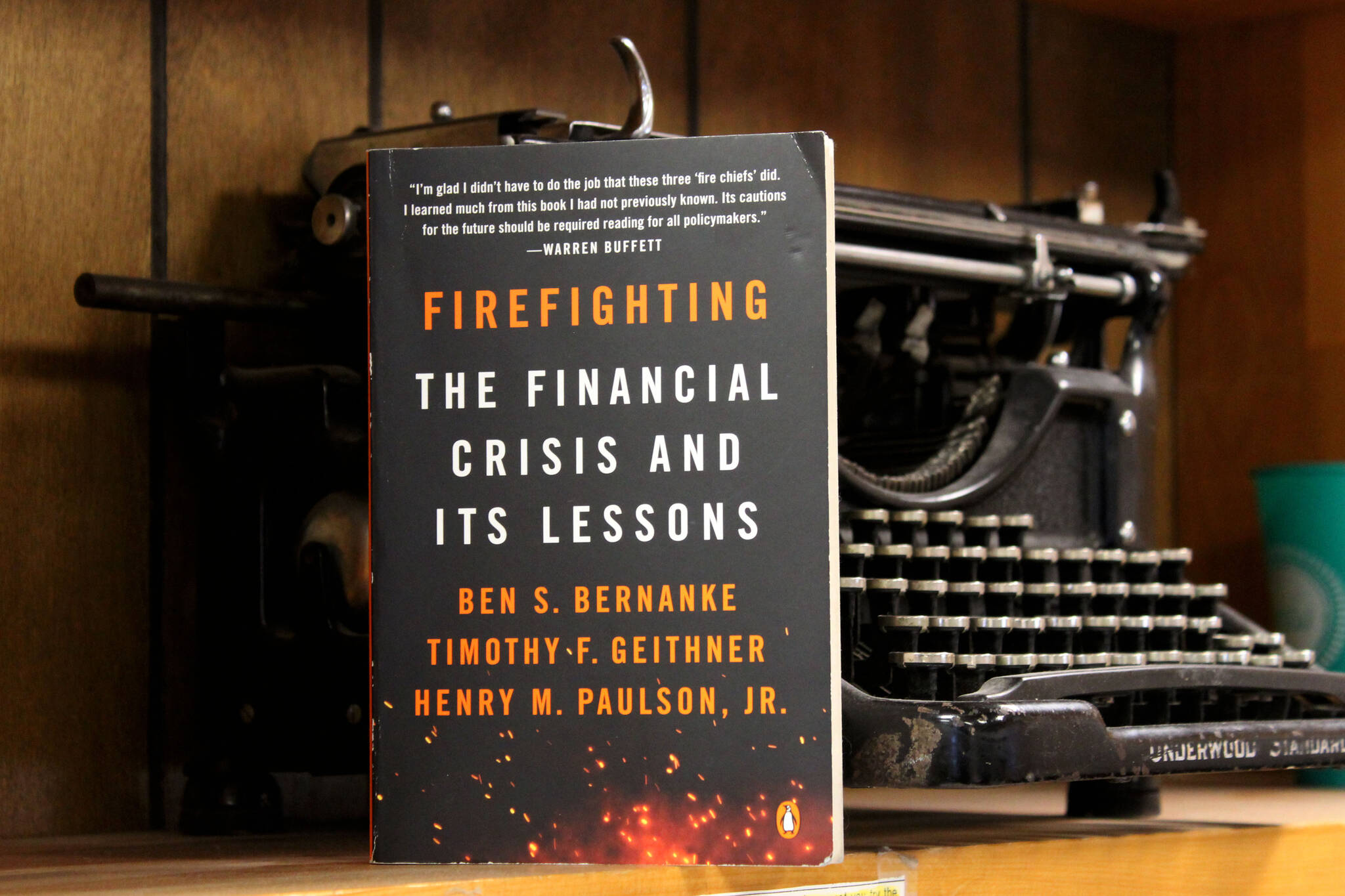
It’s for that reason, I think, that I eagerly snatched up a book about the crisis while browsing at Inkwell’s Bookshop a few months ago.
“Firefighting: The Financial Crisis and Its Lessons” is a 10-year retrospective of the 2008 financial crisis written by people who were in charge at the time. Through text and more than 70 pages of annotated graphs and charts, it lays out how loosely regulated, overleveraged and interconnected financial institutions crippled the U.S. economy by having too much exposure to real estate and vulnerability to short-term financing.
It’s a play-by-play of how financial leaders responded to the crisis wrapped in an extended metaphor of a wildfire, in which the authors position themselves as the firefighters scrambling to contain the blaze of the crisis. From the “dry tinder” in overleveraged nonbanks with little financial oversight to “dousing the fire” with new powers, the metaphor is an effective way to frame a complicated event in history.
Familiarity with the logistics of the financial crisis and the roles different players had is crucial to understand the book at the level of detail into which the authors go. I found pairing the book with complementary materials, including the 2010 documentary “Inside Job” and the 2015 feature film “The Big Short” made it easier to understand.
Worth keeping in mind, of course, is that the book is written by three of the guys who were in charge during the crisis: Henry Paulson, Tim Geithner and Ben Bernanke.
Paulson served as the secretary of the Treasury between 2006 and 2009. Geithner served as the president of the Federal Reserve Bank of New York from 2003 until he was appointed as Secretary of the Treasury in 2009. Bernanke served as chairman of the Federal Reserve from 2006 to 2014.
Their shared belief that they did the best they could in the moment and effectively rescued the global economy is reiterated throughout the book.
“This whatever-it-takes attitude drove almost everything we did during the crisis,” they write.
Walking the “communications tightrope” through which they sought to share information while not further spooking the markets and lobbying Congress for more money and powers amid rigid bipartisan gridlock are among the challenges the three men recall holding up recovery efforts.
In great detail with enough acronyms and financial lingo to warrant a running list of notes, the three men explained the thought process behind their decisions during the height of the financial crisis. Early efforts to reform the country’s fragile financial system, they assert, were squashed because markets were booming. A crisis was needed to spur reform, they say.
What the authors make clear is that their ad hoc approach to solving the crisis in real time was not ideal. Rather, they claim it laid bare all of the powers that financial regulators didn’t have, such as the ability to regulate interconnected nonbanks like Lehman Brothers — perhaps the crisis’ most notorious casualty.
“The ad hoc rescue had exposed the inadequacy of (the Fed’s) powers,” the authors write.
They leave readers with ominous warnings about what could happen if people forget about the causes and effects of the 2008 crisis.
“As the traumas of 2008 recede further into the distance, extended periods of stability could encourage renewed complacency, policymakers may be tempted to soften the post-crisis restrictions on risk taking, and markets could again get comfortable financing significant amounts of maturity transformation outside the perimeter of strict regulatory oversight.”
“Firefighting: The Financial Crisis and Its Lessons” was published in 2019 by Penguin Books.
Ashlyn O’Hara can be reached at ashlyn.ohara@peninsulaclarion.com.
Off the Shelf is a bimonthly literature column written by the staff of The Peninsula Clarion that features reviews and recommendations of books and other texts through a contemporary lens.
