
“Noah”
Paramount Pictures
2 hour, 18 minutes
It’s common for a certain percentage of a theater-going audience to take umbrage when Hollywood translates a true story to the big screen. Events are rearranged for dramatic intent, characters combined or simplified, ages changed to fit whatever lead actor the studio has in mind, etc. It happens in every biopic, and there are some who just cannot stand it because the story on screen is somehow less true.
Now, take that idea and apply it to an ancient tale — a story that forms one of the pillars to the faith of the majority of the world’s believers, and you can imagine that such an adaptation would be fraught with peril. This is exactly what the producers of “Noah” are discovering as the faithful are standing up to complain, sometimes right in the theater — but more on that later.
The irony is that it’s not so much the particular variances from the story, and there are some, that people are complaining about, but more the feel of director Darren Aronofsky’s biblical epic. Be warned if you have yet to see “Noah,” this is not your sweet Sunday school story. This is not the tale of a kindly, white-bearded Dr. Dolittle on a boat in the rain. This is a gripping, rough, very emotional tale of terrifying loss and almost disturbing resolve. It is a movie that feels very Old Testament, in the best and worst ways.
As an adaptation, the story of Noah and the ark is begging for some kind of embellishment, if only to fill out a feature length runtime. In the Bible, the tale takes up a handful of verses, basically laying out the story you already know. Several generations down from Adam comes Noah, a righteous man from the line of Seth (the brother that Cain didn’t kill) living apart from the wicked descendents of Cain who have spread all over the Earth. God likes Noah, but doesn’t think much of the rest of humanity, who have proved very disappointing thus far.
So, God decides to hit reset, wipe out all life from the face of the earth and start over with Noah, his wife, their three sons, and their wives, as well as one pair of each of the various kinds of animals from around the globe. He tells Noah to build a giant boat to ride out the coming storm and after forty days and nights of rain, plus a year or so on ship, Noah and his progeny emerge to go forth and multiply. Cue the rainbow and we’re done.
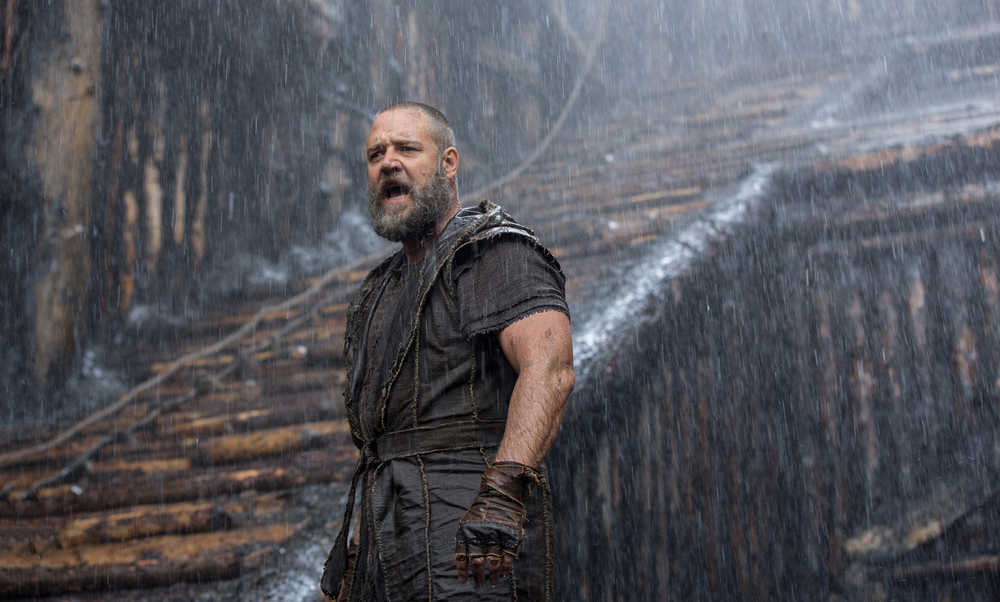
What Aronofsky has done is to create something quite remarkable out of this simple tale, working much harder on an emotional kind of truth than a literal one. In the film, Noah, as portrayed excellently by Russell Crowe, is a bit of grim figure, disturbed by the horrors perpetrated on the world by the Cainites and content to keep his family far apart. When disturbing visions begin to suggest that the Creator is going to punish the world for its evil, he seeks out his grandfather, the ancient Methuselah, played with remarkable restraint by Anthony Hopkins, who confirms his suspicions.
From there, the story plays out much as the Biblical tale, the building of the ark (this time with the aid of some computer generated rock monsters/fallen angels derived from an obscure passage in the Book of Enoch), the gathering of the animals, etc. — but with a few significant differences. In the Bible Noah’s sons Shem, Ham, and Japheth are already married, but here they are still too young. Shem is smitten with Ila, an adopted daughter played by Emma Watson, but Ham and young Japheth are out of luck.
As Ila is unable to bear children due to a childhood injury, Noah decides to get his other two sons wives so as to ensure the survival of the species. But one trip into the hellish camps of the Cainites convinces him that wickedness is endemic to the human condition and that God means to give the world back to the animals only — that Noah and his family are meant to die out after delivering their cargo to safety. This turns Noah into a zealot, of sorts, a man driven to fulfill God’s will no matter what, even if it means resorting to murder.
It’s this aspect of the story, I suspect, that’s got most people in an uproar, and I can understand. Aronofsky is trying to get at Noah’s humanity — at what it would do to a person to have to turn their back on their fellow man, no matter how terrible those men happened to be. In doing so, he’s extended his reach into other parts of the Old Testament, including most obviously the story of Abraham, and while I can understand why some people won’t appreciate it, I can forgive the director his encompassing approach. Crowe’s Noah is a force to behold and the emotional journey his character takes is a powerful one, despite how “faithful” it may or may not be to the source material.
It is not the story beats, however, that I found most impressive in this film. I was fascinated by the look of the movie — Aronofsky succeeds in giving us a world that seems young. The sparse landscape, combined with a peculiar quality to the light gave the impression that this is a very different world, maybe even a stone’s throw from the Garden of Eden. The production design, a combination of bronze age with hints of early industrial, is made up of cultures from around the globe, from European, to Asian, to Middle Eastern, giving no one people a claim to history. I was blown away by Noah’s recounting of the Creation. The narration is scripture, while the images on screen are a dizzying marvel of science, tying the big bang and evolution and creation all together in one beautiful bundle.
And lest you think Aronofsky is attempting to pull a fast one, suggesting God doesn’t exist or that Noah is some kind of flawed secular humanist having a psychotic breakdown, make no mistake. There is no ambivalence in “Noah.” The Creator is real. He’s real, he’s active, and he’s pretty unhappy with the way things have been going. The scenes of wickedness in this film are truly nightmarish, and just short of warranting an R rating. It’s actually very effective, unlike, say, the revelry scene of the golden calf in “The Ten Commandments.” Comparatively, that’s just a zany party with Edward G. Robin as the king of the Mardi Gras parade. As well, the images in “Noah” of the last remaining humans clinging to the rocks as the flood waters take them below was haunting to say the least.
In truth, it’s not in the liberties Aronofsky takes that “Noah” runs into problems. It’s in the conventional blockbuster elements of the story. Much of the computer animation is good in a broad sense, but when it comes to the animals, it’s a little dismal. The fallen angels, or Watchers, are overused, going from interesting mysteries to rejects from “The Lord of the Rings” after a while. The scenes of them hauling lumber up to help build the ark has the effect of making them less … angelic, somehow.
And finally, as any good historical/fantastical epic must, there is a major battle scene, culminating in hand-to-hand combat between the big, bad Tubal-Cain, and Noah. I see the point of inserting a villain, but in this film it’s overdone and mostly unnecessary, adding needless distraction to an already fraught climax.
Known for smaller, tightly wound emotional dramas, Darren Aronofsky has managed to make a tightly wound emotional drama out of the biggest story of them all. Though it gets away from him at times, the director mostly manages to hold it together and creates something remarkable, if not always entirely enjoyable.
Grade: B
One final thought that I alluded to early on. The most disturbing thing that happened at the showing of “Noah” that I went to was right at the end. As soon as the film concluded, just as the credits were rolling, an earnest young man bounded down to the front of the auditorium and began to preach about the evils of Hollywood and how everything we’d just watched was somehow wrong. At least I’m assuming that’s what he talked about, because my wife and I and our friends, among others, made a hurried exit. It’s hard to describe how inappropriate that was. Hijacking an audience in that way to espouse a particular opposing viewpoint is obnoxious, but it can be argued that we’d already paid to see one viewpoint, why not give us two for the price of one?
That’s not what happened, however. What that young man did, instead, was to give many people in that room, myself included, a momentary stab of panic, evoking terrible memories of other radicals in movie theaters and the horror that followed. I’m sure that was not his intention, but if he, or any members of his congregation are reading this, I’d ask that they reserve that particular brand of film criticism for the parking lot or the hall, like the rest of us do.
“Noah” is rated PG-13 for some very disturbing scenes, including bloody violence and some brief scenes of sensuality.
Chris Jenness is a freelance graphic designer, artist and movie buff who lives in Nikiski.
