
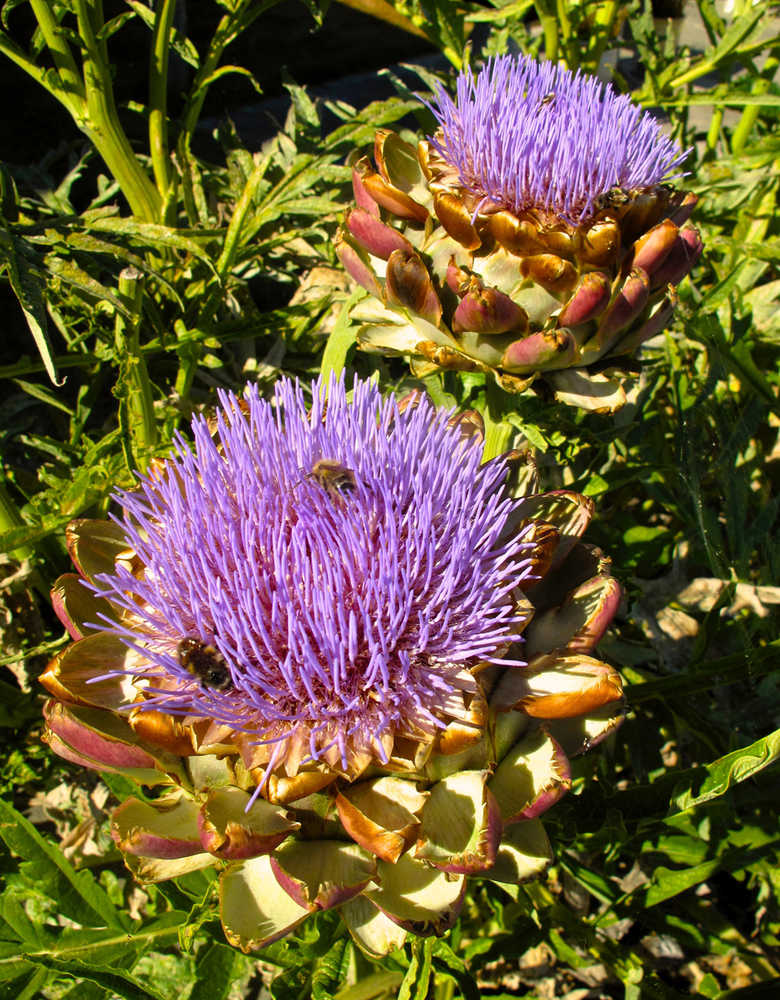
This Aug. 5, 2013 photo shows artichokes on a beachfront near Clinton, Wash. Globe artichokes have much to contribute in home gardens, from providing thin layers of leathery leaves for delectable dining to serving as flowery backdrops in border settings. Pollinators, like the bees shown here, like their purple thistle-like blossoms, too. (Dean Fosdick via AP)

This Aug. 5, 2013 photo shows artichokes on a beachfront near Clinton, Wash. Globe artichokes have much to contribute in home gardens, from providing thin layers of leathery leaves for delectable dining to serving as flowery backdrops in border settings. Pollinators, like the bees shown here, like their purple thistle-like blossoms, too. (Dean Fosdick via AP)

More than edibles, artichokes can be ornamentals

Globe artichokes have much to contribute to home gardens, from providing thin layers of leathery leaves for delectable dining to serving as flowery backdrops in border settings. Pollinators like their purple, thistle-like blooms, too.

“I think they’re kind of a novel plant,” said Dan Drost, a vegetable specialist with Utah State University Cooperative Extension. “They’re not as popular as tomatoes, but they can look very attractive in the landscape. It’s one plant for gardeners to try if they’re feeling adventurous.”

Globe artichokes are native to the Mediterranean region, and grow well as perennials in the Far West and Pacific Northwest with their cool, moist summers and relatively mild winters (Zone 6 when mulched). Artichokes become annuals in frigid areas.

“Oftentimes, gardeners dig up their plants in the fall and plant them out again the next spring in cool climates,” Drost said. “The trick in getting artichokes to flower is that they need a cold period. You need to plant them early to get cold temperatures on them — 50 degrees for a few weeks, and then they’ll flower. Other than that, they’ll just grow tall and can be used as a vegetable.”

Some globe artichoke varieties mature to 4 feet across and 5 or 6 feet tall. As perennials, it’s recommended that they be divided every several years or before they begin to lose their vigor. That increases the number of plants in the landscape as well as their productivity.

“The older the plant, the more years it’s been growing in the garden, the more flower stalks it has,” Drost said. “Each produces seven to 10 blossoms.”

Artichokes can be grown from seed or by using starter plants. It depends on the location.

“To grow artichokes from seed, start them indoors in late February or March under grow lights for about eight weeks, and then plant them outside after the last frost,” said Jim Myers, a plant breeder and researcher at Oregon State University. “In May or June, it’s best to purchase starts from your local nursery or mail-order catalog.”

Artichoke plants should be budding by mid-summer. If the flower buds are destined for the table, then harvest them when they reach full size but before they open. They’ll store properly for three to five days once refrigerated.

“If left to flower, they will produce a large purple thistle that can be dried and used in arrangements,” Myers said in a fact sheet. “If you harvest all the heads in milder climates, artichokes may send up a second crop in the fall.”

Globe artichokes are easy to cook.

“Boil or steam immature heads until tender, drain, remove the leaf scales one by one, dip them in melted butter, vinaigrette or hollandaise sauce, and then suck out the juicy flesh from each scale,” the Royal Horticultural Society recommends. (Mayonnaise works, too.)

Remove and toss the fibrous “choke” in the bud’s center, and then finish by eating the meaty “heart” that extends down into the stem.

“Mature flowers take longer to cook and are less flavorsome, but can be cooked and consumed in the same way,” the society says.

Online:

For more, see this Utah State University Cooperative Extension fact sheet: http://www.extension.usu.edu/files/publications/factsheet/HG-2003-03.pdf

More in Life

Historic Elwell Lodge Guest Cabin is seen at its new spot near the Kenai National Wildlife Refuge’s Visitor Center. (USWS)
Around the peninsula

Local events and happenings coming soon.

Nián gāo is a traditional Lunar New Year treat enjoyed in China for over two thousand years. Photo by Tressa Dale/Peninsula Clarion
A Lunar New Year’s treat

This sweet, steamed rice cake is chewy, gooey and full of positivity.

This excerpt from a U.S. Geological Survey map shows the approximate location of Snug Harbor on lower Kenai Lake. It was in this area that William Weaver nearly drowned in 1910.
Ben Swesey: More to the story — Part 2

AUTHOR’S NOTE: Michigan’s hard-luck Swesey clan sprang into existence because of the… Continue reading

File
Minister’s Message: Rhythms and routines

Your habits are already forming you.

This dish is creamy, rich and comforting, and gets dinner time done fast. Photo by Tressa Dale/Peninsula Clarion
Full of mother’s love

This one-pot dish is creamy, rich and comforting, and can be ready in 30 minutes.

This screenshot from David Paulides’s “Missing 411” YouTube podcast shows the host beginning his talk about the disappearance of Ben Swesey and William Weaver.
Ben Swesey: More to the story — Part 1

More than a hundred years after Ben Swesey and Bill Weaver steered… Continue reading

Photo by Clark Fair
This 2025 image of the former grounds of the agricultural experiment station in Kenai contains no buildings left over from the Kenai Station days. The oldest building now, completed in the late 1930s, is the tallest structure in this photograph.
The experiment: Kenai becomes an agricultural test site — Part 8

Over the past 50 years or more, the City of Kenai has… Continue reading

File
Minister’s Message: So your life story can be better

Last month the Christmas story was displayed in nativity scenes, read about… Continue reading

These gyros make a super delicious and satisfying tofu dish. Photo by Tressa Dale/Peninsula Clarion
A new addition to the menu

Tofu gyros with homemade lentil wraps are so surprisingly satisfying and add extra fiber and protein to a meal.

Death notice: Marvin “Ted” Dale Smith

Marvin “Ted” Dale Smith passed on Dec. 27, 2025 in his home.… Continue reading

Photo courtesy of the 
Arness Family Collection
L. Keith McCullagh, pictured here aboard a ship in about 1915, was a U.S. Forest Service ranger charged with establishing a ranger station in Kenai, a task that led him to the agricultural experiment station there and into conflict with “Frenchy” Vian and his friends.
The experiment: Kenai becomes an agricultural test site — Part 7

AUTHOR’S NOTE: After the agricultural experiment station in Kenai closed May 1,… Continue reading

These treats are full of fiber and protein and contain less sugar than a Nutri-grain bar, so you can feel good about spoiling yourself a little. Photo by Tressa Dale/Peninsula Clarion
A treat for a new start

These cosmic brownies are a healthier, homemade version of the usual cafeteria currency.