Long haul: Adventurer plans on hiking, biking 16,000 remote miles
Published 12:37 am Friday, July 11, 2014
RENO, Nev. — After Adam Bradley walks with his wife, Shelly Culbertson, to her workplace about six miles from their Reno home, the couple will have gone further by foot than many people do in a week.
At that point, Bradley will have about 15,668 more miles of walking and bicycling before his scheduled return, in October, 2015.
Bradley, 42, an experienced adventure traveler, embarked in June on the Strange Loop journey, the name he’s given his attempt to become the first person to walk the Pacific Crest, Appalachian and Continental Divide trails while using a bicycle to get from one trail to the next.
Save for a 55-mile bus ride from Campo, Calif., to San Diego, the entire trip is human powered and contiguous, meaning Bradley will be on the road or on the trail the entire 16 months, including winter on the Appalachian Trail.
The Strange Loop is distance journey number 21 for Bradley, including setting a speed record for completing the Pacific Crest Trail in 2009 and an epic 4,738-mile trip from Reno to the Bering Sea by foot, bicycle and canoe.
To add further challenge to the hiking portions, Bradley is deviating from the main sections of Pacific Crest, Appalachian and Continental Divide trails in order to cover more remote territory that’s usually not even seen by through-hikers on those routes.
“As I’ve gotten older now I know what it is I like in a trail’s character,” Bradley told the Reno Gazette-Journal. “I want to try and get away from people because that ups the quality of the experience for me, it ups the wildlife sightings I see big time.”
Despite the deviations, Bradley planned to stay true to his longtime practice of verifying the authenticity of his travel by documenting the trip as it unfolds. He said he learned the importance of verification in the days when he focused on record-setting attempts on the Pacific Crest and Tahoe Rim trails.
“All of my records have a detailed timeline, photos, journals, gear lists, video,” Bradley said. “These are put up immediately after the record. I have found when folks don’t put that up that is because there is something fishy about their claim.”
A satellite-enabled tracking device monitored by a third party is following Bradley and sending a signal every five minutes in order to update a live, online map of the journey.
In addition to recording the travel, Bradley is documenting wildlife observations. On the hiking portions he is spending about 40 minutes each day documenting birds, or the lack of birds, for eBird.org, an online birding organization. And while biking he plans to document roadkill and other wildlife observations for the Road Ecology Center at the University of California, Davis.
The Road Ecology Center is among the largest organizations in the country to use roadkill records to study wildlife and habitats. Research from the center has shown how roads and highways can decimate wildlife. It’s also used to make highway travel safer for people and animals.
Fraser Shilling, co-director of the center, said Bradley’s trip across the country will be the most extensive of its kind in terms of roadkill data gathering.
“There is really no other way to get that kind of data,” Shilling said.
Travel by car is too fast for thorough data collection, Shilling said, and passive observation by random observers can be inconsistent and ineffective for researchers.
The map of the Strange Loop on Bradley’s website starts and ends at his southwest Reno home. But the mental, physical and logistical preparation has taken years.
Bradley, who was born and raised in Anchorage, Alaska, worked as a river guide in Texas and was introduced to distance hiking in Vermont by Shelly, his future wife.
“When she first met me, my focus in life and a lot of my ego was wrapped up in me being a river guide. I think I had a really hard time letting go of certain things,” Bradley said.
He started in 2002 with the Long Trail in Vermont, a 270-mile route from Massachusetts to Canada that was America’s first long distance hiking trail, got hooked and began making more journeys.
Being mentally tough has helped Bradley complete journeys or return to the trail despite being swarmed by clouds of mosquitoes on the Yukon River, getting charged by a black bear in Idaho and being ambushed by a shirtless, meth-fueled felon in the middle of the night just off Hunter Lake Road near Reno. Each experience had a practical lesson, be it about giving wide berth to wildlife or camping far from roads, in addition to reminding him why it is important to stay the course in the face of obstacles.
“If for whatever reason something were to occur, I was mauled by a bear, got hit on a bike, I have lived a very good life, no doubt about it,” he said. “I can’t imagine my life having not done these things.”
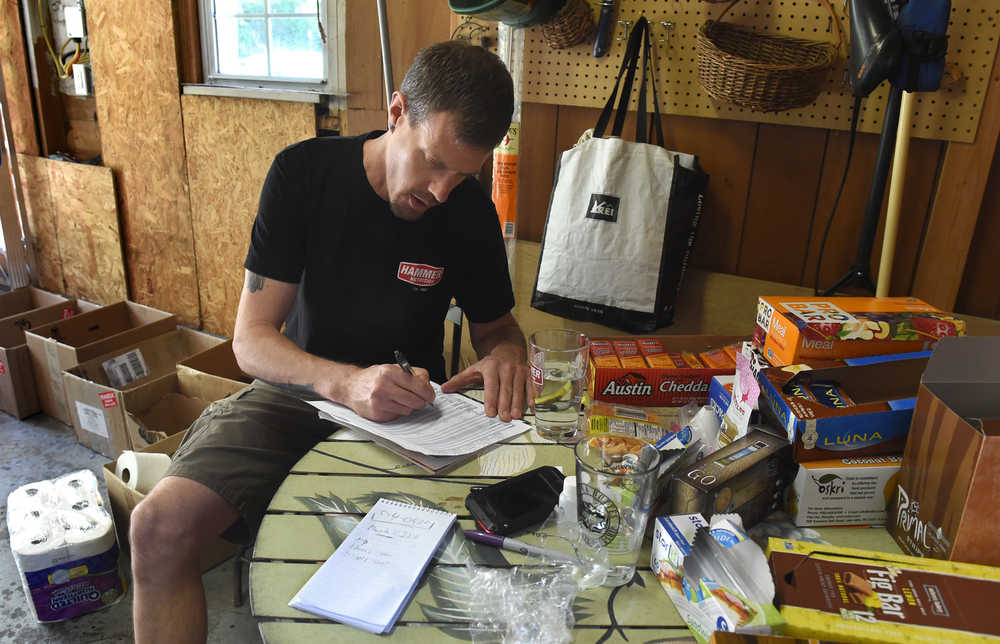
There’s also a lot of logistical preparation for each trip. Bradley spent the days leading up to the Strange Loop packing thousands of energy bars, sacks of dehydrated beans, packages of whey powder and other food items into hundreds of boxes. Each box is labeled for a specific section of the trip and filled with enough supplies for that section. Shelly will mail the boxes to predetermined stops along the route. Not only does the address of each mail drop need to be checked and double-checked, Bradley has to verify someone will be available to receive the package and hold it until he arrives.
Although the preparation and journey itself will consume about two years of Bradley’s life, the idea of postponing travel until retirement age or taking more convenient trips isn’t an option.
“I could walk out my front door and get hit by a meteor … I could get diagnosed with cancer,” he said. “The door is open and I am going to take advantage of that.”