
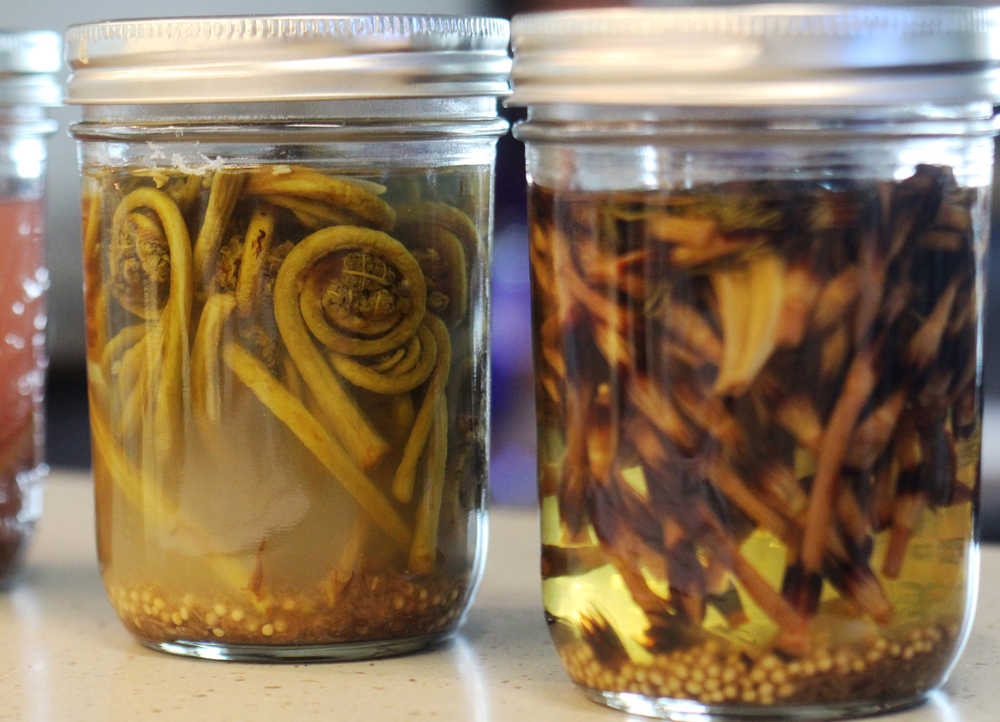
Spring is a good time to start eating plants, according to Dena’ina Wellness Center traditional healer Estelle Thomson.
“All the things that are in those new shoots are things that your body needs to perk itself up for the summer,” Thomson said. “Like vitamin A. Vitamin A is huge for your organ function.”
Thomson’s Traditional Medicine program and other groups such as the Kenai Peninsula Garden club are taking advantage of the fresh abundance of spring growth to teach people about medicinal and edible herbs. The Dena’ina Wellness Center hosts two monthly public workshops on the subject, while the Kenai Peninsula Garden club recently hosted a workshop with Anchorage herbal-medicine user Brenda Beck, who demonstrated to attendees how to make muscle-soothing oil extractions from birch, alder, and willow bark.
“More and more people are becoming aware of (herbology) and wanting to incorporate it into their homes, instead of going into a store and popping a bunch of pills,” Beck said.
Thomson also said interest in herbal medicine is rising.
“It’s really heartening to a lot of us in traditional medicine to see that people are starting to really pay attention and veer away from some of these things that are harmful to us and go back to a more natural approach,” Thomson said.
Thomson was also caution, however — not only are some plants dangerous, but the effects and potency of a known plant can be influenced by its climate and life-stage, as well as small differences in the doseage and prepartion, making herbal medicine potentially dangerous to novices.
“We always talk about moderation and being very careful,” Thompson said. “So we don’t want people just going out there willy-nilly and picking plants and incorporating them into their diet.”
Thompson recommended adding natural herbs to one’s diet gradually, trying one plant at a time, “so if you do have a reaction, you know that specific plant is the one you’re having a reaction to.”
Rather than sporadic plant-eating, Thompson said people interested in a herbal diet should begin with workshops and lessons, such as those offered by the Dena’ina Wellness Center or the University of Alaska Cooperative Extention service. She recommended supplementing book learning with hands-on work alongside an experienced guide.
“(Aspiring herbalists) have to have a credible source, so work with organizations that have really strong connections to science and medicine,” Thomson said. “ …We want people to be aware not just academically, but have somebody who shows them hands on. That’s how we taught our people to be. That’s how the information was passed on. You had somebody guiding you throughout this process.”
Thomson said the workshops at the Dena’ina center are meant to introduce the more accessible and less dangerous plants in the local environment. Wednesday’s workshop focused on fireweed shoots and fiddleheads — the uncoiling sprouts of ferns that begin emerging from shaded hillsides this time of year.
Traditionally, Dena’ina ate fiddleheads of lady fern and spreading wood fern — munching them raw, boiled, or roasted wrapped in birch bark. Fireweed shoots were eaten raw in the spring. The pickled ferns and fireweed shoots demonstrated in the workshop are a modern way to eat the plant.
Fiddleheads are valuable as a source of potassium, phosphorous, and vitamin C — a nutrient in short supply in Alaska during the winter. Thomson said she freezes them in the spring for use in her meals during the darker months.
A more potent medicinal plant, which Thomson cautioned novices away from, is Devil’s Club. The plant’s fresh leaves can used to make teas, and the interiors of the spiny stalks can be dried and used in salves that can be beneficial to diabetics, Thomson said. But not everyone reacts to the plant’s chemistry in the same way — in some, it can create severe inflamation.
Dena’ina Wellness Center Wellness Assistant Bessie Phillip said dosage in just as important in herbal treatments as in any other kind of medicine.
“Kind of like how your provider gives you medicine,” Phillip said. “You just don’t eat the whole can. You have to measure these Native medicines. You don’t just gobble them all at once.”
Another part of a herbologist’s essential knowledge is legal. Harvesting on private land is allowed with a land-owner’s permission, but on state, federal, and tribal land, rules vary across groups and agencies. According to an online FAQ, the Alaska Department of Natural Resources allows plant harvest for personal use from its land without a permit. On federal lands owned by the Fish and Wildlife Service — such as the Kenai National Wildlife Refuge — harvesting plant material for personal use is currently prohibited, though KNWF Law Enforcement Park Ranger Rob Barto said the Refuge will soon be exempt from that federal rule.
“When (the rule) changes in two weeks, Kenai Refuge-specific regulation will allow the collection of edible and medicinal plants,” Barto said. The new Refuge rule will be similar to the current DNR rule, allowing unlimited harvesting for non-commercial purposes.
“You can collect 30 pounds of morrels, as long as it was strictly for personal use,” Barto said.
The ethics of such a harvest are another matter. In her workshop, Thomson emphasized a plant-harvesting ettiquette of taking only from areas where a plant is abundant, and taking no more than a third of the harvestable plants in an area.
“Some of the things that we’re harvesting and have been harvesting for eons are things the public is now realizing are valuable,” Thomson said. She, too, used morel mushrooms as example. “Morels are extremely expensive per pound if you purchase them commercially. The fact that we have morels that we can harvest in our backyard is a huge blessing. But there are people that will go out and overharvest. I saw pictures of people with multiple 5 gallon buckets of morels. And you know they’re going to sell it. But being able to have that available to us is priceless.”
The Dena’ina Wellness Center’s Traditional Medicine program is relatively new, having opened in September 2015, and is just beginning its work with medicinal plants. Because the potency and abundance of medicinal plants can vary due to climate, season, and the stages of the plant’s life, Thompson said the Wellness Center needs to do research and consult with pharmacists before it begins to use them in its treatments. For now, Thomson offers workshops in how to eat fireweed and ferns.
In addition to the open kitchen workshops, Thomson also leads medicinal plant harvesting walks for tribe members and those served by the Wellness Center. These are not public, Thompson said, in order to protect the owners of the lands from which the group harvests (often tribe members) as well as the cultural integrity of traditional herbal lore — knowledge that Thomson said still belongs to the Dena’ina culture.
“It’s extremely important that the information that we share with our people remain ours,” Thomson said. “The information that’s passed on down to us from our teachers and our elders and communities — that’s proprietary knowledge. There are lots of things we will not share with people who are not Native people. There have been people who’ve tried to capitalize on our knowledge, to take as much of the resource as they can for personal gain. We don’t do that. We utilize resources because they’re important to our wellbeing, our physical wellbeing and our spiritual wellbeing, and also for our culture.”
Reach Ben Boettger at ben.boettger@peninsulaclarion.com.
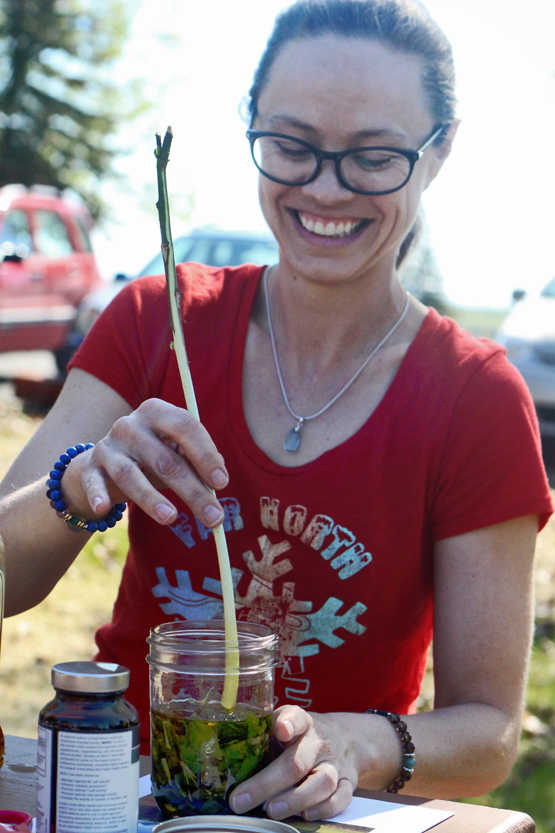
Tamara Leach uses a stripped birch branch to stir a mixture of birch, willow, and cottonwood leaves in oil during the Kenai Peninsula Garden Club’s edible and medicial plants workshop on Saturday, May 14 in Soldotna. Instructor Brenda Beck said the mixture creates an ointment that can be used against muscle pain.
