
Sitting at the intersection of Seward Street and Fronts Street, Rico Worl’s mind began spinning about a new design concept.
Worl, a local artist who was approached by the City and Borough of Juneau on design ideas for the intersection, said one thing, in particular, stuck out to him about that area of downtown during a weekend day in October 2017.
“For this corner, I ended up just sitting there and figuring out what that corner felt like,” Worl said in his design studio downtown Tuesday. “What I discovered is when you are on foot in downtown Juneau, you are probably going to go through that intersection. When I was out there, it was just nonstop. It was like a public gathering space just by circumstance.”
Worl said the lines represent the flow of water that is the intersection and the fish stamps represent the people themselves “swimming through the water” of that intersection. From above, the intersection represents a salmon fin. However, he said the design is something that is meant to be taken in at ground level “where you feel the flowing lines.”
The intersection is the biggest of the new art projects that are part of the CBJs Downtown Street Improvements Project. Worl said he worked with city Chief Landscape Architect Michele Effers and Project Engineer Lori Sowa on the projects. CBC Construction, Inc., Southeast Earthmovers, Compass Construction and DOWL, an engineering consultant, constructed the designs. The concept, Worl said, stems from making that part of downtown a “cultural district.” While Tlingit art is showcased now, Worl said the space may broaden out to the various cultural histories associated with Juneau.
Designing the intersection meant more than just doing the artwork. Worl said the project was a learning experience about street architecture. He said he had to learn details about the turn radius of vehicles and what portions of the project fit in where.
“It was about knowing what makes an intersection work,” Worl said. “Trying to be aware of both was a huge learning curve.”
He said he watched the design of the intersection “in very slow motion” and the project did change from what he initially envisioned.
“I got a text one day that one of the construction workers thought there should be more fish stamps down and I said, ‘Yes, please,’” Worl said. “Another thing I noticed is that some of the fish have slits for eyes. I don’t know who it was, but it was probably somebody in the construction crew who thought these fish needed eyes and took a little bit of ownership on that.”
The ideas that went beyond his original plan, Worl said, made him even happier with the final product.
“I really appreciated how everyone was excited about it,” Worl said.
Worl has guided the downtown projects. He said as part of a collaboration effort, he asked other local artists to be a part of the plans. Worl worked with Clarissa Rizal on the first medallion showcasing the Tlingit core cultural values on South Franklin Street. That medallion has a Tlingit script on it stating “Haa Shuká” which represents honoring our ancestors and future generations.
The other finished medallion, which sits on the northwest corner of the Front Street and Seward Street intersection, features art by Crystal Worl. Another medallion, also sharing the phrase, “Haa Shuká,” will be at the triangle intersection of Franklin and Front in the fall. Worl is working with Alison Marks on that one. Lettering on all the medallion designs was done by Christy NaMee Eriksen. Adam Dimmitt contributed by cutting all the metal on the medallions.
Worl said the collaborative effort showcases what Juneau is about.
“It is just exciting to be a part of downtown Juneau life,” Worl said. “It is all about that community and representing all those parts of the community. It is a symbol of that. That is what felt important to me.”
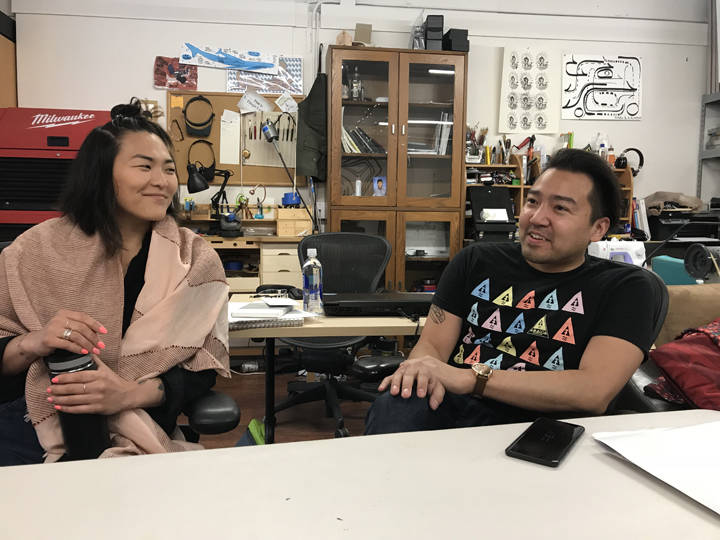
Eriksen, who joined Worl at the studio Tuesday, said her idea of lettering came from sitting down with Worl and figuring out how lettering could work with traditional formline art. She said the artwork is a symbol about the community.
“As someone who is non-(Alaska) Native, it was a privilege to work on this,” Eriksen said. “I think it symbolizes our coexistence, our collaboration and a celebration of the ownership we take in with it. I think there is an emotional element related to us as artists on a grander scale that resonated with me.
Eriksen also said she hopes these projects are just the beginning.
“I hope that is not all,” Eriksen said. “I hope what it is is a symbol of direction in where we are heading. I think it is exciting to live in a city where arts and culture are elevated in that way and I hope artists’ and cultural producers’ roles continue to expand and grow. I hope artists and cultural producers are seen as community leaders, seen as people who should have a seat at the table and are people who are socially engaged. I hope even more people get that opportunity as the city develops.”
• Contact reporter Gregory Philson at gphilson@juneauempire.com or call at 523-2265. Follow him on Twitter at @GTPhilson.
