
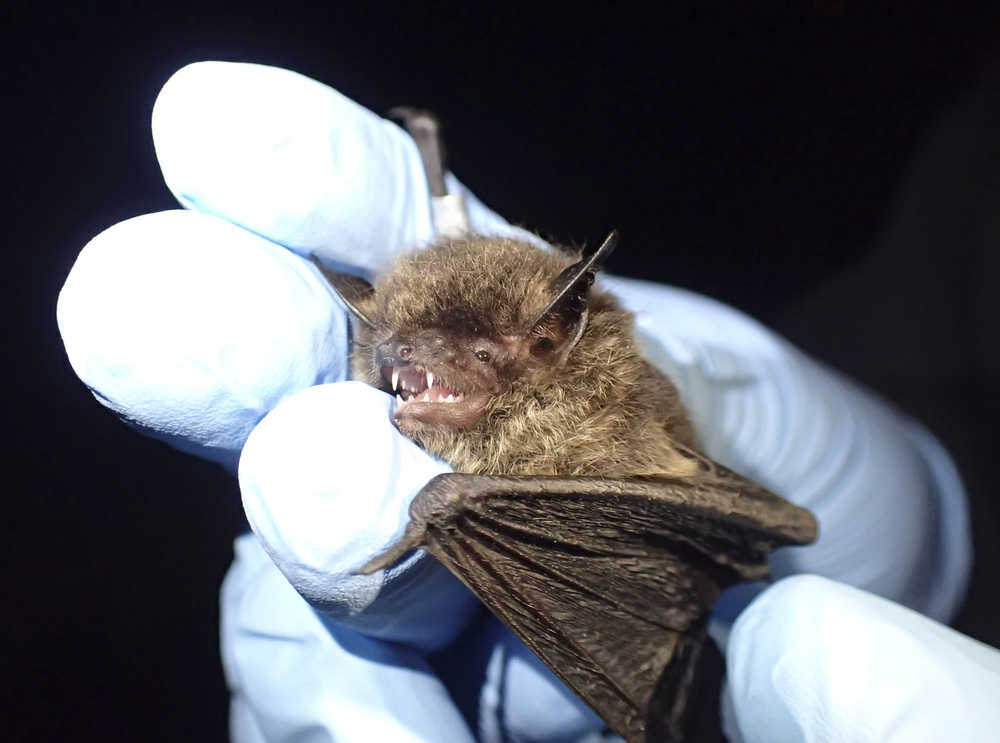
“Gross” is the response I often get from my mother when I talk about bats. Stories that make me smile usually make her cringe. I’ve had bats sneak out of their bags while tucked inside my waders or start wandering back down my arm rather than off my hand as I’m trying to release them. While bats are quite feisty when handled, not once have I been bitten by an unrestrained bat simply trying to make its escape back into the wild.
Yet despite my adventures, my mom still doesn’t quite view the world’s only flying mammal as the adorable and fascinating critter that I do. So for those of you like my mom, please allow me to dispel some common myths.
Bats aren’t rodents. Bats are actually more closely related to humans than rodents. They belong to the Order Chiroptera, which means “hand-wing” as their wing bones are comparable to human fingers.
Bats aren’t blind. The insect-eating bats even have an additional sense of “sight” called echolocation. They are able to navigate in complete darkness by listening for echoes of the ultrasonic sounds they emit. This means that they can “see” better than us and won’t get tangled in your hair.
Bats don’t suck blood. Vampire bats (found in Latin America) only lap small amounts of blood from tiny incisions and feed not on humans, but mostly cattle. They have even benefited humans as the anti-clotting enzyme in their saliva is being used to develop heart medications.
Bats aren’t rabid. Only about 1 percent of bats actually carry rabies and of the hundreds of bats that have been caught in Alaska, only four have tested positive for the virus. When it comes to bats, prevention is easy — don’t touch one and you’ll never be bitten!
The three vampire species make up a small proportion of the more than 1,200 species of bats found worldwide. Bats all over the globe play vital roles in diverse ecosystems ranging from pollinating plants that produce fruit, to dispersing seeds that regenerate forests, to consuming insects considered agricultural pests.
All of the bats in Alaska are insectivorous and can each consume up to 2,000 insects per night. In the United States alone, bats are estimated to be worth $3.7 billion a year in their reduction of crop damage and the need for pesticides. So whether you realize it or not, we are all impacted by bats and depend on the ecological and economic services they provide.
It is for these reasons that we should all be concerned about the rapid bat population declines. In addition to being threatened by factors such as habitat loss, bats are being wiped out in devastating numbers by white-nose syndrome (WNS). A fungus, WNS wakes bats from hibernation during the winter when temperatures are low and food and water are unavailable.
The disease was first documented in New York in 2006 and has spread rapidly, already being confirmed in 26 states and 5 Canadian provinces. It has killed more than 5.7 million bats in eastern North America with 90-100 percent mortality rates in some hibernacula. The Little Brown Bat, once the most common and widespread, has seen such dramatic population declines that scientists have recommended listing it as endangered.
The Little Brown is one of seven species of three genera known to occur in Alaska along with the Long-legged Myotis , California Myotis, Keen’s Myotis, Yuma Myotis, Silver-haired Bat and Hoary Bat. While the range of the Little Brown extends into southcentral and interior with records as far north as Fairbanks, the other six have only been documented in southeast Alaska.
So what does all of this mean for us here in Alaska and in particular, on the Kenai Peninsula? There’s a lot to do! Very little is known about basic bat ecology in Alaska, especially outside of the southeastern part of the state. How many species do we have? How abundant are they? What habitats do they prefer? Where do they go in the winter?
Researchers are trying to answer some of these questions in order to address the potential impacts of habitat loss, climate change, and the arrival of WNS. We still don’t know whether our bats are overwintering locally or heading south, and who they mingle with during hibernation could affect whether or not WNS makes it to Alaska — or at least how soon.
Got bats? We want to hear from you! If you have bats on your property or know of a roost, please contact mallory_okuly@fws.gov at the Kenai National Wildlife Refuge. Also, please don’t touch or handle any bats. They are likely to bite in self-defense and, while rare, diseases such as rabies can be transmitted to humans.
Mallory Okuly is a seasonal biotech at the Kenai National Wildlife Refuge. Find more information at www.fws.gov/refuge/kenai/ or facebook.com/kenainationalwildliferefuge
