
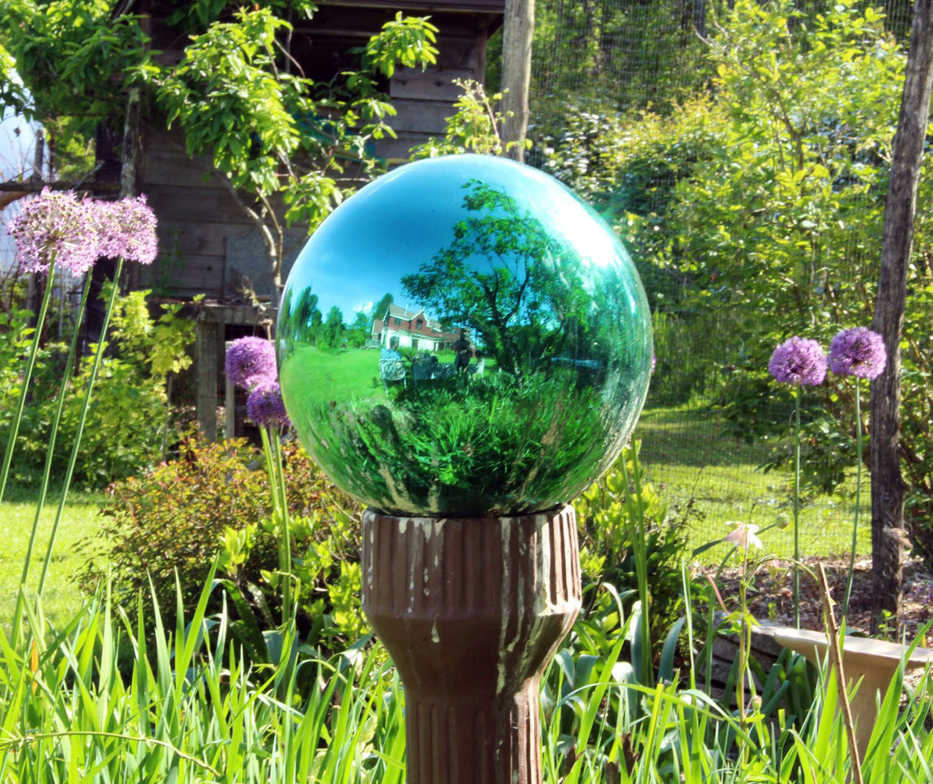
In this undated photo, a green-tinted gazing globe visually takes in all of last summer's garden in New Paltz, New York. These mirrored glass ornaments fell out of favor about 50 years ago, but are making a comeback, seen by some as attractive ornaments and by others as kitsch. (AP Photo/Lee Reich)

In this undated photo, a green-tinted gazing globe visually takes in all of last summer's garden in New Paltz, New York. These mirrored glass ornaments fell out of favor about 50 years ago, but are making a comeback, seen by some as attractive ornaments and by others as kitsch. (AP Photo/Lee Reich)

Is there a gazing globe in your garden’s future?

Did I see a glint of mocking laughter in a friend’s eyes when I mentioned the new addition to my garden, a gazing globe?

These mirrored glass ornaments were popular until about 50 years ago, when they fell from their pedestals, figuratively speaking. They’re now making a comeback, straddling the fence between attractive ornament and — to some people — kitsch.

Gazing globes date back to 13th century Italy, a country known for garden ornaments, and, more specifically, to Venice, a city known for glassworks.

They once were more than mere ornaments. They also were put in place to bring happiness, ward off evil spirits or attackers, and attract fairies. In Victorian times, a globe near a gate allowed you to look around the corner to see who or what was approaching from the other side of the fence or hedge.

The globes also found their way indoors. A butler could look around a corner to check if anyone was pocketing cutlery. A father could maintain a watchful eye on his daughter and her beau.

Look at a gazing globe and you’ll have a fish-eye view of everything except what’s directly behind the globe. As you move, the reflection also moves, except that you, the viewer, are always staring directly back at yourself. You are always the center of this perceptual universe — a metaphor, perhaps, for existence.

In my garden, however, the globe isn’t a protector or metaphor; it’s really just an ornament. It’s a shiny object off which dances light. In summer, it peeked out from among low shrubs and flowers. Over the past few months, the globe has increasingly come into focus, like a developing photographic image. It stands out most boldly in the garden on those winter days when it’s perched above and surrounded by billowing, white snow.

Today’s gazing globes have evolved from those orbs of past decades that often stood alone on pedestals in the center of lawns. In various sizes and tints, today’s globes nestle into flower beds, hang from branches or float in ponds. Rather than having a smooth, mirrored surface, today’s gazing globe might be a mosaic of silvered and colored glass.

Some gardeners make their own by gluing shards of mirrors or tile onto old bowling balls. To avoid the fragility of traditional gazing globes, some are now made from shiny, stainless steel.

I remember gazing globes from my youth, and nostalgia figures into my liking for them. I also remember being a little nervous around them, and I still like the glass ones for their fragility. They’re not that fragile, though; more than once, strong winds have knocked my globe off its pedestal and each time the globe, thankfully, made a soft enough landing to remain intact.

Most of all, I like gazing globes because they are fun, whether truly or mockingly so.

More in Life

This dish, an earthy and herbaceous vegetarian reimagining of the classic beef wellington, is finished nicely with a creamy maple balsamic sauce. Photo by Tressa Dale/Peninsula Clarion
A special dish for a special request

This mushroom wellington is earthy and herbaceous, and its preparation comes with much less pressure.

File
Minister’s Message: Lifelong learning is a worthwhile goal

Lifelong learning. That’s a worthwhile goal. Schools have been in session for… Continue reading

This E.W. Merrill photograph shows Charles Christian Georgeson, special agent in charge of all agricultural experiment stations in Alaska, starting in 1898. (Photo from Alaska History Magazine, July-August 2020)
The Experiment: Kenai becomes an agricultural test site — Part 1

Individuals deciding to explore Kenai’s historic district might start their journey by… Continue reading

This virgin blueberry margarita made with blueberry flavored kombucha is perfect for sipping while playing cards.  Photo by Tressa Dale/Peninsula Clarion
Sweet fruit for sober fun

Blueberry kombucha gives this virgin margarita complexity in flavor and a lovely purple hue.

John W. Eddy was already a renowned outdoor adventurer and writer when he penned this book in 1930, 15 years after the mystery of King David Thurman’s disappearance had been solved. Eddy’s version of the story, which often featured wild speculation and deviated widely from the facts, became, for many years, the accepted recounting of events.
King Thurman: An abbreviated life — Part 6

AUTHOR’S NOTE: The fate of King David Thurman, a Cooper Landing-area resident,… Continue reading

File
Minister’s Message: Being ‘thank full?’

As a young dad, I remember teaching my toddler children to say… Continue reading

Public photo from ancestry.com
James Forrest Kalles (shown here with his daughters, Margaret and Emma) became the guardian of King David Thurman’s estate in early 1915 after Thurman went missing in 1914 and was presumed dead.
King Thurman: An abbreviated life — Part 5

AUTHOR’S NOTE: King David Thurman left his Cooper Landing-area home in late… Continue reading

These heart-shaped chocolate sandwich cookies go perfectly with a glass of milk. (Photo by Tressa Dale/Peninsula Clarion)
Chocolate cookies for a sweet treat

A healthy layer of frosting makes these sandwich cookies perfectly sweet and satisfying.

File photo.
Minister’s Message: Memento mori

In the early centuries of Christianity, the Desert Fathers — Christian monks… Continue reading

Emmett Krefting, age 6-7, at the Wible mining camping in 1907-07, about the time he first met King David Thurman. (Photo from the cover of Krefting’s memoir, Alaska’s Sourdough Kid)
King Thurman: An abbreviated life — Part 4

AUTHOR’S NOTE: In 1913, King David Thurman, a Cooper Landing-area resident who… Continue reading

Bulgogi kimbap is a favorite lunchtime staple and easy travel meal. Photo by Tressa Dale/Peninsula Clarion
Kimbap when craving Korean food

Bulgogi kimbap is a favorite lunchtime staple and easy travel meal.