
EDITOR’S NOTE: This is the first part of a two-part story about the Kings County Mining Company’s expedition to the Kenai Peninsula in 1898.
In the City Hall lobby in Homer is a small section of one wall dedicated to local history. In a small frame on that wall is an orange-brown photocopy of a document cover more than a century old and titled “Constitution and By-Laws of the Kings County Mining Company of New York.” The story behind that document and its connection to Homer and the central Kenai Peninsula requires a step back in time and across the North American continent.
Two things are important to understand from the beginning: First, the Kings County Mining Company originally had no intention of going to the Kenai. Its advertised goal was the Klondike, in Canada’s Yukon Territory, where gold had been discovered in 1896. Second, shortly after the expedition was launched in mid-February 1898, many people believed it had ended in tragedy.
But not everything is what it seems. Changing plans and adapting to obstacles were going to be the norm on this expedition.
Only about a week after the three-masted bark, the Agate, had set sail from Pier 4 in New York’s East River, this headline appeared in The New York Times:
“THE AGATE’S OWNERS WORRIED.
Uncertainty as to Whether Wreckage
Reported Off Barnegat Is that of the Bark.”
Barnegat is a sheltered bay off the New Jersey coast. Floating debris had been spotted nearby, and early reports pointed to the Agate. The well-financed dreams of the members of the Brooklyn-based mining company appeared to have been crushed.
Fortunately, it was a false alarm. Shortly thereafter, the Brooklyn Daily Eagle produced a headline announcing that company officials had determined the Agate was safe after all; the wreckage, said the newspaper, had come from some other unlucky vessel.
A few weeks later, in early April, came a definitive sighting of the Agate near Rio de Janeiro, off the coast of Brazil, still on course to sail around Cape Horn and then northward to San Francisco.
Back in New York, members of the mining company sighed with relief.
Reports vary, but the Kings County Mining Company had about 60 shareholders, all with a financial stake of five $100 shares, for a total investment of $30,000 (about $828,000 in today’s money). They also had a 50-year charter and plenty of optimism.
In fact, the day before they set sail, the Brooklyn Daily Eagle characterized the company as “made up of good businessmen, all determined before they return to amass good-sized fortunes.”
To help them realize this golden goal, the Agate was carrying nearly all of the company’s gear—small steam-powered launch boats, mining implements, tents, and about two years’ worth of provisions—plus about 30 members of the company, in addition to a captain and crew. According to their stated plan, once the ship reached San Francisco, they would telegraph notice of their arrival back to New York, and the remaining members of the expedition would journey by transcontinental railroad to unite the full company.
But the Spanish-American War, which also began in 1898, complicated matters.
The Spanish gunboat Temerario was prowling the east coast of South America. Fearing that the American vessel might be captured, the United States consul in Montevideo, present-day capital of Uruguay, halted the Agate’s voyage there and caused a considerable delay.
In fact, due also in part to heavy weather experienced in traveling around the Horn, the Agate did not arrive in San Francisco until late August. By the time mining company members back in Brooklyn clambered aboard the West Shore Railroad and began their journey westward, they were well behind schedule, and the season was growing late.
As August became September and crept toward October, members of the Kings County Mining Company reconsidered their plans. Deciding they were too close to winter to reach the Yukon gold fields, they opted instead for the Kenai Peninsula and set their sights on the burgeoning mining town of Sunrise.
Gold had been discovered in the Hope and Sunrise area by at least the early 1890s. When word got out, miners surged in. In spring of 1896, according to the Hope & Sunrise Historical Society, 3,000 gold seekers sailed into Cook Inlet. By the summer of 1898, there were an estimated 8,000, and, for a few weeks, Sunrise City, along Sixmile Creek, was the largest town in Alaska with 800 residents.
The members of the Kings County Mining Company, cruising into the inlet in late autumn, hoped to add to the population and get rich.
But even in this they were unlucky.
NEXT TIME: The conclusion of this two-part story will follow the Kings County Mining Company after it enters Cook Inlet.
• By Clark Fair, for the Peninsula Clarion
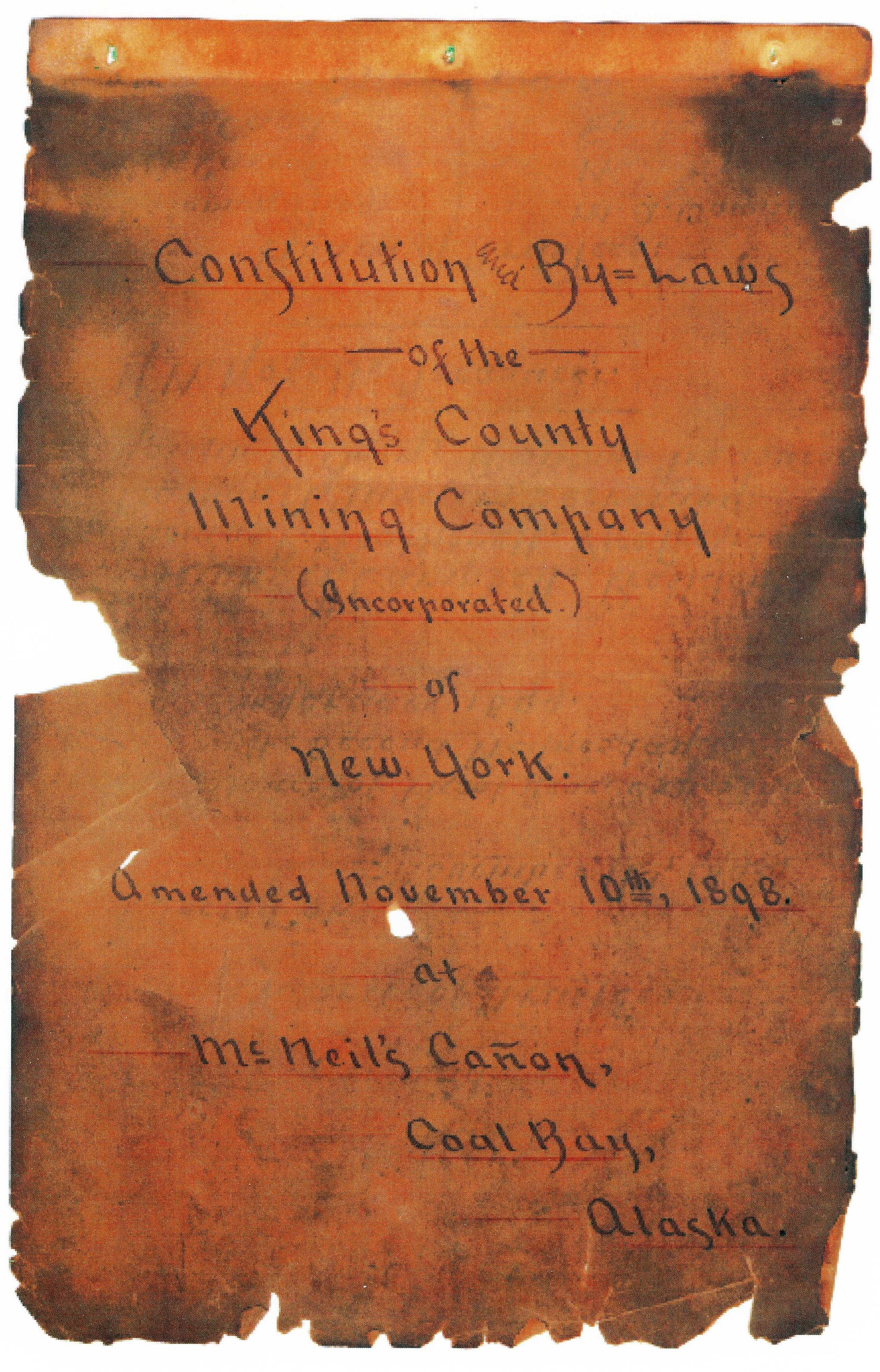
This is the cover page of the Kings County Mining Company’s constitution and bylaws, updated on Nov. 10, 1898, at McNeil Canyon, near Homer. (Photo from document in Pratt Museum, Homer)
