
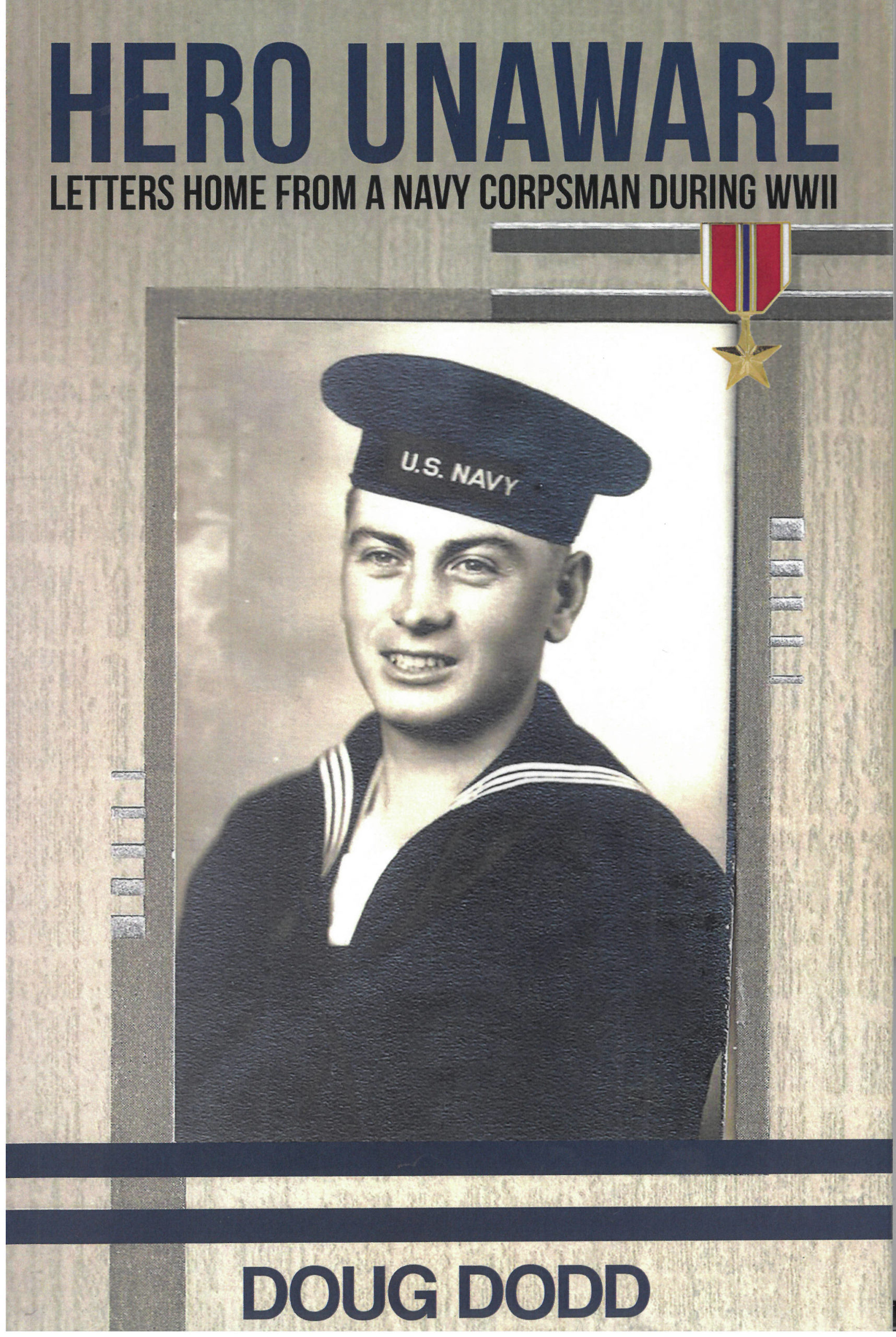
The title of Homer author Doug Dodd’s second book, “Hero Unaware: Letters Home from a Navy Corpsman During WW II,” might lead the reader to think the book tells of intense combat. But for Dodd, the book based on the letters from his father, Walter Dodd, to his mother holds a different meaning.
“To an extent, it’s about his character going in and coming out,” Dodd said. “It is a biography with a lot of things left out, but I wanted to convey the damage the war did to him.”
Published this month by Publication Consultants, “Hero Unaware” is Dodd’s second book, after “Man in Hole,” a memoir of Dodd’s adulthood that came out in 2018. Dodd’s work is available locally at the Homer Bookstore. He’s married to another Homer author, Joan Brown Dodd, who wrote “Cow Woman of Akutan” and other stories about her life in Bush Alaska.
Based on a cache of letters Dodd found after Walter Dodd died at age 98 in 2016, the correspondence spans the years the older Dodd served in World War II as a U.S. Navy Corpsman later attached to the U.S. Marines 4th Battalion. Growing up on a ranch near Missoula, Montana, Dodd knew his father had been in the Navy during the war, but not much else. Later, his father told him some stories. He didn’t discover the full extent of Walter Dodd’s experience until he uncovered the letters.
“I read them three times,” Dodd said. “It’s enough to drive a saint to curse.”
The 314 letters represent only those Walter Dodd wrote home to his mother, Myrtle Dodd. She kept them all in their original envelopes, and Walter Dodd got them after his mother died. His father had an office in his home, and while looking through the office after his father’s death, Doug Dodd found the letters in a desk.
Doug Dodd said his dad wrote probably 2,000 letters during the war to friends and extended family. Each letter might say something like, “I got a couple of letters from such and such,” Dodd said.
As a history of World War II from a combat veteran’s perspective, there can be few better overall accounts, at least in breadth. Walter Dodd enlisted on Jan. 2, 1942, not even a month after the attack on Pearl Harbor, and served until Nov. 17, 1945, after the end of the war.
“He was the war,” Doug Dodd said. “Pretty much the whole war.”
Walter Dodd joined the Navy on the theory that he wouldn’t be fighting a land war and risking maiming or death. Dodd said his father thought that if he was on a ship that got attacked and sank, at least it would be a quick death. Dodd took training as a Corpsman — a ship’s or naval base medic — and had put in for an assignment to Alaska. Initially, he was stationed at Bremerton Naval Base in Washington.
Uncle Sam had other plans. “They said, ‘You’re going to go to San Francisco,’ ” Dodd said of his father’s assignment. “Once they got there, they got the cheery news: ‘Now you’re a Marine.’ … It’s a huge irony.”
With the Marines, Walter Dodd fought in four battles, invasions of Japanese held islands at Roi-Namur, Saipan, Tinian and Iwo Jima, one of the deadliest battles of the war. Dodd received two Bronze Stars for meritorious service in combat when he rescued wounded Marines under heavy enemy fire.
Dodd tells little of that, and for good reason, Doug Dodd said.
“The reasons were he didn’t want to worry his mother, essentially,” he said.
The closest Walter Dodd came to describing war was in a letter written after Roi-Namur. After the battle was over, he reassured them he had come through fine, not even a scratch, though one sniper shot at him.
“All of our corpsmen and doctors came out OK — guess one corpsman is up for a citation,” Dodd wrote. “Twenty of us went up where he was the first night as stretcher bearers. A scary job but no one shot at me. It’s a terrible job going around picking up the decomposed Jap bodies.”
Dodd said none of the letters after that were as graphic. He imagined his grandmother’s reaction was probably horror. His father saw much worse, like Japanese soldiers and civilians who jumped off cliffs in Saipan. “I wasn’t particularly interested in the battle scenes, and he didn’t write much about that,” Dodd said. “He minimized the drama as much as possible.”
Many of the letters concern the banality and boredom of the military. Dodd said in the first few years of his father’s correspondence, much of it dealt with discussions about ranch life — how did the sheep do during the winter? How many lambs killed by coyotes? As the war went on, Walter Dodd drifted away from domestic concerns.
Some of the letters came during combat intervals, when the 4th Battalion rested and regrouped in Maui, Hawaii. Dodd said that must have been a rough period, for the Marines knew that they would likely face more battles. One letter described how cheerful and animated new Marines acted in contrast to the older combat veterans.
“After you’ve been through it once and know you’re going through it again, that anxiety must have been intense,” Dodd said.
Dodd said he saw another change in his father as reflected in the letters: growing tolerance. Walter Dodd had high morals.
“He didn’t drink. He didn’t swear. He didn’t chase women,” Dodd said.
In earlier letters, Walter Dodd wrote of his disgust at the sailors and Marines who did drink and swear. Dodd said in the later letters his father shows understanding and tolerance for those not like him. Walter Dodd also showed the bigotry of many Americans then, sometimes using ethnic slurs or stereotyping some people. As the war went on, he got to know people from other cultures better.
Though Dodd’s character didn’t change, his experience did. He grows more confident in his abilities. Dodd said he saw through the letters how the war had damaged his father. After the war, Walter Dodd returned to the family ranch, and like many veterans, had to cope with what we now call post-traumatic stress disorder.
“The damage from the PTSD … I’m grateful it wasn’t dramatic,” Dodd said of his father. He didn’t get in fights or punch people, and he didn’t drink.
Instead, Walter Dodd got through his trauma through work — “I’ll do my job. I’ll work until I drop,” Doug Dodd put it.
With a small printing, Dodd said his main audience is the family and friends who knew his father.
“That limits it greatly,” he said. “… I’ll probably get rid of a 100 copies that way.”
But “Hero Unaware” can have a larger audience, that of history and for those who want to know and understand one of the most horrible wars ever from the simple perspective of a country kid who saw much of it.
Reach Michael Armstrong at marmstrong@homernews.com.
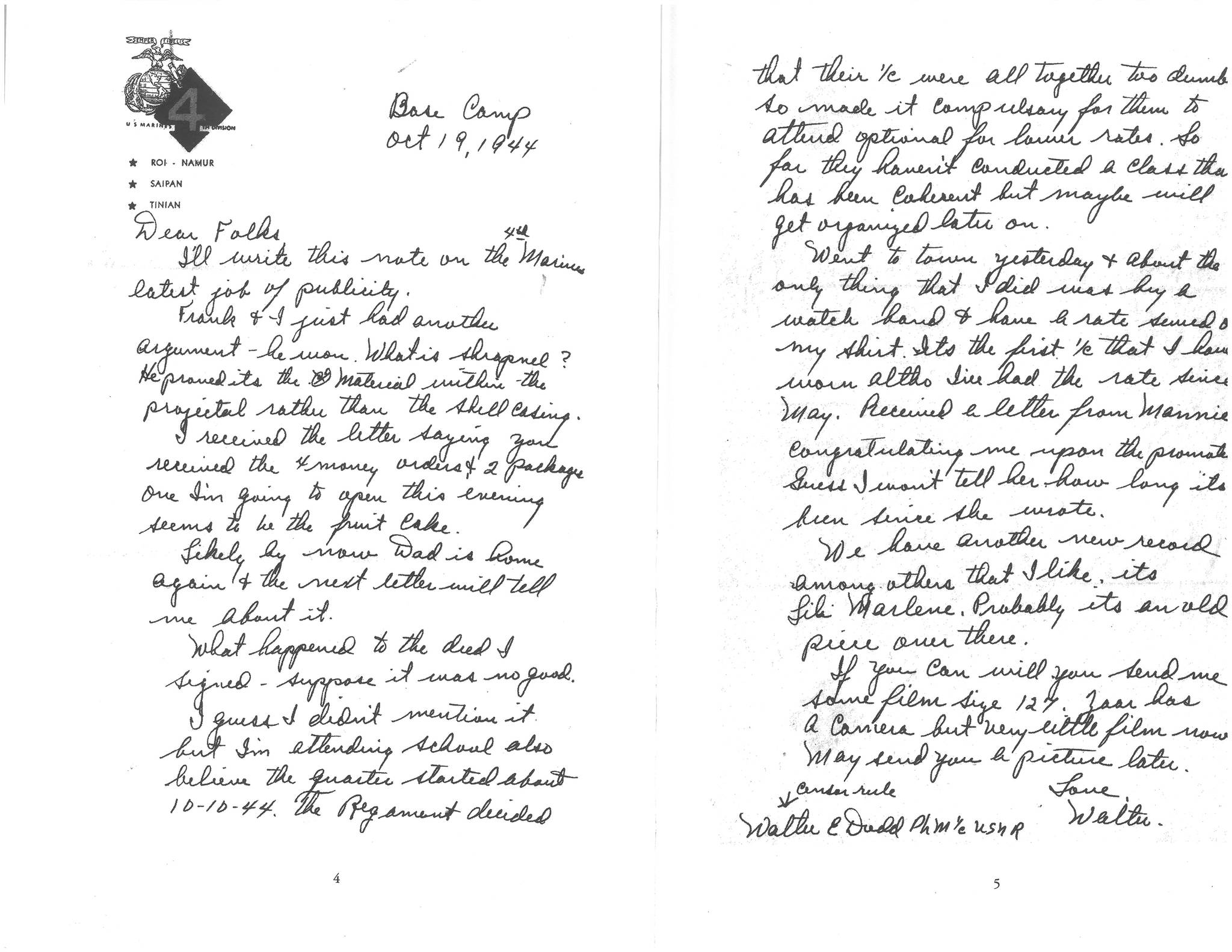
One of the letters Walter Dodd wrote to his mother during his service as a U.S. Navy corpsman attached to the U.S. Marine Corps 4th Division. The stars in the letterhead show the battles fought by the division. The Marines would later fight at Iwo Jima. (Photo courtesy Doug Dodd)
One of the letters Walter Dodd wrote to his mother during his service as a U.S. Navy corpsman attached to the U.S. Marine Corps 4th Division. The stars in the letterhead show the battles fought by the division. The Marines would later fight at Iwo Jima. (Photo courtesy Doug Dodd)
