
William Morrow and Company

William Morrow and Company

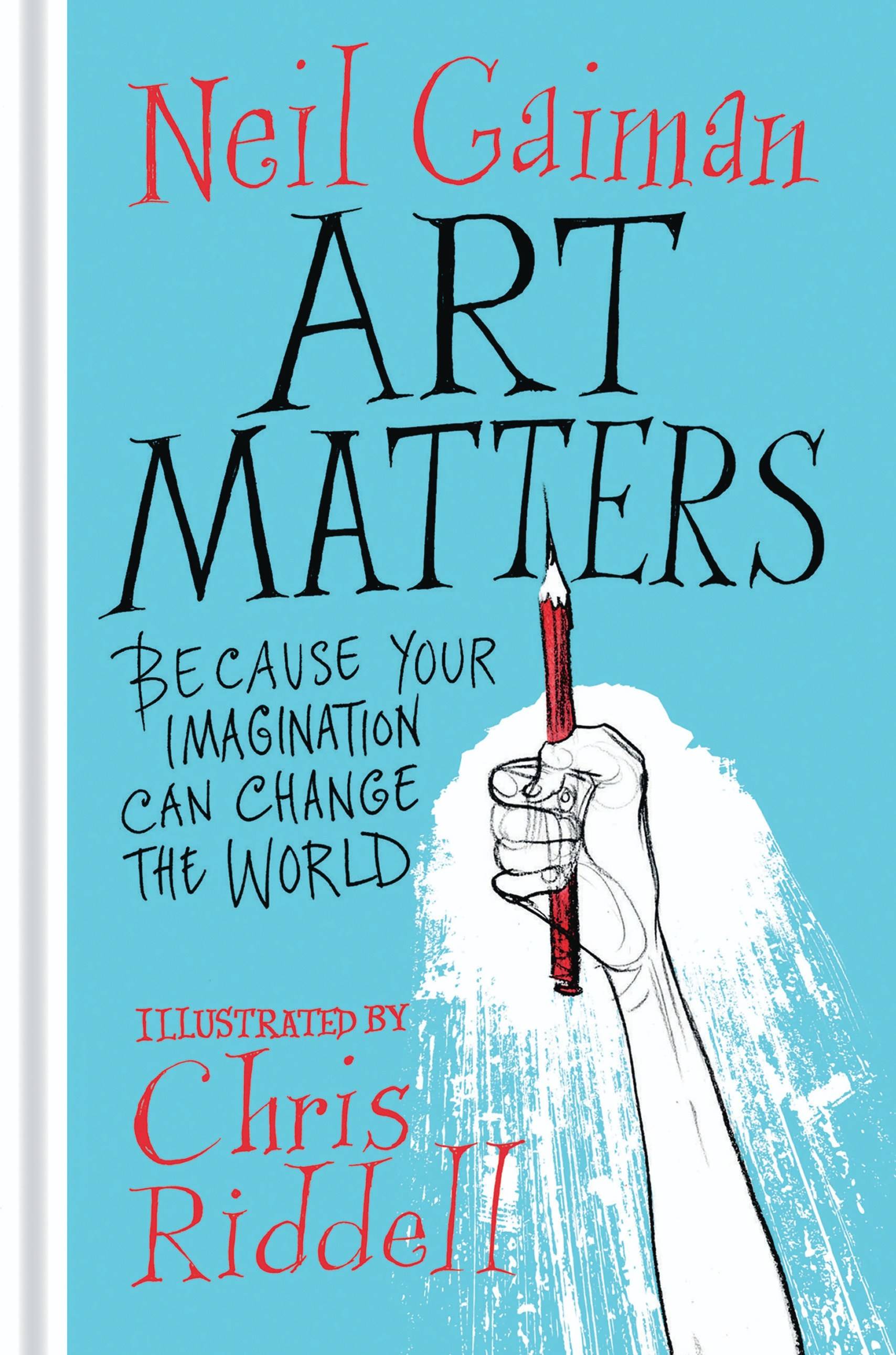
Gaiman makes a case for why ‘Art Matters’

Doodling, scribbling, sketching.

That’s what most people think you’re doing when you’ve got pen in hand and paper in front of you: just idly making squiggles and amusing yourself. You, however, know that what you’re really doing is letting your ideas, your creativity, pour into the world. And in “Art Matters,” author Neil Gaiman and illustrator Chris Riddell know it, too.

Sometimes, it might seem (at least to others) like a little bit of magic: with a writing tool, a keyboard, or stylus, you can make something out of almost nothing. Nothing – except the creativity you carry in your head.

Gaiman knows how important that is. He knows how fragile ideas are, and that they can be squashed just as easy as they can be grown. But once an idea is out in the open, it’s stronger and there’s usually no turning back: it will forever be “hiding behind people’s eyes,” whether it’s good or “vile.”

On the subject of books, Gaiman says you should read a lot because “fiction builds empathy.” Reading will “slightly change” you, as you see the world “through other eyes…” It’s also essential that we “understand what libraries and librarians are” and that we know what they do.

“If you do not value libraries you are silencing the voices of the past and you are damaging the future,” says Gaiman.

Taking your ideas further won’t be easy, as he shows in his final chapter.

Starting out in his career, he set his eye on a fictional “mountain” that he wanted to reach someday. He accepted jobs that took him on journeys and that made him write about many different things, which was good because, he “became a better writer the more [he] wrote…”

As for your future, remember that if you don’t know what you’re doing at first, “This is great” because then you can make your own rules. Use your creativity to find adventure. Don’t copy anybody, because they’re not you.

And finally, in your creative process, “let go and enjoy the ride because the ride takes you to some remarkable and unexpected places.”

Just by quickly paging through “Art Matters,” you’ll see that this book isn’t very big. It’ll probably take you maybe a half hour to read. But what you’ll find inside may be some of the most inspirational, important notions a creative mind will ever see.

Here, author Neil Gaiman splits his thoughts on the written word into four sparse chapters that will offer comfort to those who feel most at ease with a pen in hand. That means that this book is not just for writers and book lovers, but also for those who think in cartoons and oils. It’s a book that, through its prose, seems to free its readers of the “shoulds” of a budding career, and it’s also a bit biographical.

Add in illustrations by Chris Riddell that give this book energy, and anyone ages fifteen and up might feel their imaginations soar. For that, reading “Art Matters” is a great idea.

More in Life

This dish, an earthy and herbaceous vegetarian reimagining of the classic beef wellington, is finished nicely with a creamy maple balsamic sauce. Photo by Tressa Dale/Peninsula Clarion
A special dish for a special request

This mushroom wellington is earthy and herbaceous, and its preparation comes with much less pressure.

File
Minister’s Message: Lifelong learning is a worthwhile goal

Lifelong learning. That’s a worthwhile goal. Schools have been in session for… Continue reading

This E.W. Merrill photograph shows Charles Christian Georgeson, special agent in charge of all agricultural experiment stations in Alaska, starting in 1898. (Photo from Alaska History Magazine, July-August 2020)
The Experiment: Kenai becomes an agricultural test site — Part 1

Individuals deciding to explore Kenai’s historic district might start their journey by… Continue reading

This virgin blueberry margarita made with blueberry flavored kombucha is perfect for sipping while playing cards.  Photo by Tressa Dale/Peninsula Clarion
Sweet fruit for sober fun

Blueberry kombucha gives this virgin margarita complexity in flavor and a lovely purple hue.

John W. Eddy was already a renowned outdoor adventurer and writer when he penned this book in 1930, 15 years after the mystery of King David Thurman’s disappearance had been solved. Eddy’s version of the story, which often featured wild speculation and deviated widely from the facts, became, for many years, the accepted recounting of events.
King Thurman: An abbreviated life — Part 6

AUTHOR’S NOTE: The fate of King David Thurman, a Cooper Landing-area resident,… Continue reading

File
Minister’s Message: Being ‘thank full?’

As a young dad, I remember teaching my toddler children to say… Continue reading

Public photo from ancestry.com
James Forrest Kalles (shown here with his daughters, Margaret and Emma) became the guardian of King David Thurman’s estate in early 1915 after Thurman went missing in 1914 and was presumed dead.
King Thurman: An abbreviated life — Part 5

AUTHOR’S NOTE: King David Thurman left his Cooper Landing-area home in late… Continue reading

These heart-shaped chocolate sandwich cookies go perfectly with a glass of milk. (Photo by Tressa Dale/Peninsula Clarion)
Chocolate cookies for a sweet treat

A healthy layer of frosting makes these sandwich cookies perfectly sweet and satisfying.

File photo.
Minister’s Message: Memento mori

In the early centuries of Christianity, the Desert Fathers — Christian monks… Continue reading

Emmett Krefting, age 6-7, at the Wible mining camping in 1907-07, about the time he first met King David Thurman. (Photo from the cover of Krefting’s memoir, Alaska’s Sourdough Kid)
King Thurman: An abbreviated life — Part 4

AUTHOR’S NOTE: In 1913, King David Thurman, a Cooper Landing-area resident who… Continue reading

Bulgogi kimbap is a favorite lunchtime staple and easy travel meal. Photo by Tressa Dale/Peninsula Clarion
Kimbap when craving Korean food

Bulgogi kimbap is a favorite lunchtime staple and easy travel meal.