
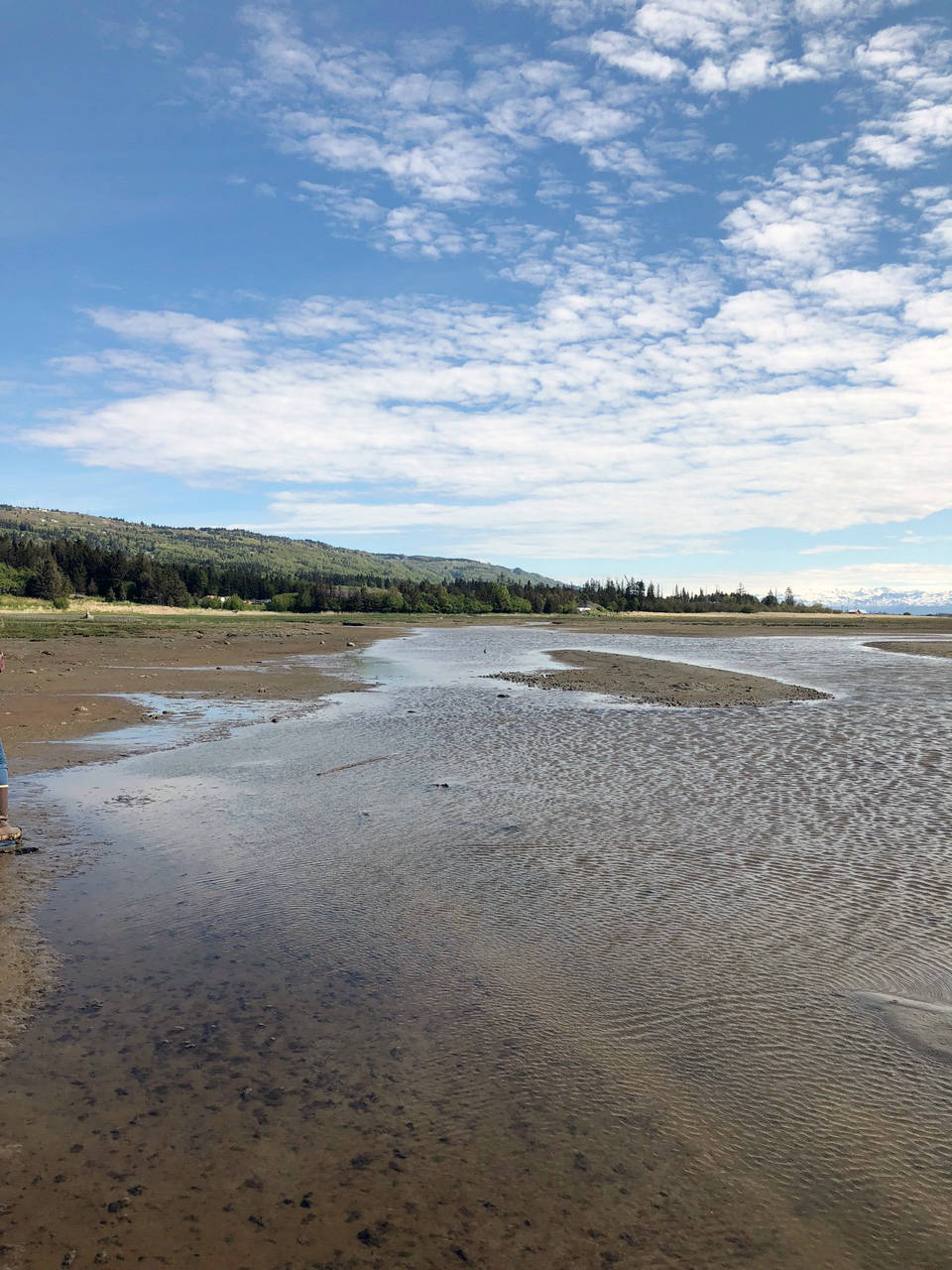
Growing up in Homer was an experience that I am incredibly happy to have had. From playing outside in the summers until midnight or helping out my grandpa at the Beluga Lake ice races to fishing in Kachemak Bay and cheerleading for the Homer Raiders.
Driving out to The Spit, my family and I would always ensure the windows were rolled up when we passed by Beluga Slough because that drive was most often accompanied by breezes of rotten egg. Even though I didn’t always appreciate its lovely aroma, I was still happy to tromp around in my “tufs” looking at the little pools of sticklebacks and pointing out gulls and ducks. I looked past its little faults to enjoy the bigger picture of Beluga Slough, its uniqueness, and the fun creatures it housed that were so in reach.
On the Kenai Peninsula, Beluga Slough is among our estuaries that include Chickaloon Flats, Kenai Flats, Kasilof Flats and the Fox River Flats at the headwaters of Kachemak Bay. Acting as transition zones or gradients at the interface of land and sea, estuaries and the surrounding areas are wetlands where fresh water meets salt water. This brackish water sets the stage for some of the most highly productive habitats.
These coastal wetlands serve a variety of functions and values for us, including flood alleviation through water storage and slow release, educational opportunities, enhanced water quality through filtering and phytoremediation, and as recreational areas.
Though wetlands have not always been viewed in as positive a light as this, it seems estuaries on the Kenai are highly valued by people for everything from the annual shorebird festivals in Homer to waterfowl production and fisheries. Those who hold even more value in these estuaries are the plants and animals that inhabit them.
Prime land for food, habitat and nursery grounds of many bird and fish species throughout the world, estuaries are sometimes dubbed the “nurseries of the sea.” A unique community of plants and animals arise in this brackish habitat adapted to high and varying water salinity, tidal inflows and outflows, and hydrophobic soils in anaerobic conditions that occur in estuaries and other wetlands.
Wetland plants have adaptions to uptake nutrients, minerals and chemicals considered toxic in other situations like sulfur, methane and excess nitrogen. When plants (like sedges) die back, the microorganisms in the soil get to work decomposing the tissues and releasing the plant’s stored sulfur and methane.
This process produces that rotten egg smell with which some of us are too familiar. An example of these specially adapted plants native to the Kenai is the Lyngbye’s sedge. This grasslike plant has a high tolerance for anaerobic conditions that occur in estuaries, and a medium tolerance for salinity and slightly acidic waters.
Adaptations unique to wetlands in the animal kingdom are brackish-water-tolerating euryhaline organisms that can take advantage of estuaries as permanent or semipermanent residents. Among these are mollusks like the Baltic macoma, a permanent bivalve resident of estuaries and intertidal zones in sandy and muddy soils.
This oval-shaped clam, up to 1.5 inches long, is polymorphic with coloration variations, and serves as a food source for visiting birds. The coho salmon is considered a euryhaline species, too. Estuaries act as brackish nurseries where coho spend time from alevin to smolt (one to three years) before heading out to open sea where they mature.
Of course, there is the famous annual shorebird festival in Homer where visitors (human and avian alike) come from all over to enjoy and admire estuaries like Beluga Slough. Western sandpipers and Pacific golden plovers are two of the more common avian visitors that make a stop on the peninsula during their migrations. Larger mammals like moose, bears and coyotes also forage for the unique food sources available in these estuaries that do not occur elsewhere (or in the same abundance).
Estuaries only constitute about 1 percent of the Kenai Peninsula. However, they provide habitats for many species while providing unique opportunities for recreation, education and economic gain.
Because of their great value and the limited land area they occupy, some estuaries like Fox River Flats are designated Critical Habitat Areas by the Alaska Department of Fish and Game, and are managed with special regulations. Chickaloon Flats, the largest estuary on the Kenai Peninsula, is under the care of the Kenai National Wildlife Refuge.
Next time you are near an estuary, take the time to admire everything they provide for you and for the wildlife that is precious to our way of life.
Angelica Smith is a biological intern this summer at Kenai National Wildlife Refuge. She is a junior in Wildlife Biology at Missouri State University during the rest of the year. Find more Refuge Notebook articles (1999-present) at https://www.fws.gov/refuge/Kenai/community/refuge_notebook.html
