
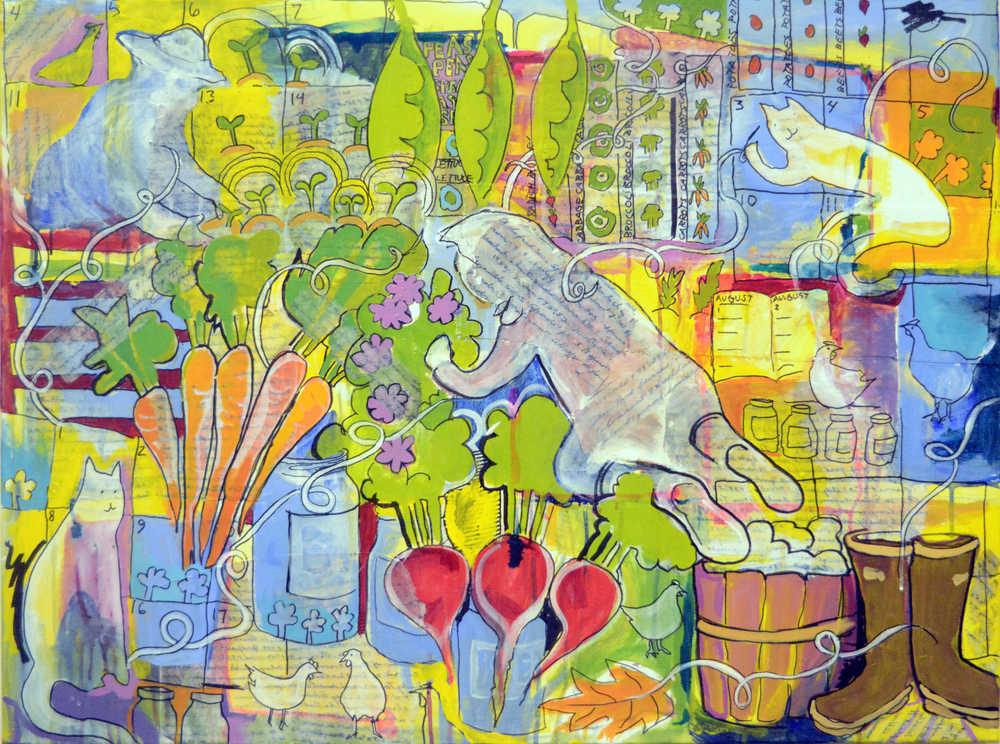
Among cultural institutions in Homer, the Pratt Museum has pioneered a unique spot. As a museum of natural history, history, culture and art, its exhibits often connect those aspects of the Pratt’s collections. “Inspired by Diaries,” on exhibit through Dec. 29, asked artists to create works in contemplation of diaries and journals in the museum’s collection or those of the artists. The show also bridges literary heritage and visual art.
“This exhibit was a great way to engage history and storytelling, way to interpret and think about the value of storytelling and storykeeping,” said Scott Bartlett, Pratt Museum curator of collections.
To get artists started, the museum held a workshop in early September where artists could look at the Pratt’s collection of journals and diaries. Its collection includes diaries from several pioneer Kachemak Bay settlers, such as the Elizabeth and Bob Smith family, who lived at Aurora Lagoon in Kachemak Bay. Works cover the era from the early 1930s to the early 1980s, with such treasures as former Homer Mayor Hazel Heath’s European travel journal. Many of the diaries cover practical matters like recordings of weather or animals caught that day.
Jesse Merriam’s “In the Garden,” made from a potato print, walnut ink and colored pencil, is a fanciful illustration of an entry from Elizabeth Smith’s diary entry for May 15, 1931: “Spaded garden; nasty day; found skull.”
Another garden diary piece, Savanna Bradley’s “Chronicle of a Plant Foretold,” uses copies of Joseph Drew’s 5-year diary entries as the backdrop to illustrations of those activities. In blocks of the same date over five years he logged information on weather, plantings, harvests and daily activities.
“It is interesting to see how, over a 5-year period, similar activities would take place within a few days or weeks of the previous years, an ongoing cycle of routine,” Bradley writes in her artist’s statement.
One work is an actual historical artifact, Jan Knutson’s “Wedding Blessings,” an installation piece that is a string of prayer flags in which guests wrote down thoughts on her marriage to her husband, Ed Hutchinson.
“It’s a different take on the diary as recording,” Bartlett said.
Two artists, Michael Murray and Jo Going, keep diaries in visual forms, especially when traveling. Murray’s watercolor, “Tinning,” shows a Bulgarian man making a copper pot and includes the very pot he made. Going’s “Una Gitta Alla Toscana” is a multi-page pen and ink illustration of villages and landscapes she saw on a trip to Italy. She took a different approach to the show, though, and wrote a poem to go with her illustration.
“Rather than produce the art based on the writing, she produced the writing based on the art,” Bartlett said.
Several artists looked to family history for inspiration. Mary Bee Kaufman, another Homer watercolor artist, created a sculpture of several screens with collages of paintings. Kaufman used her father, James W. Bee’s, Arctic journals as inspiration. “A classic 1950s museum curator, collector, taxonomist and writer,” as Kaufman describes him, his journals are shown along with her work. Bee’s handwriting is precise and his field sketches are extraordinary. In her artist’s statement, Kaufman notes that every evening after a day of field work her father would rewrite his work notes onto archival paper.
“In beautiful, meticulous and artful cursive, field notes of the day’s activities were interpreted, replete with detailed observations that were chronologically annotated,” Kaufman writes.
Artist and teacher Lynn Marie Naden went to a basic text for the source of her work: the 1943 ledgers of her grandmother, Ladia Naden’s, peache orchard, Naden Ranch, in Clovis, Calif. The installation includes the ledger, a photograph of Ladie Naden and embroidery done by Naden using her grandmother’s embroidery hoop, needles, thimble, even some of her thread. Naden learned embroidery from both grandparents.
“I wanted it to be something more personal,” Naden said of her work. “As I was embroidering, it just brought me closer to her. Every stitch, it was like a memory.”
The embroidery shows a peach tree with branches, flowers and roots. Hanging from threads are several beads, also from Ladia Naden, showing the boxes of fruit packed for that year. Farmers didn’t keep diaries; they kept ledgers, she said.
“It was a real tenuous year for my family,” Naden said. “It was during the war time and just after the Depression. They were just scraping by. … They accounted for everything.”
Naden said the idea of stringing beads also was inspired by a piece from the Pratt’s Exploring People and Place exhibit, Dena’ina counting cords. Knotted pieces of sinew, Bartlett said the cords were used to chronicle events.
“It was their diary, their counter,” Naden said. “That has always fascinated me.”
Other works in the exhibit include paintings by Eve Remme, Mae Remme and Ed Hutchinson.
Michael Armstrong can be reached at michael.armstrong@homernews.com.
